
Class 12 English The Last Lesson Solutions. Class 12 English The Last Lesson Solutions with complete answers, explanations, important questions, and exam-ready notes. Perfect for HS 2nd Year students. Continue reading: Class 12 English The Last Lesson Solutions
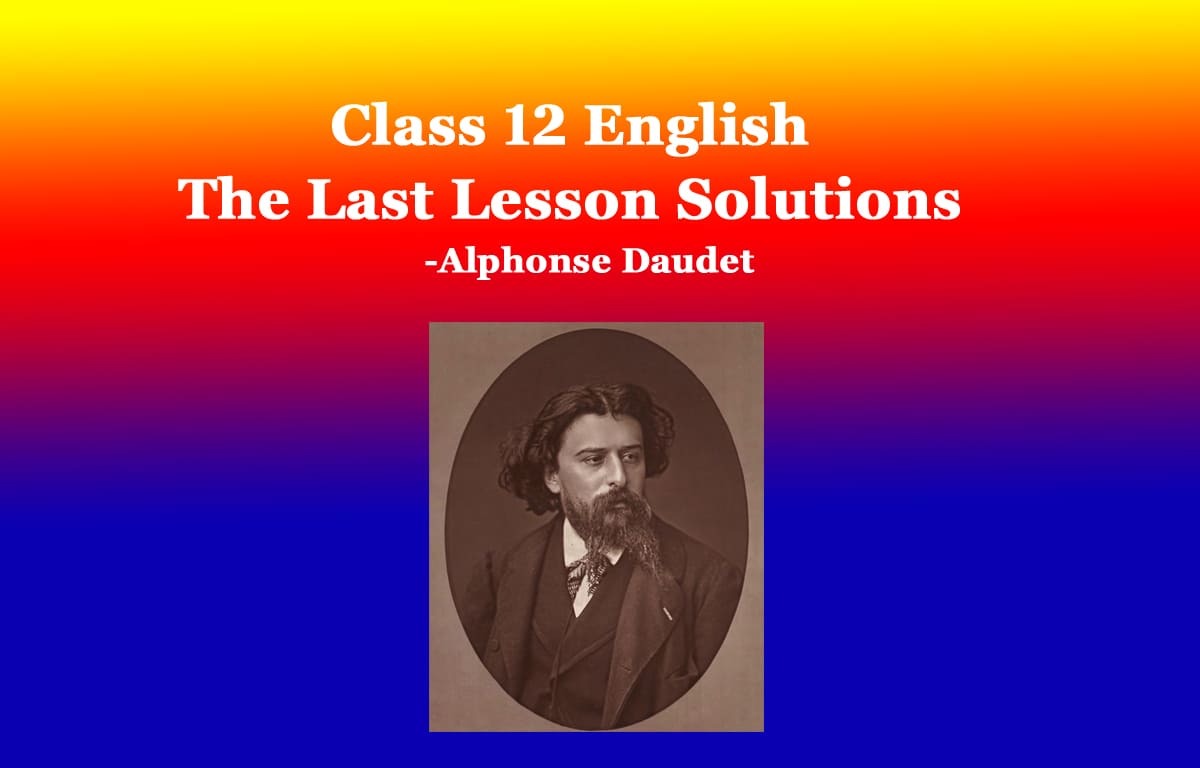
Class 12 English The Last Lesson Solutions
— Alphonse Daudet
TEXTUAL QUESTION-ANSWERS
THINK AS YOU READ-I
Q.1. What was Franz expected to be prepared with for school that day? (H. S. ’15)
Ans: Franz was supposed to prepare a lesson on the rules of participles, as M. Hamel had announced he would question the class on the topic. However, Franz had not studied and did not know even the first word about them.
Q.2. What did Franz notice that was unusual about the school that day? (H.S. ’13, ’17)
or
Give a detailed account of the scene in the classroom on the day of the last lesson. (H. S. ’15)
Ans: Instead of the usual morning bustle, the school was completely still and quiet, resembling a Sunday morning. Franz found his classmates already seated in their places, and M. Hamel was walking with his iron ruler tucked under his arm, dressed in his ceremonial Sunday attire—a beautiful green coat, a frilled shirt, and an embroidered black silk cap. Most surprisingly, the backbenches, which were usually vacant, were occupied by somber village elders, including old Hauser, the former mayor, the former postmaster, and several others.
Q.3. What had been put up on the bulletin-board?
Ans: An official order from Berlin had been posted on the bulletin-board, stating that only German would be taught in the schools of Alsace and Lorraine from the following day, thereby putting an end to the teaching of the French language in the region.
THINK AS YOU READ-II
Q.1. What change did the order from Berlin cause in school that day?
Ans: The order that came from Berlin was that only German, not French, would be taught in the schools of Alsace and Lorraine. This order caused great trouble in the school that day. M. Hamel was disappointed. The village people and even the students were sorry and upset.
Q.2. How did Franz’s feelings about M. Hamel and school change?
Ans: On the day of the last lesson, when the teacher, M. Hamel, announced that in the schools of Alsace and Lorraine only German, instead of French would be taught, then Franz’s feelings about M. Hamel and school changed. Since that moment, Franz developed a strong fascination for his language and his school. He began to feel his French books were his old friends. And about M. Hamel, he developed a strong respect and forgot all about the teacher’s cranky behaviour.
ADDITIONAL QUESTION-ANSWERS
Q.1. What is the name of the blacksmith mentioned in‘The Last Lesson’? H.S. ’18
Ans: The name of the blacksmith mentioned in ‘The Last Lesson’ is Wachter.
Q.2. What did Franz think for a moment?
Ans: Franz thought for a moment to run away from home and spend the day out of doors without going to school.
Q.3. What is the name of the river mentioned in ‘The Last Lesson’? H.S. ’19
Ans: The name of the river mentioned in ‘The Last Lesson’ is Saar.
Q.4. What would Franz love to do on that sunny morning instead of going to school? H.S. ’19
Ans: Instead of going to school, little Franz would like to enjoy the bright day, the chirping of the birds and the drill of the Prussian soldiers that day.
Q.5. What, according to M. Hamel, is the great trouble with Alsace? H.S. ’18, ’20
Ans: The great trouble with Alsace was that it was conquered by the Germans and they imposed German culture and language on the people of that province. But the people did not like them.
Q.6. ‘Will they make them sing in German, even the pigeons’? What does this sentence suggest? H.S. ’18
Ans: After conquering Alsace and Lorraine- two provinces of France- the shrewd Germans imposed the German language on the people of those provinces. Resultantly, the French people had to lose their mother tongue. It was a pathetic matter for the people of France. When the teacher M. Hamel announced, after an order from Berlin, that only German, not the French language, would be taught in the schools of Alsace and Lorraine, then the little Franz became so sorry and thought that the shrewd Germans might impose the German language on the pigeons. It suggests Franz’s deep regret and sorrow for losing their motherland.
Q.7. What was written in the new copies brought by M. Hamel for the students in a beautiful round hand? H. S. ’17
Ans: The two words ‘France, Alsace’ were written in the new copies brought by M. Hamel for the students in a beautiful round hand.
Q.8. What did M. Hamel write at the end of the class?
Ans: At the end of the class, the teacher, M. Hamel, took a piece of chalk in his hand and wrote ‘Vive La France’ (Long Live France) on the blackboard.
Q.9. Who is the author of the short story ‘The Last Lesson’?
Ans: Alphonse Daudet is the author of the short story ‘The Last Lesson’.
Q.10. ‘I started for school very late that morning. Who is the ‘I’ here? H.S. ’14
Ans: Here ‘I’ refers to Franz, a little student.
Q.11. How long did the Teacher M. Hamel teach in the school?
Ans: The teacher M. Hamel taught in the school for forty years.
Q.12. What did M. Hamel pronounce to the students, mounting from his chair?
Ans: M. Hamel, mounting from his chair, pronounced to his students that it was the last day of his teaching in the school. He said that an order had come from Berlin that only German would be taught in the schools of Alsace and Lorraine. The new master would come the following day. He expected that the students would be very attentive as it was his last day at the school.
Q.13. What did M. Hamel do when he went for fishing?
Ans: M. Hamel just gave a holiday to the students when he went for fishing.
Q.14. What did M. Hamel write on the black-board just before the school was dismissed on the day of the last lesson? What did they mean? H.S. ’19
Ans: As the church bell struck twelve, M. Hamel took a piece of chalk in his hand and, bearing it with all his might, wrote ‘Vive la France ’ on the blackboard. The phrase means, ‘Long Live France!’
Q.15. What did M. Hamel want to give his students before leaving the school?
Ans: M. Hamel wanted to put all the knowledge that he knew into the head of the students at one stroke.
Q.16. Why did Franz want to spend his day out of doors that day? H.S. ’12
Ans: That day Franz started for school very late and was in great dread of getting M. Hamel’s scolding because the teacher said that he would question the students on participles, but he did not read about them. So, to get rid of the scolding from the teacher, he wanted to spend the day outdoors that day.
Q.17. Usually how was the atmosphere of the school when it began?
Ans: Usually, when the school began, there was a great bustle which could be heard out in the street. The bustle was made of the sound of the opening and closing of desks, the lesson repeated by the students in unison and the teacher’s great ruler rapping on the table.
Q.18. What does the phrase ‘Vive La France’ mean? H.S. ’24
Ans: The phrase ‘Vive La France’ means ‘long live France’.
Q.19. Why was the lesson called ‘The Last Lesson’?
Ans: It was called ‘The Last Lesson’ because an order had come from Berlin that only German, not French, would be taught in the schools of Alsace and Lorraine from the next day.
Q.20. What was M. Hamel’s opinion on the French Language? H S ’13,’16
Ans: M. Hamel’s opinion on the French language was that it was the clearest, most beautiful and most logical language of the world.
Q.21. Why did Wachter, the blacksmith, tell Franz that he would reach school in ‘Plenty of time’? H.S. ’20
Ans: Wachter, the blacksmith, told Franz that he would reach school in plenty of time because Franz was in a hurry to reach school. He did not even have any interest in reading the news on the bulletin board. Seeing this, Wachter told him so.
Q.21. Who were responsible for the students’ inability to read and write?
or
How does M. Hamel make the people realize how they, the students and he have been responsible for not learning their language well? H. S. ’20
Ans: According to M. Hamel the following people were responsible for the students’ inability to read and write their language correctly as:
First, the parents of the students were not anxious enough to have their children learn more. They preferred their children to work on the farm or in the mills to earn some money.
Secondly, the teacher himself was responsible because he sometimes gave the students a holiday when he went fishing and sometimes asked them to water his flower plants instead of making them learn their lessons.
Q.22. Draw a character sketch of M. Hamel as it is shown the Lesson’.
Ans: M. Hamel was a school teacher at a school in the province of Alsace. The story writer has portrayed him fully in the story. He is shown as a strict disciplinarian. He often punished and rebuked the students. The students were also afraid of his cranky nature. But sometimes he himself broke the school discipline as he gave a holiday to the students when he went fishing. Sometimes he put the students to water his garden instead of making them learn their lesson. But above all, he was a very good teacher and rendered his faithfully served for forty years in the school. He was very patriotic also. He felt sorry for losing their motherland to the Germans. He hoped that one day they would get freedom. As a sign of patriotism, he wrote ‘Vive La France’ on the blackboard as large as he could.
23. Who asked Franz not to hurry to school? H S ’24
Ans: Wachter, the blacksmith, asked Franz not to hurry to school.
24. How was M. Hamel dressed differently that day? H S ’24
Ans: In honour of the last lesson, M. Hamel dressed differently that day. He wore a green coat and a frilled shirt, all embroidered, which he usually wore on school-inspection and prize-distribution days.
25. What were the topics and subjects taken up by M Hamel on the day of the last lesson? H S ’24
Ans: The topics and subjects taken up by M Hamel were as follows.
First, he taught French grammar, explaining everything very attentively. Secondly, he taught the history of the saints. Thirdly, he taught handwriting from a copy. Fourthly, he taught the French alphabet to the babies. When the babies were learning the French Alphabet, Hauser also uttered words that seemed pathetic. All the topics that he taught that day were understood very clearly by the students. 0 0 0
N.B. If you like Class 12 English The Last Lesson Solutions, please don’t forget to share your thoughts.
Educational Guide Books:
- Class 12 Biology Concept Summary
- Class 12 Biology Mind Map
- Class 12 Alternative English Solutions
- Class 12 English Solutions
- Class 12 Anthropology Solutions
- Class 12 Home Science Solutions
- Class 12 Employability Skills Solutions
- Class 12 Automotive Solutions
- Class 12 General Studies Solutions