Class 12 Employability Skills Solutions is a concise and student-friendly educational book designed to help learners develop essential skills for academic success, career readiness, and the workplace. Based on the Employability Skills (NSQF) framework, the book presents important concepts in clear and accessible language, making them easier to understand, revise, and apply. Continue reading: Class 12 Employability Skills Solutions
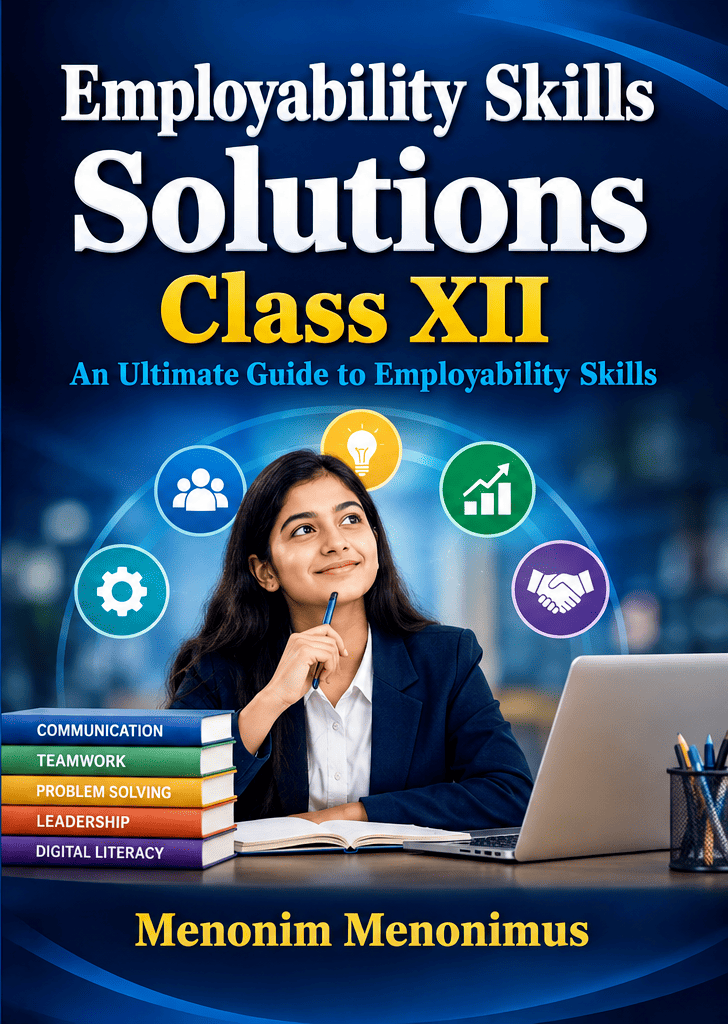
Class 12 Employability Skills Solutions
Edited by
Menonim Menonimus
Menonimus Publishing
Copyright
Copyright © Menonim Menonimus
All rights reserved.
No part of this publication may be reproduced, distributed, stored, transmitted, or used in any form or by any means—electronic, mechanical, photocopying, recording, scanning, or otherwise—without prior written permission from the copyright owner, except for brief quotations used for purposes such as review, criticism, or scholarly reference where permitted by applicable law.
This publication, including its text, explanations, questions, answers, examples, summaries, tables, and other original material, has been independently prepared by the author/publisher for educational and examination-preparation purposes. 0 0 0
Disclaimer
This book, Employability Skills (NSQF), has been prepared for educational and examination-preparation purposes. Every reasonable effort has been made to ensure the accuracy and usefulness of the content, examples, formats, and exercises. However, requirements and conventions may vary among educational boards, examinations, and institutions. Readers are advised to follow the latest official guidelines applicable to them.
The author and publisher do not guarantee any particular academic or examination result and shall not be responsible for any loss or consequence arising from the use of this book.
Table of Contents Of Class 12 Employability Skills Solutions
Unit 1: Communication Skills
Session 1: Active Listening
Session 2: Parts of Speech
Session 3: Writing Sentences
Unit 2: Self-management Skills
Session 1: Motivation and Positive Attitude
Session 2: Result Orientation
Session 3: Self-awareness
Unit 3: Information and Communication Technology Skills.
Session 1: Getting Started with Spreadsheets
Session 2: Performing Basic Operations in a Spreadsheet
Session 3: Working with Data and Formatting Text
Session 4: Advanced Features in Spreadsheet
Session 5: Presentation Software
Session 6: Opening, Closing, Saving and Printing a Presentation
Session 7: Working with Slides and Text in a Presentation
Session 8: Advanced Features Used in Presentations
Unit 4: Entrepreneurship Skills
Session 1: Entrepreneurship and Entrepreneurship
Session 2: Barriers to Entrepreneurship
Session 3: Entrepreneurial Attitudes
Session 4: Entrepreneurial Competencies
Unit 5: Green Skills
Session 1: Green Jobs
Session 2: Importance of Green Jobs
Unit 1: Communication Skills
Session 1: Active Listening
Questions with Solutions
Multiple-choice questions
Read the questions given below carefully and choose the correct option.
- You work at the front desk of a telecom company. A customer approaches you while you are working. The customer has a query regarding a bill. What would you do?
(a) Do not pay attention to the customer
(b) Keep the work aside and help the customer
(c) Continue doing your work while talking inattentively to the customer
(d) Ask the customer to talk to someone else
Ans: (b) Keep the work aside and help the customer
- Which of the following can be a barrier to active listening?
(a) Noisy environment
(b) Not maintaining eye contact with the speaker
(c) Not being attentive
(d) All of the above
Ans: (d) All of the above
- Which of the following is not a stage of active listening?
(a) Receiving
(b) Understanding
(c) Non-responding
(d) Evaluating
Ans: (c) Non-responding
- What are the characteristics of an ideal message?
(a) Clear
(b) Concise
(c) Accurate
(d) All of the above
Ans: (d) All of the above
Short answer question (80–100 words)
- Write down a situation you faced at school, wherein you overcame a barrier and practised active listening.
Ans: During a group discussion in school, I faced difficulty in understanding my classmate because the classroom was noisy. This noise acted as a barrier to active listening. I overcame this barrier by moving closer to the speaker and maintaining proper eye contact. I also avoided distractions and listened carefully to every point being explained. I nodded at appropriate times and asked questions to clarify my doubts. By doing this, I was able to understand the topic clearly and contribute meaningfully to the discussion.
Session 2: Parts of Speech
Questions with Solutions
Multiple choice questions
Read carefully the questions given below and choose the correct option.
- What is a sentence?
(a) A group of ideas that form a complete paragraph
(b) A group of words that communicates a complete thought
(c) A set of rules that we must follow to write correctly
(d) A set of words that contains basic punctuation marks
Ans: (b) A group of words that communicates a complete thought
- Which of these sentences is capitalised correctly?
(a) I am Hungry.
(b) Divya and sunil are reading.
(c) The bucket is Full of water.
(d) She lives in Delhi.
Ans: (d) She lives in Delhi.
- Which of these sentences is punctuated correctly?
(a) Where are you going.
(b) I have a pen a notebook and a pencil.
(c) I am so happy to see you!
(d) This is my house.
Ans: (c) I am so happy to see you!
Fill in the blanks
- Fill in the correct nouns and verbs as given at the top of the table to complete the following sentences.
Nouns: girl, girls, boy, milk, dog, student
Verbs: skipping, riding, running, studying, drinking, barking
(a) The ……… is ……… .
Ans: The girl is skipping.
(b) The ……… are ……… .
Ans: The girls are running.
(c) The ……… is ……… .
Ans: The boy is riding.
(d) Raju ……… is ……… .
Ans: Raju student is studying.
(e) The ……… is ……… .
Ans: The dog is barking.
(f) The ……… is ……… .
Ans: The milk is drinking.
Short answer question
- Identify conjunctions and prepositions (remember, conjunctions join two sentences, while prepositions help answer the words ‘where’, ‘when’, and ‘how’) from the list given below and write them in the following columns.
Under, and, in, at, or, up
Ans: Prepositions: and, or
Conjunctions: under, in, at, up.
Session 3: Writing Sentences
Questions with Solutions
Multiple choice questions
- Identify the subject in the sentence, “The children played football”.
(a) The children
(b) children played
(c) played
(d) football
Ans: (a) The children
- Identify the object in the sentence, “The children played football.”
(a) The children
(b) children played
(c) played
(d) football
Ans: (d) football
- Which of these sentences has/have both indirect and direct objects?
(a) I am working on a presentation.
(b) She bought a blue pen.
(c) The girls played cricket.
(d) He wrote a letter to his sister.
Ans: (d) He wrote a letter to his sister.
- Which of these sentences is/are in passive voice?
(a) They are watching a movie.
(b) The clock was repaired by Raju.
(c) He is sleeping in the room.
(d) My pet dog bit the postman.
Ans: (b) The clock was repaired by Raju.
Short answer questions
- Write one sentence of each type: statement, question, exclamatory and order.
Ans:
Statement: I complete my homework every day.
Question: Where are you going now?
Exclamatory: What a beautiful day it is!
Order: Please close the door.
- Which job role do you wish to pursue? Write two paragraphs (about 100–150 words) about that industry and your career preferences. Make sure you follow all the rules about sentences and paragraphs that you have learnt.
Ans: I wish to pursue a job role in the automotive service industry. This industry deals with the maintenance, repair, and servicing of vehicles such as cars, bikes, and commercial automobiles. With the increase in the number of vehicles on roads, the demand for skilled automotive technicians is also growing. The industry uses modern tools, diagnostic equipment, and safety practices to ensure vehicles run efficiently and safely. It also provides opportunities to learn new technologies related to electric and hybrid vehicles.
My career preference is to work as a trained automotive service technician. I want to develop strong technical skills and gain practical experience in vehicle servicing and troubleshooting. I am interested in continuous learning and upgrading my skills as technology changes. In the future, I also wish to start my own automobile service centre and provide quality service to customers while following safety and environmental rules.
Unit 2: Self-management Skills
Session 1: Motivation and Positive Attitude
Questions with Solutions
Short answer questions
- Describe the ways you can make positive thinking a habit in life.
Ans: Positive thinking can be made a habit by practising self-awareness and replacing negative thoughts with positive ones. One should start the day with positive affirmations and focus on solutions instead of problems. Setting realistic goals and celebrating small achievements also helps in developing a positive mindset. Spending time with positive people and avoiding negative influences is important. Regular exercise, meditation, and maintaining a healthy lifestyle improve mental well-being. Learning from failures instead of feeling discouraged helps in building confidence and maintaining positive thinking in daily life.
- List the importance of positive thinking. Describe how it can help someone achieve one’s goals.
Ans: Positive thinking is important because it builds confidence, reduces stress, and improves overall mental health. It helps a person stay motivated and face challenges with courage. Positive thinking allows individuals to focus on their strengths and learn from their weaknesses. When a person thinks positively, they are more determined to work hard and not give up easily. This mindset helps in setting clear goals, making better decisions, and staying focused. As a result, positive thinking plays a key role in achieving personal and professional goals.
Session 2: Result Orientation
Questions with Solutions
- Fill in the table given below, which can help you to prepare an action plan to achieve the set results.
Results I want to achieve | What am I doing for achieving the results? | What should I do to achieve the results?
I want to score 80 per cent in quarterly exam. | I study for two hours daily. | I should study for three hours and practise sample test papers.
Ans:
Results I want to achieve: I want to score 80 per cent in quarterly exam.
What am I doing for achieving the results?: I study for two hours daily.
What should I do to achieve the results?: I should study for three hours and practise sample test papers.
Session 3: Self-awareness
Questions with Solutions
Multiple choice questions
Read the questions carefully and put a tick mark against the correct option.
- Which of the following is not a parameter to describe an individual’s personality?
(a) Self-confidence
(b) Openness
(c) Neuroticism
(d) Agreeableness
Ans: (a) Self-confidence
- Which of the following is characterised by an extreme feeling of self importance?
(a) Narcissistic personality disorder
(b) Borderline personality disorder
(c) Dependent personality disorder
(d) None of the above
Ans: (a) Narcissistic personality disorder
- Ravi has feelings of emptiness, abandonment and suicide. What type of personality disorder is this?
(a) Borderline
(b) Dependent
(c) Avoidant
(d) Obsessive
Ans: (a) Borderline
- Mona is helping her sister to overcome a personality disorder. What should she do?
(a) Talk to her sister
(b) Engage her in hobbies
(c) Help her build confidence
(d) All of the above
Ans: (d) All of the above.
Unit 3: Information and Communication Technology Skills
Session 1: Getting Started with Spreadsheet
Questions with Solutions
Multiple choice questions
- A ………… is an electronic document used to store data in a systematic way and perform calculations just like an expense sheet.
(a) spreadsheet
(b) worksheet
(c) workbook
(d) name box
Ans: (a) spreadsheet
- Which of the following functions can be performed with the help of spreadsheets?
(1) Maintaining records
(2) Creating videos
(3) Analysing data
(4) Performing financial calculations
(5) Writing letters
(a) 1, 2, 3, 4, 5
(b) 1, 3, 4
(c) 1, 3, 5
(d) 3, 4, 5
Ans: (b) 1, 3, 4
- Match the columns, and then, choose the correct answer.
- Grid of horizontal rows and vertical columns
- Horizontal arrangement of cells numbered 1, 2, 3, 4
- Where rows and columns meet or intersect
- Which contains one or more worksheets
- Vertical arrangement of cells named A, B, C, D
- Row
- Workbook
- Columns
- Cell
- Worksheet
(a) 1-E, 2-A, 3-B, 4-D, 5-C
(b) 1-E, 2-B, 3-C, 4-D, 5-A
(c) 1-A, 2-B, 3-C, 4-D, 5-E
(d) 1-E, 2-A, 3-D, 4-B, 5-C
Ans: (d) 1-E, 2-A, 3-D, 4-B, 5-C
- A ………… is an arrangement of cells in a horizontal manner.
(a) column
(b) row
(c) cell
(d) worksheet
Ans: (b) row.
Session 2: Performing Basic Operations in a Spreadsheet
Questions with Solutions
Multiple choice questions
- The correct order of steps for entering data in a spreadsheet is:
(a) type the data, click the cell and press Enter.
(b) click the cell, type the data and press Enter.
(c) press Enter, click the cell and type the data.
(d) click the cell, press Enter and type the data.
Ans: (b) click the cell, type the data and press Enter.
- What will you do to select an entire worksheet in a spreadsheet?
(a) Click the File tab and select properties from the list
(b) Click the grey row heading
(c) Click the grey rectangle in the upper left corner of the spreadsheet
(d) Click the grey column heading
Ans: (c) Click the grey rectangle in the upper left corner of the spreadsheet.
Session 3: Working with Data and Formatting Text
Questions with Solutions
Multiple choice questions
- What is the default alignment of numbers in a cell?
(a) Left aligned
(b) Right aligned
(c) Center aligned
(d) Randomly aligned
Ans: (b) Right aligned
- “By default, the text in a cell is left-aligned.” State whether this is true or false.
(a) True
(b) False
Ans: (a) True
- What is the shortcut key to underline text in a spreadsheet?
(a) Ctrl+b
(b) Ctrl+i
(c) Ctrl+1
(d) Ctrl+u
Ans: (d) Ctrl+u
- Which of the following features is used to perform addition in spreadsheets?
(a) Format option
(b) Charts
(c) Graphs
(d) Formula
Ans: (d) Formula
- Which of the following signs defines a formula?
(a) +
(b) /
(c) =
(d) +
Ans: (c) =
Session 4: Advanced Features in Spreadsheet
Questions with Solutions
Multiple choice questions
- Which menu option will you use to sort data?
(a) Tools
(b) Data
(c) Format
(d) View
Ans: (b) Data
- Mr Gupta has a spreadsheet with a list of 500 items in his shop. A customer comes and asks for a particular item. How should he arrange the data so that he can find that item fast? What would Mr Gupta do? He will:
(a) apply filter.
(b) sort the data.
(c) use password.
(d) format data.
Ans: (b) sort the data.
- Mr Verma shares the computer in his office with other colleagues. He wants to make sure no one sees the financial data he saves on the computer. What should he do?
(a) Lock the computer in a cupboard
(b) Change the password of his computer so that no one can use it
(c) Apply password to the financial data sheet
(d) Leave it as it is and hope that no one will open it
Ans: (c) Apply password to the financial data sheet
Session 5: Presentation Software
Questions with Solutions
Multiple choice questions
- You have a summer vacation project on how to make biogas. You have done a lot of research, clicked pictures of biogas plants and taken videos of people, who use biogas. Now, you have to make a presentation before the class. What would you use?
(a) Chart paper
(b) Word document
(c) Presentation software
(d) Spreadsheet
Ans: (c) Presentation software
- What do you need to install on your computer to be able to run Impress?
(a) Google
(b) Microsoft Office
(c) LibreOffice
(d) Apple iOS
Ans: (c) LibreOffice
- How many textboxes does the first slide of LibreOffice Impress have by default?
(a) 1
(b) 2
(c) 3
(d) 4
Ans: (b) 2
Session 6: Opening, Closing, Saving and Printing a Presentation
Questions with Solutions
Multiple choice questions
- Which is the correct step to save a presentation?
(a) File>Save As>Type file name>Save
(b) File>Open File name>Open
(c) File>Template>Save as Template
(d) File>Close>Save>OK
Ans: (a) File>Save As>Type file name>Save
- Which is the correct step to close a presentation?
(a) File>Save As>Type file name>Save
(b) File>Exit
(c) File>Close
(d) File>Export
Ans: (c) File>Close
- Which is the correct step for printing a presentation?
(a) File>Print
(b) File>Print Handout
(c) File>Print>Handout>OK
(d) File>OK
Ans: (a) File>Print
Session 7: Working with Slides and Text in a Presentation
Questions with SolutionsMultiple choice questions
- Which menu option do you use to insert a slide?
(a) Edit
(b) Insert
(c) Slide
(d) Tools
Ans: (b) Insert
- How will you, usually, align the title of a slide?
(a) Left
(b) Right
(c) Center
(d) Justify
Ans: (c) Center
- Which option will you use to change the colour of the text?
(a) Font Color
(b) Font
(c) Highlight Color
(d) Format
Ans: (a) Font Color.
Session 8: Advanced Features used in Presentation
Questions with Solutions
Multiple choice questions
- Which menu option will you click on to insert shapes and images?
(a) Format
(b) Tools
(c) Edit
(d) Insert
Ans: (d) Insert
- What are the steps to insert a square shape in a presentation?
(a) Insert > Shape > Line > Square
(b) Tools > Shape > Line > Square
(c) Insert > Shape > Basic > Square
(d) Format > Text > Basic > Square
Ans: (c) Insert > Shape > Basic > Square
- What happens when you change the layout of a slide?
(a) The format of the text changes
(b) New slide is inserted
(c) The arrangement of content (text, images, shapes) changes
(d) The title gets aligned to the center of the slide
Ans: (c) The arrangement of content (text, images, shapes) changes.
Unit 4: Entrepreneurship Skills
Session 1: Entrepreneurship and Entrepreneur
Questions with Solutions
Multiple choice questions
- Salman tries new ideas as a tailor in a garment factory. …………….Salman is a/an
(a) entrepreneur
(b) wage employed person
(c) labourer
(d) unskilled worker
Ans: (a) entrepreneur
- Prashant works for Surabhi, who is a businesswoman. Prashant is an ……………..
(a) entrepreneur
(b) wage employed person
(c) skilled worker
(d) businessman
Ans: (b) wage employed person
- Ridhi owns a construction company and takes risky decisions in her work everyday. Ridhi is an ……………
(a) entrepreneur
(b) wage employed person
Ans: (a) entrepreneur
Short answer question
- Name an entrepreneur you admire and what do you admire about the person.
Ans: I admire Ratan Tata as an entrepreneur. He is known for his leadership, honesty, and commitment to ethical business practices. Under his guidance, the Tata Group expanded globally and introduced many successful products. I admire him because he believes in innovation as well as social responsibility. He has contributed to education, healthcare, and rural development through various initiatives. His simple lifestyle, vision, and dedication to the welfare of society make him an inspiring entrepreneur.
Session 2: Barriers to Entrepreneurship
Questions with Solutions
Match the situations in the columns to the meaning of the word.
Situations
(a) Gauri has started a fashion designing store, where she sells clothes.
(b) Akshay wants to start more classes in his school but is finding it difficult to hire teachers.
(c) Shubham has a business of selling groceries. He wants to open a store that sells everything from clothes to shoes to bags, along with groceries.
Word
(i) Barrier
(ii) Risk
(iii) Venture
Ans:
(a) – (iii) Venture
(b) – (i) Barrier
(c) – (ii) Risk
Multiple choice questions
Identify and put a tick mark (—’) against the type of barrier in each situation.
- Mary believes that she will not have the ability to work with a team when she starts her business. The barrier she is facing is ……………..
(a) getting capital
(b) self-doubt
(c) risk taking
Ans: (b) self-doubt
- Sayed knows what business he wants to do but does not know what steps he has to take to get it running. The barrier stopping him is ……………….
(a) building the right team
(b) lack of plan
(c) risk taking
Ans: (b) lack of plan
- Harish has a rug business in India. He wants to start exporting rugs to Canada but does not know if they would sell there. The barrier he is facing is ……………..
(a) self-doubt
(b) lack of plan
(c) selecting the right business idea
Ans: (c) selecting the right business idea.
Session 3: Entrepreneurial Attitudes
Questions with Solutions
Multiple choice questions
- The ability to continue to do something, even when it is difficult is called …………….
(a) initiative
(b) organisational skills
(c) perseverance
Ans: (c) perseverance
- The ability to act in a situation before others do is ………………
(a) interpersonal skills
(b) initiative
(c) perseverance
Ans: (b) initiative
- The ability to work with others is ………………
(a) organisational skills
(b) interpersonal skills
(c) initiative
Ans: (b) interpersonal skills
Short answer questions
- What do you understand by attitude?
Ans: Attitude is a person’s way of thinking or feeling about something, which reflects in their behaviour. It can be positive or negative and affects how a person reacts to situations, solves problems, and interacts with others. A positive attitude helps in overcoming challenges and achieving success.
- What do you understand by interpersonal skills? Share an example where you displayed interpersonal skills.
Ans: Interpersonal skills are the abilities to communicate, interact, and work effectively with others. These skills help in building relationships, resolving conflicts, and collaborating as a team. For example, during a group project at school, I listened to everyone’s ideas, shared my suggestions respectfully, and helped coordinate tasks so that our team completed the project successfully.
Session 4: Entrepreneurial Competencies
Questions with Solutions
Match the situations to the type of attitude that an entrepreneur is showing.
(a) Aamir has been an entrepreneur for 15 years. His business has a culture, where people working with him are free to give feedback on his work and share new ideas for the business.
(i) Decisiveness
(b) Shanaya wants to start a sweet shop. After speaking to some people in her area, she finds out that nobody sells healthy sweets. She decides to make non-fried sweets.
(ii) Taking initiative
(c) Malvika has a book selling business. One day, a shipment of her books gets lost. This creates a lot of problems for her customers. She apologises to them and works hard for two days to get a new shipment by the next day.
(iii) Interpersonal skills
(d) Archana wants to start a 24×7 medical shop in her village. However, she does not know anything about medicines and has doubts about her selling skills. After talking to some people, she realises how important it is. Finally, she works with a pharmacist to set up a medical store.
(iv) Perseverance
Ans:
(a) – (iii) Interpersonal skills
(b) – (i) Decisiveness
(c) – (iv) Perseverance
(d) – (ii) Taking initiative
Short answer question
- After taking your entrepreneurial report, you know what you are good at and what can be improved upon. How do you think you can improve? Write down three steps that you shall take.
Ans: To improve myself after reviewing my entrepreneurial report, I will take the following three steps:
- I will work on enhancing my knowledge and skills by attending workshops, reading books, and taking online courses related to my business area.
- I will seek feedback from mentors, teachers, and peers to understand my weaknesses and areas where I can improve.
- I will practice better time management, organisation, and communication skills by setting small goals and regularly reviewing my progress to ensure continuous improvement.
Unit 5: Green Skills
Session 1: Green Jobs
Questions with Solutions
Multiple choice questions
Read carefully all questions given below and choose the correct option.
- Rita’s children fall sick very often. They have cold and cough every month. What should Rita do?
(a) Grow organic food in kitchen garden
(b) Use air purifiers with HEPA filters
(c) Keep them inside the house all the time
(d) Paint her house with non-VOC paint
Ans: (a) Grow organic food in kitchen garden
- Jaanvi’s children have grown up. They have a lot of clothes that are too small for them now. What should Jaanvi do with these old clothes?
(a) Throw them in the trash can
(b) Burn them
(c) Keep using them even though they are too small
(d) Donate them or make bags out of them
Ans: (d) Donate them or make bags out of them
Short answer question
- Name any two green jobs in the following sectors.
(i) Construction
Ans: Green building architect, Energy-efficient construction manager
(ii) Renewable energy
Ans: Solar panel technician, Wind energy engineer.
Session 2: Importance of Green Jobs
Questions with Solutions
Multiple choice questions
ead carefully the questions given below and choose the correct option(s).
- There is a garbage bin in your canteen and it, generally, gets filled beyond capacity every day. What should you do?
(i) Ask the canteen management to get a bigger bin
(ii) Suggest ways to reduce the amount of garbage collected
(iii) Throw garbage on the floor and walk away
(iv) Talk to your friends about the problem
(a) (i), (ii), (iii)
(b) (i), (ii)
(c) (i), (iii), (iv)
(d) (i), (iv)
Ans: (b) (i), (ii)
- In a steel factory, a lot of utensils are being made. The manager finds a number of defective pieces, which have to be discarded. How can the person minimise the waste?
(a) Give it to kabaadiwala or scrap dealer
(b) Dump it in a landfill site
(c) Send it back to the production line to be melted
(d) Sell it in market
Ans: (c) Send it back to the production line to be melted
Short answer questions
- List some ways by which we can reduce the amount of waste generated.
Ans: Some ways to reduce the amount of waste generated are:
Use reusable items instead of single-use items.
Avoid unnecessary packaging while buying products.
Repair and reuse items instead of throwing them away.
Segregate waste into biodegradable and non-biodegradable for proper disposal.
Donate or recycle old clothes, books, and household items.
- Explain the importance of green jobs in reducing the emission of greenhouse gases.
Ans: Green jobs are important because they focus on environmentally sustainable practices that reduce pollution and greenhouse gas emissions. Jobs in renewable energy, waste management, energy-efficient construction, and organic farming help lower carbon footprints. By creating and promoting green jobs, industries can use cleaner technologies, reduce dependency on fossil fuels, and manage waste effectively. This helps in controlling climate change and ensures a healthier and sustainable environment for future generations.
0 0 0
List of Some Books by M. Menonimus:
Poetry Books
- Rainbow Tomorrow Night
- A Heart Full of Golden Hopes
- Evergreen Loves
- For My Countrymen
- If You Go Away
- In Search of a White Heart
- In the Light of Candle
- In the River of Blood
- Lovelia
- My Dear a Heart
- My Native Land
- The Lost Reminiscence
- Under the Starry Sky
- The Little Girl and the Stars
- Loves and Songs
- My Casual Poems
- An Orphan and Other Poems in Prose
Novels
- The Weight of Monsoon Flowers
Literary Criticism
- World Short Story Criticism
- World Poetry Criticism
- World Drama Criticism
- World Novel Criticism
- World Essay Criticism
- Indian English Poetry Criticism
- Indian English Poets and Poetry Chief Features
- Emily Dickinson’s Poetry-A Thematic Study
- Walt Whitman’s Poetry-A Thematic Study
- Critical Essays on English Poetry
- Tawfiq al-Hakim’s Novel: Return of the Spirit-An Analytical Study
- Tawfiq al-Hakim’s Novel: ‘Yawmiyyat Naib Fil Arayaf’-An Analytical Study
- Analytical Studies of Some Arabic Short Stories
- A Brief History of Arabic Literature: Pre-Islamic Period (500 AD-622 AD)
- A Brief History of Arabic Literature: Early Islamic Period (622 AD-661 AD)
- Reviews of William Shakespeare’s Works
- Reviews of Charles Dickens’ Works
- Reviews of John Milton’s Literary Works
- Reviews of Some Iconic Travelogues
- Shakespeare’s Sonnets-Critical Studies
- Analytical Studies of Selected Poems of Sarojini Naidu
- Analytical Studies of Selected Poems of Rabindranath Tagore
- Analytical Studies of Selected Indian English Poems
- Reviews of Selected Motivational Books
- Origin, Evolution & Functions of Literature
- Essays on Shakespeare and His Time …
Linguistics
- A Brief History of the English Language
- Essays on Linguistics
- Learners’ English Dictionary
Short Story Books
- The Fugitive Father and Other Stories
- The Prostitute and Other Stories
- Neha’s Confession
- Juvenile Stories and Essays
Autobiography
- A Few Pages of My Lost Diary
Biography
- The World Writers-Brief Biographies
- Introduction to World Writers
- Introduction to World Personalities
- Love of Reputed Persons
- Brief Biographies of Prominent Bengali Writers
- Brief Biographies of Eminent Monarchs
- Brief Biographies of Ancient Thinkers and Writers
- Brief Biographies of Eminent Generals and Conquerors
- Biographies of Writers Around the World
- Introduction to Men of Letters
Non-Fiction
- Love Letters to Liza
- Let’s Look Into
- Articles on Contemporary Affairs
- Gleaned Essays
- Educational Psychology: A Comprehensive Study
- The Human Psychology: A Comprehensive Study…
- The Scariest Hunted Places in India
- The Origin and Evolution of God
Science & Technology
- Select Essays on Technology
- Essays on Science and Technology
- Interactive SEO Guide
- Tips For Best SEO
Motivational Books
- Earn One Million Dollars a Month
- Earn Million Dollars Using ChatGPT
- The Millionaire Mindset
- YouTube Millionaire Blueprint
- Success Stories of Millionaire YouTubers
- On Becoming a Public Speaker…
- The Zuckerberg Blueprint
- How the Top Students Write in the Exam
- Why to Begin With Why?
- Japanese Ikigai
- The Necessity of Memorization
- Build Your Personality
- How to Make Friends
- Unlock the Future Within You
- How to Live a Peaceful Life
- The Meaning of Life
- Habits of Highly Successful People
- The Evils of Love Affairs in Student Life
Health Education
- Masturbation: How Much Harmful
- The Science of Love…
- The Evils of Love Affairs
- Beauty Tips For Winter
- The Miracles of Walking
Academic Books
- Advertisement Writing
- The Art of Amplification Writing
- Note Making
- The Art of Paragraph Writing
- Notice Writing
- Passage Comprehension
- The Art of Poster Writing
- The Art of Letter Writing
- Report Writing
- Story Writing
- Substance Writing
- School Essays Part-I
- School Essays Part-II
- School English Grammar Part-I
- School English Grammar Part-II…
- How to Take Notes in Class
- How to Increase General Knowledge
Children Books
- My First Hindi-English Alphabet
Academic Guide Books
- Class XI Biology Mind Map
- Class XI Chemistry Mind Map
- Class XI Physics Mind Map
- Class XI Biology Concept Summary
- Class XI Chemistry Mind Map
- Class XI Physics Mind Map
- Class XII Biology Mind Map
- Class XII Chemistry Mind Map
- Class XII Physics Mind Map
- Class XII Biology Concept Summary
- Class XII Chemistry Mind Map
- Class XII Physics Mind Map
- Class XII Alternative English
- Class XII English Solutions
- Class XII Anthropology Solutions
- Class XII Home Science Solutions
- Class 12 Employability Skills Solutions
N.B. If you like the Class 12 Employability Skills Solutions, please share your feedback with us.
The above-listed books are available on the author’s official website: www.menonimus.org
The End