Biology Concept Summary Class 12, is a concise and student-friendly guide created for quick understanding, effective revision, and confident examination preparation.
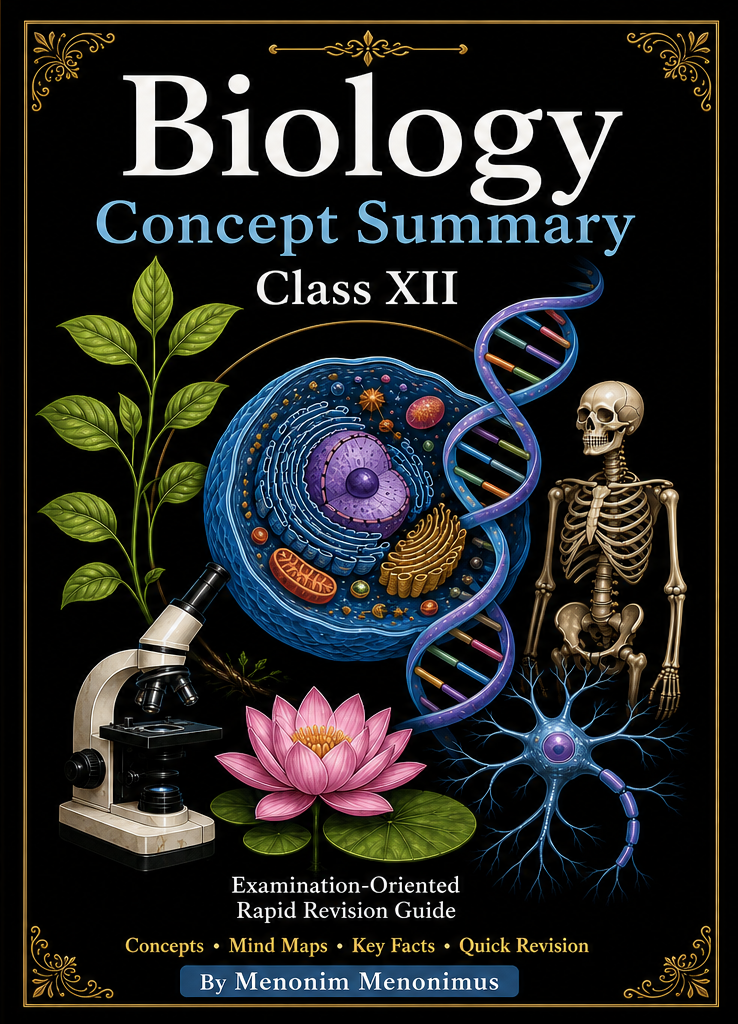
Biology Concept Summary Class 12
Examination-Oriented Rapid Revision Guide
Concepts • Mind Maps • Key Facts • Quick Revision
By
Menonim Menonimus
Copyright & Publisher Details
Biology: Concept Summary — CBSE Class XII
Copyright © 2026 Menonim Menonimus
All rights reserved. No part of this publication may be reproduced, stored or transmitted in any form or by any means without prior written permission of the author, except for brief quotations used for review or educational reference as permitted by law.
This book is an independent educational guide. It is not an official publication of CBSE or NCERT and is not affiliated with or endorsed by either organisation.
This edition has been revised for alignment with the CBSE Class XII Biology (Code 044) curriculum for the academic session 2026–27. Students should always consult the latest official CBSE curriculum, examination notices and prescribed learning materials for their examination year.
Preface
Biology is a subject in which success depends on understanding concepts and recalling important facts, processes, examples, diagrams and scientific terms accurately. Biology: Concept Summary, CBSE Class XII has been designed as a compact revision companion for students who want to revise systematically without repeatedly going through lengthy chapters.
The book follows the Class XII Biology unit structure used by CBSE and presents major examinable concepts in a concise, student-friendly form. Chapter-wise mind-map style summaries are included to help students see relationships among concepts and recall important information quickly.
This book is a revision aid, not a substitute for the prescribed textbook, classroom teaching or the official syllabus. It has been checked against the CBSE Class XII Biology curriculum for 2026–27, and selected factual statements have been corrected or clarified where the earlier manuscript was outdated or oversimplified.
About the Book
Turn long chapters into quick, organised revision. Biology: Concept Summary, CBSE Class XII is designed for students who want to strengthen recall, identify important ideas and revise efficiently before examinations.
The book combines concise concept summaries with chapter-wise mind maps. Instead of reading every chapter from beginning to end during every revision, students can use the visual structure first, then revisit the relevant concepts and facts. This makes repeated revision faster and more purposeful.
How to Use This Book for Better Results
- Step 1: Learn first — Study the prescribed textbook and classroom material before using this summary as a compression tool.
- Step 2: Start with the mind map — Look at the chapter structure and try to recall each branch before reading the detailed points.
- Step 3: Revise actively — Close the book after each section and reproduce key terms, sequences, comparisons and examples from memory.
- Step 4: Mark weak areas — Use a pencil or light highlighter to identify facts and concepts that you repeatedly forget.
- Step 5: Revise in cycles — Use the book after learning a chapter, again after a few days, again before the examination, and once more for final rapid recall.
Golden rule: Use this book to accelerate recall, but build your understanding from the prescribed textbook and syllabus.
Syllabus Snapshot
The current CBSE Class XII Biology (Code 044) theory course is organised into five units. Total theory marks: 70.
| Unit | Title | Marks
|
|---|---|---|
| Unit VI | Reproduction | 16 |
| Unit VII | Genetics and Evolution | 20 |
| Unit VIII | Biology and Human Welfare | 12 |
| Unit IX | Biotechnology and its Applications | 12 |
| Unit X | Ecology and Environment | 10 |
The present edition covers the 13 chapters prescribed for these units. Topics that were missing or too briefly treated in the earlier manuscript have been incorporated where needed, including parthenocarpy and seed dispersal, GIFT, additional sex-determination systems, thalassemia, RNA and the rice genome project, additional diseases, judicious antibiotic use, stem-cell technology, biosafety, age distribution, and Ramsar sites.
For Comfortable Reading: Download PDF
Unit VI: Reproduction
Chapter 1: Sexual Reproduction in Flowering Plants
Rapid Revision Mind Map
Flower: Structure and Function
- Flower is the reproductive unit of angiosperms
- It consists of four whorls: calyx, corolla, androecium, gynoecium
- Androecium → Male reproductive part (stamens)
- Gynoecium → Female reproductive part (carpels/pistil)
Pre-fertilization: Structures and Events
- Stamen, Microsporangium and Pollen Grain:
- Stamen has filament and anther
- Anther is bilobed, each lobe has two theca → four microsporangia
- Microsporangia develop into pollen sacs containing pollen grains
- Microsporogenesis:
- Formation of microspores (pollen grains) from microspore mother cells (MMC)
- MMC undergoes meiosis → produces haploid microspore tetrad (n)
- Structure of Pollen Grain:
- Pollen grain has two layers: Exine (Hard outer layer made of sporopollenin) and Intine (Inner cellulose layer)
- Contains vegetative cell and generative cell
- Generative cell divides to form two male gametes
- Pollen Viability and Storage:
- Viability depends on species and environmental conditions
- Can be stored in liquid nitrogen at −196°C (pollen bank)
- Pistil, Megasporangium and Embryo Sac:
- Pistil consists of stigma, style and ovary; Ovary contains ovules
- Ovule has funicle, hilum, integuments, nucellus and micropyle
- Megasporogenesis:
- Formation of megaspores from megaspore mother cell (MMC)
- MMC undergoes meiosis → forms four haploid megaspores
- One functional megaspore develops into embryo sac
- Structure of Embryo Sac:
- Typical embryo sac is 7-celled and 8-nucleate
- Components: Egg apparatus (1 egg cell + 2 synergids), Central cell (2 polar nuclei), 3 antipodal cells
- Pollination:
- Transfer of pollen grains from anther to stigma
- Types: Autogamy (Same flower), Geitonogamy (Different flowers of same plant), Xenogamy (Different plants)
- Agents: Abiotic (Wind/anemophily, water/hydrophily), Biotic (Insects, birds, bats)
- Outbreeding Devices:
- Prevent self-pollination and promote cross-pollination
- Dichogamy (Different timing of pollen release and stigma receptivity), Herkogamy (Spatial separation of anther and stigma), Self-incompatibility (Genetic mechanism preventing self-fertilization)
- Pollen-Pistil Interaction:
- Recognition of compatible pollen
- Pollen germination → Formation of pollen tube carrying male gametes to embryo sac
Fertilization
- Fusion of male and female gametes
- Double Fertilization (Unique to angiosperms):
- One male gamete + egg → Zygote (2n) (syngamy)
- Other male gamete + two polar nuclei → Primary endosperm nucleus (3n) (triple fusion)
Post-fertilization: Structures and Events
- Endosperm: Formed from primary endosperm nucleus (3n); Provides nutrition to developing embryo
- Embryo Development: Zygote develops into embryo (Radicle forms root, Plumule forms shoot, Cotyledons are seed leaves)
- Seed Formation: Ovule develops into seed; Integuments form seed coat; Seed contains embryo and stored food
- Fruit Formation: Ovary develops into fruit; Pericarp is fruit wall; Types: true fruit and false fruit
- Apomixis and Polyembryony:
- Apomixis → Formation of seeds without fertilization (produces genetically identical offspring)
- Polyembryony → Occurrence of more than one embryo in a seed
Special Modes and Seed Dispersal
- Parthenocarpy → Formation of fruit without fertilisation; it can produce seedless fruits in suitable plants.
- Apomixis → Formation of seeds without normal fertilisation, often preserving maternal genotype.
- Polyembryony → Formation of more than one embryo in a seed.
- Seed dispersal → Helps reduce competition with the parent plant and assists colonisation of new areas.
Quick Recall
Remember the sequence: floral structure → gametophyte formation → pollination → pollen-pistil interaction → double fertilisation → endosperm and embryo → seed and fruit formation → special modes.
For Comfortable Reading: Download PDF
Chapter 2: Human Reproduction
Rapid Revision Mind Map
Human Reproductive System
- Humans show sexual reproduction with internal fertilization
- Reproductive system is well-developed and shows sexual dimorphism
Male Reproductive System
- Primary sex organs → Testes
- Accessory ducts → Rete testis, vasa efferentia, epididymis, vas deferens, ejaculatory duct, urethra
- Accessory glands → Seminal vesicles, prostate gland, bulbourethral glands
- Testes: Located in scrotum outside abdominal cavity; Maintain temperature about 2–2.5°C lower than body temperature; Consist of seminiferous tubules where sperms are produced
- Structure of Seminiferous Tubule: Lined by germinal epithelium; Contains spermatogonia, Sertoli cells and developing sperms; Interstitial cells (Leydig cells) present outside tubules → secrete testosterone
- Male Accessory Glands and Their Secretions: Seminal vesicles (fructose-rich fluid), Prostate gland (milky secretion), Bulbourethral glands (mucus secretion for lubrication)
- Semen: Mixture of sperms and seminal plasma; Seminal plasma provides nutrition and medium for sperm movement
Female Reproductive System
- Primary sex organs → Ovaries
- Accessory ducts → Oviducts (fallopian tubes), uterus, vagina
- External genitalia → Vulva
- Ovaries: Produce ova (eggs) and hormones (estrogen and progesterone); Contain follicles at different stages of development
- Oviduct (Fallopian Tube): Divided into infundibulum, ampulla and isthmus; Site of fertilization → Ampulla region
- Uterus: Pear-shaped organ where embryo develops; Lining is called endometrium; Myometrium → muscular layer
Menstrual Cycle
- Cyclic changes in female reproductive system (~28 days); Controlled by hormones
- Phases:
- Menstrual phase → Shedding of endometrium (day 1–5)
- Follicular phase → Growth of follicles and endometrium
- Ovulation → Release of a secondary oocyte, often around the middle of a 28-day cycle
- Luteal phase → Formation of corpus luteum and secretion of progesterone
- Hormonal Control: GnRH from hypothalamus, FSH stimulates follicle growth, LH induces ovulation, Estrogen and progesterone regulate uterine changes
Gametogenesis
- Spermatogenesis: Formation of sperms in seminiferous tubules (begins at puberty); Spermatogonia (2n) → spermatocytes → meiosis → spermatids (n) → spermiogenesis → spermatozoa (n)
- Structure of Sperm: Head (nucleus and acrosome), Middle piece (mitochondria), Tail (helps in movement)
- Oogenesis: Formation of ova in ovaries (begins before birth); Primary oocyte (2n) undergoes meiosis I to form a secondary oocyte (n) and first polar body; meiosis II is completed on fertilisation, producing the ovum and second polar body
Fertilization and Implantation
- Fertilization: Fusion of sperm with the secondary oocyte, followed by completion of meiosis II and formation of the zygote; Occurs at the ampullary-isthmic junction of the fallopian tube (forms 2n zygote)
- Events of Fertilization: Sperm reaches secondary oocyte and penetrates coverings; Acrosome releases enzymes; Fusion of nuclei → zygote formation
- Implantation: Zygote undergoes cleavage → forms blastocyst; Blastocyst embeds into endometrium of uterus
Pregnancy, Development, Parturition and Lactation
- Gestation period in humans → about 9 months
- Placenta: Disc-like structure with chorionic villi; Forms connection between mother and fetus; Supplies nutrients/oxygen and removes waste; Secretes hormones (hCG, progesterone, estrogen)
- Parturition (Childbirth): Expulsion of fully developed fetus from uterus; Triggered by hormonal signals; Oxytocin induces uterine contractions
- Lactation: Production of milk by mammary glands after childbirth; Colostrum → first milk rich in antibodies (IgA)
Quick Recall
Remember the sequence: gametogenesis → ovulation → fertilisation → cleavage → blastocyst → implantation → pregnancy → parturition → lactation.
Chapter 3: Reproductive Health
Rapid Revision Mind Map
Reproductive Health: Definition and Importance
- Reproductive health refers to a total well-being in all aspects of reproduction (physical, emotional, behavioural and social)
- Ensures safe and satisfying reproductive life; Awareness is essential
Reproductive Health Programmes
- Initiated by government and organizations to promote awareness, facilities, and education
- National Programmes: Family planning programmes introduced in India in 1951; Reproductive and Child Health (RCH) programmes focusing on maternal health, child care, contraception, and awareness
- Sex Education: Provides knowledge about reproductive organs, puberty, and sexual health; Prevents misconceptions and encourages responsible behaviour
Birth Control (Contraception)
- Methods to prevent unwanted pregnancy; Should be user-friendly, effective, reversible, with minimal side effects
- Natural Methods: Periodic abstinence (avoiding intercourse during fertile window), Coitus interruptus (withdrawal), Lactational amenorrhea (temporary infertility during breastfeeding)
- Barrier Methods: Condoms (male/female), diaphragms, cervical caps; Also protect against STIs
- Intrauterine Devices (IUDs): Non-medicated (Lippes loop), Copper-releasing (Cu-T, Cu-7, Multiload 375), Hormone-releasing (LNG-20, Progestasert)
- Hormonal Methods: Oral contraceptive pills (combined or progestin-only), injections, implants
- Emergency Contraceptives: Most effective within 72 hours (some up to 120 hours); Prevent ovulation or fertilization
- Surgical Methods (Sterilization): Vasectomy (male sterilization), Tubectomy (female sterilization)
Medical Termination of Pregnancy (MTP)
- Intentional termination of pregnancy before full term; Medically and legally regulated procedure used in unwanted pregnancies or medical complications
Sexually Transmitted Infections (STIs)
- Infections transmitted through sexual contact (Gonorrhoea, Syphilis, Chlamydia, HIV/AIDS, Genital herpes)
- Symptoms: Itching, fluid discharge, pain, swelling; Some remain asymptomatic
- Prevention: Avoid multiple partners, use condoms, maintain hygiene, early diagnosis
Infertility and Assisted Reproductive Technologies (ART)
- Infertility: Failure to achieve pregnancy after 12 months or more of regular unprotected intercourse
- ART Methods:
- IVF (In vitro fertilization) → Fertilization outside body, embryo transferred to uterus
- ZIFT (Zygote intrafallopian transfer) → Zygote transferred to fallopian tube
- IUT (Intrauterine transfer) → Embryo transferred to uterus
- ICSI (Intracytoplasmic sperm injection) → Sperm injected into ovum
- AI (Artificial insemination) → Semen introduced into female tract
- GIFT (Gamete Intra-Fallopian Transfer) → Transfer of gametes into fallopian tube for in vivo fertilisation
Amniocentesis
- Technique to detect genetic disorders in fetus via amniotic fluid analysis; Misuse for sex determination is legally banned
Quick Recall
Remember the major areas: reproductive health awareness → contraception → STIs → MTP → infertility → ART → amniocentesis.
For Comfortable Reading: Download PDF
Unit VII: Genetics and Evolution
Chapter 4: Principles of Inheritance and Variation
Rapid Revision Mind Map
Genetics: Introduction & Terms
- Genetics is the study of heredity (transmission of traits) and variation (differences among individuals)
- Mendel’s experiments on pea plant (Pisum sativum) using controlled pollination
- Key terms: Gene, Alleles, Homozygous, Heterozygous, Dominant, Recessive
Mendelian Laws & Inheritance Patterns
- Monohybrid Cross: Cross involving one pair of contrasting traits
- Law of Dominance: Dominant allele expresses in heterozygote; recessive remains masked
- Law of Segregation: Alleles separate during gamete formation
- Dihybrid Cross: Cross involving two pairs of contrasting traits
- Law of Independent Assortment: Alleles of different genes assort independently (for genes on different chromosomes)
Deviations from Mendelian Genetics
- Incomplete Dominance: Intermediate phenotype in heterozygote (e.g., Snapdragon flower colour Red × White → Pink)
- Codominance: Both alleles express equally (e.g., ABO blood groups)
- Multiple Alleles: More than two alleles for a gene (e.g., IA, IB, i)
- Pleiotropy: One gene influences multiple traits
- Polygenic Inheritance: Character influenced by two or more genes showing continuous variation
Chromosomal Theory, Linkage & Sex Determination
- Chromosomal Theory of Inheritance: Proposed by Sutton and Boveri; genes are on chromosomes
- Linkage & Recombination: Linkage (genes on same chromosome inherited together); Recombination (exchange of genetic material during crossing over in prophase I)
- Sex Determination:
- Humans: XX (Female) / XY (Male – heterogametic)
- Birds: ZW (Female – heterogametic) / ZZ (Male – homogametic)
- Honey bees: Haplodiploidy (Females diploid, males haploid from unfertilised eggs)
Genetic Disorders & Pedigree Analysis
- Mutation: Sudden heritable change in genetic material
- Mendelian Disorders: Single gene mutations (Haemophilia, Colour blindness [X-linked], Sickle cell anaemia, Thalassemia)
- Chromosomal Disorders: Abnormal chromosome number/structure (Down’s syndrome [Trisomy 21], Turner’s syndrome [XO], Klinefelter’s syndrome [XXY])
- Pedigree Analysis: Study of inheritance pattern in families to identify genetic disorders
Quick Recall
Remember the inheritance framework: Mendelism → deviations → chromosome theory → linkage and crossing over → sex determination → sex-linked inheritance → genetic disorders.
Chapter 5: Molecular Basis of Inheritance
Rapid Revision Mind Map
The Genetic Material
- Experiments proved DNA is genetic material: Griffith (Transformation principle), Avery, MacLeod & McCarty (DNA is transforming substance), Hershey & Chase (Confirmed DNA via bacteriophages)
- RNA acts as genetic material in some viruses (e.g., TMV); single-stranded, contains ribose sugar and uracil
Structure & Packaging of DNA
- Watson & Crick Double Helix Model: Two antiparallel polynucleotide strands (5′ → 3′ and 3′ → 5′)
- Nucleotide = Nitrogen base + Deoxyribose sugar + Phosphate group
- Base pairing: A=T (2 H-bonds), G≡C (3 H-bonds); Distance between pairs = 0.34 nm; Turn = 3.4 nm (10 bp)
- Packaging: DNA wraps around histone proteins to form nucleosome (chromatin unit)
DNA Replication
- Occurs in S-phase; Semi-conservative mode
- Enzymes: Helicase (unwinds), DNA polymerase (synthesizes new strand), DNA ligase (joins Okazaki fragments)
- Leading strand (continuous) vs Lagging strand (discontinuous)
Transcription & Translation
- Transcription: Synthesis of RNA from DNA template (Initiation at promoter, Elongation, Termination)
- Types of RNA: mRNA (carries code), tRNA (transfers amino acids), rRNA (ribosomal structure)
- Genetic Code: Triplet, Degenerate, Universal, Non-overlapping, Comma-less
- Translation: Protein synthesis on ribosomes (Initiation, Elongation, Peptide bond formation, Termination)
Gene Regulation, Genomes & Fingerprinting
- Lac Operon: Gene regulation model in bacteria (Promoter, Operator, Structural genes; Active with lactose)
- Human Genome Project (HGP): ~3 billion bp, ~20,000–25,000 genes, <2% codes for proteins
- Rice Genome Project: Genome sequencing to understand crop trait genes
- DNA Fingerprinting: Identification based on repetitive DNA polymorphism (used in forensics, paternity)
Quick Recall
Remember the information flow: DNA/RNA → replication → transcription → RNA processing → genetic code → translation → regulation → genome projects → DNA fingerprinting.
Chapter 6: Evolution
Rapid Revision Mind Map
Origin of Life & Chemical Evolution
- Earth formed ~4.5 billion years ago
- Oparin-Haldane Theory: Chemical evolution (inorganic → organic → macromolecules → first living cells)
- Miller’s Experiment: Simulated early Earth conditions with electric discharge, producing amino acids
Evidences for Evolution
- Palaeontological: Fossils record gradual changes
- Comparative Anatomy: Homologous organs (same origin, different function), Analogous organs (different origin, same function), Vestigial organs
- Embryological & Molecular: Embryo similarities, DNA/protein sequence conservation
Theories & Mechanisms of Evolution
- Darwin’s Natural Selection: Overproduction, limited resources, struggle for existence, variation, survival of the fittest
- Modern Synthetic Theory: Combines Darwinism with genetics (allele frequency changes)
- Mechanisms: Mutation, Gene Flow, Genetic Drift (random changes in small populations), Natural Selection (Stabilizing, Directional, Disruptive)
- Hardy-Weinberg Principle: Genetic equilibrium (p² + 2pq + q² = 1); evolution occurs when equilibrium is disturbed
- Adaptive Radiation: Evolution of different species from common ancestor in an area (e.g., Darwin’s finches)
Human Evolution
- Australopithecines (early hominins, habitual bipedalism) → Homo habilis (early stone tools) → Homo erectus (migrations, controlled fire) → Homo sapiens (modern humans)
- Note: Dryopithecus and Ramapithecus represent Miocene fossil apes rather than simple direct stages to modern humans.
Quick Recall
Remember the evidence and mechanisms: fossils → comparative anatomy → embryology → molecular evidence → natural selection → mutation/recombination → gene flow/drift → Hardy-Weinberg → adaptive radiation → human evolution.
Unit VIII: Biology and Human Welfare
Chapter 7: Human Health and Diseases
Rapid Revision Mind Map
Health & Disease Overview
- Health: Complete physical, mental, and social well-being
- Infectious diseases (caused by pathogens, transmissible) vs Non-infectious diseases (non-transmissible)
Common Human Diseases
- Bacterial: Typhoid (Salmonella typhi), Pneumonia (Streptococcus pneumoniae)
- Viral: Common cold (Rhinoviruses), Influenza, Dengue & Chikungunya (transmitted by Aedes mosquitoes)
- Protozoan: Malaria (Plasmodium via female Anopheles), Amoebiasis (Entamoeba histolytica via contaminated food/water)
- Helminthic: Ascariasis (Ascaris), Filariasis (Wuchereria)
- Fungal: Ringworm (Dermatophytes)
Immune System & Cancer
- Innate Immunity: Non-specific, present from birth (physical, cellular, biochemical barriers)
- Acquired Immunity: Specific, memory-based; Active (body produces antibodies) vs Passive (external antibodies)
- Antibodies: Immunoglobulins produced by B-cell derived plasma cells
- Vaccination: Introduces antigen preparation to build immunological memory
- Allergy & Autoimmunity: Allergy (hypersensitivity via histamine); Autoimmune (system attacks self, e.g., Rheumatoid arthritis)
- Cancer: Uncontrolled cell division (benign vs malignant); caused by carcinogens/mutations in oncogenes & tumour suppressor genes; treated via surgery, radiotherapy, chemotherapy, immunotherapy
- AIDS: Caused by HIV destroying helper T-cells; transmitted via unprotected sex, blood, needles, mother-to-child
Substance Abuse & Antibiotic Use
- Drugs: Opioids (Heroin, Morphine), Cannabinoids (Marijuana), Cocaine
- Antibiotics: Must be used judiciously to prevent antimicrobial resistance
Quick Recall
Remember: pathogens and disease control → immunity and vaccines → cancer → HIV/AIDS → adolescence and substance abuse.
Chapter 8: Microbes in Human Welfare
Rapid Revision Mind Map
Microbes in Household & Industrial Products
- Household: Curd (Lactobacillus / LAB), Dough/Bread & Toddy (Yeast Saccharomyces cerevisiae)
- Industrial Beverages: Ethanol production using yeast
- Antibiotics: Penicillin from Penicillium
- Organic Acids: Acetic acid (Acetobacter), Citric acid (Aspergillus niger), Lactic acid (Lactobacillus)
- Enzymes: Lipases (detergents), Proteases, Pectinases (juice clarification)
Microbes in Sewage Treatment & Biogas
- Sewage Treatment: Primary (filtration/sedimentation) → Secondary/Biological (microbial flocs reduce BOD)
- Biogas Production: Methanogens produce methane-rich gas (CH₄) from cattle dung & organic waste
Biocontrol Agents & Biofertilizers
- Biocontrol: Bacillus thuringiensis (Bt) for insect larvae
- Biofertilizers: Nitrogen fixers (Rhizobium [symbiotic], Azotobacter [free-living], Anabaena/Nostoc [cyanobacteria]), Mycorrhiza (fungal root association)
Quick Recall
Remember: household fermentation → industrial products → antibiotics → sewage treatment → biogas → biocontrol → biofertilizers.
Unit IX: Biotechnology and its Applications
Chapter 9: Biotechnology: Principles and Processes
Rapid Revision Mind Map
Principles & Tools of Recombinant DNA Technology
- Core techniques: Genetic engineering and Bioprocess engineering
- Restriction Enzymes: Cut DNA at specific palindromic recognition sites (e.g., EcoRI)
- Cloning Vectors: Plasmids/Bacteriophages with ori, selectable markers (antibiotic resistance), restriction sites
- Competent Host: Cells (e.g., E. coli) treated to take up foreign DNA
Processes of Recombinant DNA Technology
- Isolation of DNA → Cutting with restriction enzymes → Amplification via PCR (Polymerase Chain Reaction) → Ligation using DNA ligase into vector → Transformation into host → Selection of transformants → Expression of target protein
- Bioreactors: Stirred tank / Airlift vessels for large-scale production under controlled conditions
- Downstream Processing: Separation, purification, quality control, and packaging
Quick Recall
Remember the recombinant-DNA workflow: isolate → cut → amplify → ligate → transform → select → express → bioreactor → downstream processing.
Chapter 10: Biotechnology and its Applications
Rapid Revision Mind Map
Applications in Agriculture & Medicine
- Agriculture: GMOs, Bt Cotton (insect toxin from Bacillus thuringiensis), RNA Interference (RNAi – gene silencing for pest protection)
- Medicine: Genetically engineered insulin (using E. coli), Gene therapy (e.g., ADA deficiency treatment), Molecular diagnosis (PCR, ELISA)
- Stem-Cell Technology: Self-renewing stem cells for research and therapeutic applications
- Transgenic Animals: Genetically altered animals used for studying diseases, protein production, and vaccine testing
Biosafety, Patents & Ethics
- Biosafety: Regulations for safe handling and testing of biotechnology products
- Biopatent & Biopiracy: Legal protection of biotech inventions vs unauthorized exploitation of biological resources/traditional knowledge
Quick Recall
Remember: agricultural applications → Bt crops and RNAi → insulin and vaccines → gene therapy → molecular diagnosis → stem cells → transgenic animals → biosafety → patents and biopiracy.
Unit X: Ecology and Environment
Chapter 11: Organisms and Populations
Rapid Revision Mind Map
Organism and Environment
- Abiotic factors: Temperature (Eurythermal vs Stenothermal), Water, Light, Soil
- Responses to abiotic stress: Regulate (homeostasis), Conform, Migrate, Suspend (hibernation/aestivation)
- Adaptations: Morphological, physiological, behavioural traits
Population Attributes & Growth Models
- Attributes: Density (N), Natality (B), Mortality (D), Immigration (I), Emigration (E), Age distribution (pre-reproductive, reproductive, post-reproductive)
- General Growth Equation: dN/dt = (B + I) − (D + E)
- Exponential Growth (Unlimited resources, J-shaped): dN/dt = rN
- Logistic Growth (Limited resources, carrying capacity K, S-shaped): dN/dt = rN(1 − N/K)
Population Interactions
- Predation (+, −), Competition (−, −), Parasitism (+, −), Mutualism (+, +), Commensalism (+, 0)
Quick Recall
Remember: abiotic factors → adaptations → population attributes → growth models → age distribution → population interactions.
Chapter 12: Ecosystem
Rapid Revision Mind Map
Structure & Functions of Ecosystem
- Components: Abiotic (inorganic, organic, physical) and Biotic (Producers, Consumers, Decomposers)
- Productivity: Gross Primary Productivity (GPP) vs Net Primary Productivity (NPP = GPP − R)
- Decomposition steps: Fragmentation → Leaching → Catabolism → Humification → Mineralization
Energy Flow & Ecological Pyramids
- Energy Flow: Unidirectional, follows 10% law across trophic levels; Food chains (Grazing vs Detritus) and Food webs
- Pyramids: Pyramid of Number, Pyramid of Biomass, Pyramid of Energy (Always upright)
- Ecological Succession: Primary vs Secondary succession (Pioneer stage → Intermediate stages → Climax community)
- Nutrient Cycling: Gaseous (Carbon, Nitrogen) and Sedimentary (Phosphorus) cycles
Quick Recall
Remember: components → productivity → decomposition → energy flow → food chains/webs → ecological pyramids → succession → nutrient cycles.
For Comfortable Reading: Download PDF
Chapter 13: Biodiversity and its Conservation
Rapid Revision Mind Map
Levels & Patterns of Biodiversity
- Levels: Genetic, Species, and Ecosystem diversity
- Patterns: Latitudinal gradient (highest in tropics); Species-Area relationship (log S = log C + Z log A)
Loss & Conservation of Biodiversity
- Causes of Loss (The Evil Quartet): Habitat loss & fragmentation, Over-exploitation, Alien species invasion, Co-extinction
- In-situ Conservation: Protection within natural habitat — National Parks, Wildlife Sanctuaries, Biosphere Reserves, Biodiversity Hotspots, Sacred Groves
- Ex-situ Conservation: Protection outside natural habitat — Zoos, Botanical Gardens, Seed banks, Gene banks
- Conservation tools: IUCN Red Data Book, Ramsar Sites (internationally important wetlands), Earth Summit (Rio 1992)
Quick Recall
Remember: levels of biodiversity → patterns → values → causes of loss → hotspots → in situ/ex situ conservation → international efforts → threatened species and wetlands.
Final Revision Note
This book is designed for rapid revision. For complete understanding, examples, diagrams, experiments and the latest examination requirements, students should study the prescribed NCERT material and the latest CBSE curriculum and notices.
The author has intentionally kept the presentation concise. Where a scientific statement can be misunderstood when reduced to one line, the wording has been clarified rather than relying on an oversimplification.
If you find the Biology Concept Summary (guide) helpful, please send your feedback via: [email protected].
List of Books by M. Menonimus
Poetry Books
- Rainbow Tomorrow Night
- A Heart Full of Golden Hopes
- Evergreen Loves
- For My Countrymen
- If You Go Away
- In Search of a White Heart
- In the Light of Candle
- In the River of Blood
- Lovelia
- My Dear a Heart
- My Native Land
- The Lost Reminiscence
- Under the Starry Sky
- The Little Girl and the Stars
- Loves and Songs
- My Casual Poems
- An Orphan and Other Poems in Prose
Novels
- The Weight of Monsoon Flowers
Literary Criticism
- World Short Story Criticism
- World Poetry Criticism
- World Drama Criticism
- World Novel Criticism
- World Essay Criticism
- Indian English Poetry Criticism
- Indian English Poets and Poetry Chief Features
- Emily Dickinson’s Poetry-A Thematic Study
- Walt Whitman’s Poetry-A Thematic Study
- Critical Essays on English Poetry
- Tawfiq al-Hakim’s Novel: Return of the Spirit-An Analytical Study
- Tawfiq al-Hakim’s Novel: ‘Yawmiyyat Naib Fil Arayaf’-An Analytical Study
- Analytical Studies of Some Arabic Short Stories
- A Brief History of Arabic Literature: Pre-Islamic Period (500 AD-622 AD)
- A Brief History of Arabic Literature: Early Islamic Period (622 AD-661 AD)
- Reviews of William Shakespeare’s Works
- Reviews of Charles Dickens’ Works
- Reviews of John Milton’s Literary Works
- Reviews of Some Iconic Travelogues
- Shakespeare’s Sonnets-Critical Studies
- Analytical Studies of Selected Poems of Sarojini Naidu
- Analytical Studies of Selected Poems of Rabindranath Tagore
- Analytical Studies of Selected Indian English Poems
- Reviews of Selected Motivational Books
- Origin, Evolution & Functions of Literature
- Essays on Shakespeare and His Time
Linguistics
- A Brief History of the English Language
- Essays on Linguistics
- Learners’ English Dictionary
Short Story Books
- The Fugitive Father and Other Stories
- The Prostitute and Other Stories
- Neha’s Confession
- Juvenile Stories and Essays
Autobiography & Biography
- A Few Pages of My Lost Diary (Autobiography)
- The World Writers-Brief Biographies
- Introduction to World Writers
- Introduction to World Personalities
- Love of Reputed Persons
- Brief Biographies of Prominent Bengali Writers
- Brief Biographies of Eminent Monarchs
- Brief Biographies of Ancient Thinkers and Writers
- Brief Biographies of Eminent Generals and Conquerors
- Biographies of Writers Around the World
- Introduction to Men of Letters
Non-Fiction & Educational Psychology
- Love Letters to Liza
- Let’s Look Into
- Articles on Contemporary Affairs
- Gleaned Essays
- Educational Psychology: A Comprehensive Study
- The Human Psychology: A Comprehensive Study
- Select Essays on Technology
- Essays on Science and Technology
- Interactive SEO Guide
- Tips For Best SEO
Motivational Books
- Earn One Million Dollars a Month
- Earn Million Dollars Using ChatGPT
- The Millionaire Mindset
Academic (Educational) Books
- Advertisement Writing
- Amplification Writing
- Note Making
- Paragraph Writing
- Notice Writing
- Passage Comprehension
- The Art of Poster Writing
- The Art of Letter Writing
- Report Writing
- Story Writing
- Substance Writing
- School Essays Part-I & Part-II
- School English Grammar Part-I & Part-II
0 0 0