Class 12 English Indigo Solutions. Class 12 English Indigo Solutions with complete, accurate answers, explanations, important questions, and exam-ready study material for CBSE Class 12 students. Continue reading: Class 12 English Indigo Solutions
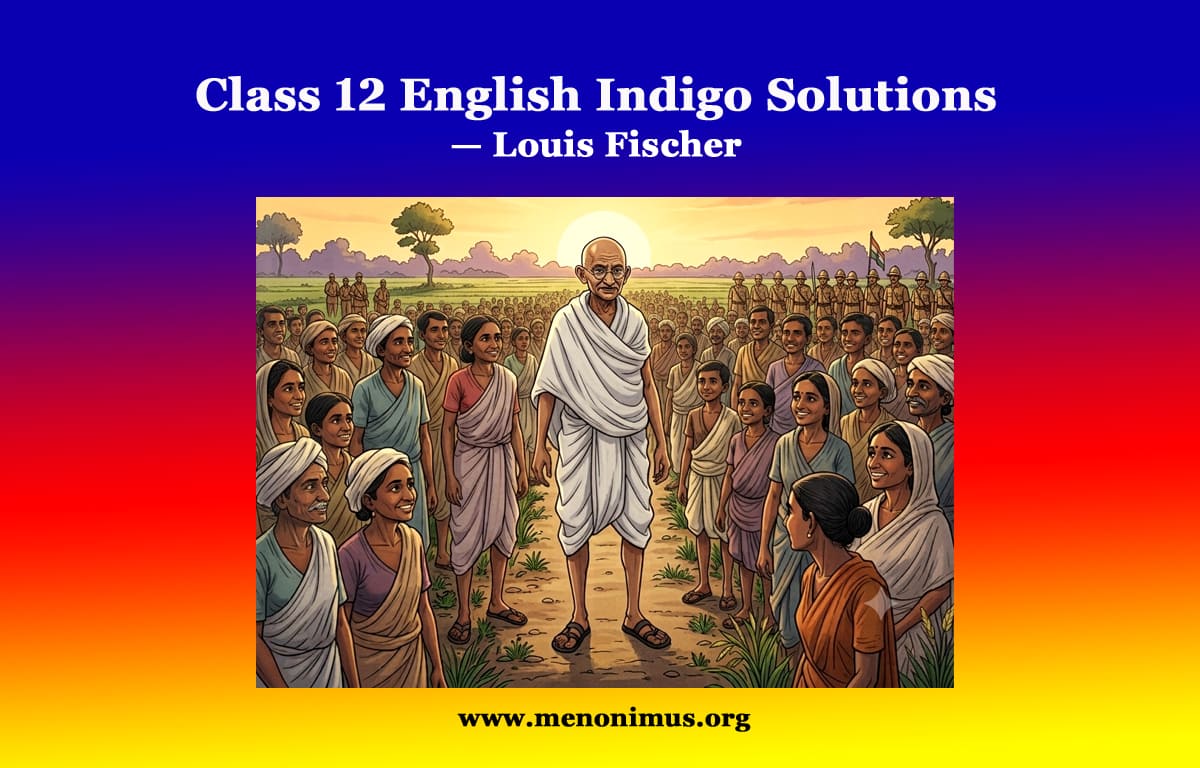
Class 12 English Indigo Solutions
— Louis Fischer
TEXTUAL QUESTION-ANSWERS
THINK AS YOU READ-I
Q.1. Strike out what is not true in the following:
(a) Rajkumar Shukla was
(i) a sharecropper.
(ii) a politician.
(iii) a delegate
(iv) a landlord
Ans: (iv) a landlord.
(b) Rajkumar Shukla was:
(i) poor
(ii) physically strong
(iii) illiterate
Ans: (iii) physically strong.
Q.2. Why is Rajkumar Shukla described as being resolute?
Ans: Rajkumar Shukla wanted to take Gandhi to Champaran for the cause of the poor peasants. But Gandhi had an engagement to go to many places. But Rajkumar Shukla was determined to take Gandhi anyway. So he followed Gandhi wherever Gandhi went. He waited till Gandhi was free. So Rajkumar was described as resolute.
Q.3.Why do you think the servants thought Gandhi to be another peasant?
Ans: In Patna, Shukla led Gandhi to the house of a lawyer named Rajendra Prasad. The servants knew Shukla to be a poor peasant of Champaran. He often troubled Rajendra Prasad to take up the case of the indigo share-croppers. So the servants of the household took Gandhi to be another peasant.
THINK AS YOU READ-II
Q.1. List the places that Gandhi visited between his first meeting with Shukla and his arrival at Champaran.
Ans: The places that Gandhi visited before he arrived at Champaran were Lucknow, Calcutta, Patna, Muzaffarpur and Motihari.
Q.2. What did the peasants pay the British Landlords as rent? What did the British now want instead and why? What would be the impact of synthetic indigo on the prices of natural indigo?
Ans: The peasants had to grow indigo on 15% of their land, the whole output of which went to the British landlords as rent.
The indigo plantation was not profitable for the peasants. So they wanted to be free of cultivating indigo. Therefore, the landlords wanted compensation for freeing the peasants.
The synthetic indigo was cheaper in cost than the natural indigo.
THINK AS YOU READ-III
Q.1. The events in this part of the text illustrate Gandhi’s method of working. Can you identify some instances of this method and link them to his ideas of Satyagraha and non-violence?
Ans: Gandhi had a deep respect for legal authority. But he could defy the authorities when they violated natural justice and human values. For Gandhi, the voice of conscience was above any law. He was polite and friendly when he helped the British to regulate the crowd. He tried to obey the law. But he was ready to disobey for any nobler cause of his people.
All these can be linked with his ideas of Satyagraha and non-violence.
THINK AS YOU READ-IV
Q.1. Why did Gandhi agree to a settlement of 25 per cent refund to the farmers?
Ans: At first, Gandhi demanded 50 per cent of the amount extorted from the peasants by the Landlords. But the landlords offered to refund only 25 per cent of the amount. Gandhi accepted the offer as he explained that this action lowered the status of the landlords in front of the peasants. Along with it, the landlords came to appreciate that the peasants had their rights also.
Q.2. How did the episode change the plight of the peasants?
Ans: The Champaran episode changed the plight of the peasants. Previously, the landlords behaved as if they were above the law. But after the episode, the peasants understood that they had the right to defy the landlords. They also learned the lesson of courage. Within a few years of this event, the British planters abandoned the lands. The peasants owned their own land. Thus, the episode changed the plight of the peasants.
ADDITIONAL QUESTION-ANSWERS
Q.1. Who was Edward Gait? H.S. ’15
Ans: Edward Gait was the Lieutenant Governor of the province of Champaran.
Q.2. What was Gandhi’s politics intertwined with? H.S. ’16
Ans: Gandhi’s politics was intertwined with the practical day-to-day problems of the millions.
Q.3. What did Shukla want Gandhi to do? H.S. ’15
Ans: Shukla wanted Gandhi to go to Champaran so as to take steps against the injustice done to the poor peasants by the landlords.
Q.4. Where was Champaran? H.S. ’18
Ans: Champaran was in the foothills of the Himalaya, near Nepal.
Q.5. Whom did Gandhi and Shukla propose to meet at Patna? H.S. ’17
Ans: Gandhi and Shukla proposed to meet Rajendra Prasad at Patna.
Q.6. Who was Rajkumar Shukla? H.S. ‘`16
Ans: Rajkumar Shukla was a poor sharecropper peasant of Champaran.
Q.7. To whose house did Rajkumar take Gandhi?
Ans: Rajkumar took Gandhi to the house of Rajendra Prasad, the lawyer.
Q.8. Who was the sole representative in the commission for the farmers?
Ans: Gandhi was the sole representative in the commission for the farmers.
Q.9. Why did Gandhi rebuke the lawyers?
Ans: Gandhi rebuked the lawyers because they collected heavy fees from the poor share-croppers.
Q.10. How many schools were set up initially under the patronage of Gandhi in Champaran?
Ans: Initially, six schools were set up in different villages of Champaran under the patronage of Gandhi.
Q.11. Where did Louis Fischer meet Gandhi first?
Ans: Louis Fischer met Gandhi first in Sevagram Ashram.
Q.12. Who is the author of the article ‘Indigo’?
Ans: Louis Fischer is the author of the article ‘Indigo’.
Q.13. Where is Champaran? H.S. ’14, ’18
Ans: Champaran is at the foothills of the Himalayas. It is near Nepal and Bihar.
Q.14. Why did Rajkumar Shukla meet Gandhi?
Ans: Rajkumar Shukla met Gandhi to take him to Champaran for the cause of the sharecroppers.
Q.15. Where did Shukla meet Gandhi?
Ans: Shukla met Gandhi at the Lucknow session of the National Congress Party.
Q.16. What country had developed synthetic indigo?
Ans: Germany developed synthetic indigo.
Q.17. What was the capital of Champaran?
Ans: The capital of Champaran was Motihari.
Q.18. Where did Gandhi stay in Muzaffarpur?
Ans: In Muzaffarpur, Gandhi stayed at the house of Professor Mulkani, who was a teacher in a government school.
Q.19. Why was Gandhi visiting Lucknow in 1916? H.S. ’20
Ans: Gandhi was visiting Lucknow in 1916 to attend the annual convention of the Indian National Congress.
Q.20. Why was Professor Mulkani’s action of offering shelter to Gandhi ‘extraordinary ‘? H.S. ’20
Ans: Mulkani was a professor of a government college. During those days, no Government official could shelter a person who was against British rule in India. But Professor Mulkani offered shelter to Gandhi. So Mulkani’s action of sheltering Gandhi was extraordinary.
Q.21. Describe the efforts made by R. K. Shukla to persuade Gandhi to go to Champaran. H.S. ’14
Ans: Shukla first met Gandhi in the annual convention of the Indian National Congress Party held in Lucknow. There, he pleaded with Gandhi to visit Champaran in favour of the share-croppers. Rajkumar Shukla wanted to take Gandhi to Champaran for the cause of the poor peasants. But Gandhi had engagements to go to many places. Rajkumar Shukla was determined to take Gandhi anyway. So he followed Gandhi wherever Gandhi went. Shukla went with Gandhi to Cawnpore, Ahmedabad, Calcutta and waited till Gandhi was free. For many weeks he did not leave Gandhi. At last, Gandhi, being impressed by Shukla’s determination and tenacity, decided to visit Champaran.
Thus Rajkumar Shukla persuaded Gandhi to go to Champaran.
Q.21. What was the significance of the Champaran movement? (Marks – 5)
or
“The battle of Champaran is won”, Gandhi exclaimed. Explain the context in which this was said. H. S. ’16, ’24
or
Why do you think Gandhi considered the Champaran episode to be a turning point in his life?
Ans: According to Gandhi, the Champaran episode was a turning point in his life. The sharecroppers got a 25% refund of the amount they paid as compensation to be exempt from planting indigo in their lands. The amount of the refund was less important than the fact that the landlords were humiliated for the first time. The peasants learned that they had rights. It also brought courage to their heart to defy the government. It was a victory for civil disobedience. After this event, the British authority began to be undermined in India.
This Champaran episode was not a turning point for Gandhi only but also for the Indians, as the Indians became aware of their rights, and after this event, the British government also became aware of the effects of Gandhi’s Non-violence Policy.
Q.22. Where did Gandhi meet Professor Kripalani for the first time? H.S. ’24
Ans: Gandhi met Professor Kripalani for the first time in Santiniketan.
Q.23. How many times did Gandhi meet the Lt. Governor? H.S. ’24
Ans: Gandhi met the Lt. Governor for one time.
Q.24. How was Gandhi able to influence lawyers? Give instances? H.S. ’24
Ans: Gandhi was able to influence the lawyers by rebuking them for taking high fees from the peasants. Moreover, he asked them what they would do if he went to jail. Their replies were negative, for which Gandhi expressed his regret.
Q.23. What did the peasants pay the British landlords as rent? H.S. ’24
Ans: The peasants had to cultivate indigo on fifteen percent of their land, and all the production was paid to the British landlord as rent.
N-B. If you like Class 12 English Indigo Solutions, please send us your feedback. 0 0 0
Some Guide Books for Class 12:
- Class 12 Biology Concept Summary
- Class 12 Biology Mind Map
- Class 12 Alternative English Solutions
- Class 12 English Solutions
- Class 12 Anthropology Solutions
- Class 12 Home Science Solutions
- Class 12 Employability Skills Solutions
- Class 12 Automotive Solutions
- Class 12 General Studies Solutions
- Class 12 Biology Solutions