Class 12 Anthropology Chapter 1 Cell Theory Solutions with complete textual questions and answers, plus important additional exam-oriented questions and answers for easy and effective preparation.
Class 12 Anthropology Chapter 1 Cell Theory Solutions
Textual Questions & Answers (Class 12 Anthropology Chapter 1 Cell Theory Solutions)
- Who noticed the human cell for the first time?
Ans: Robert Hooke was the first to observe and describe microscopic structures that he called “cells” in a thin slice of cork in 1665
- What are the two main parts of the cell?
Ans: The two main parts of a typical eukaryotic cell are the cytoplasm and the nucleus.
- What are the two main types of human cell?
Ans: The two main types of human cells are:
(i) Somatic cells or body cells.
(ii) Germ cells or reproductive cells.
- Define human cell.
Ans: A human cell is the basic structural and functional unit of the human body. It carries out essential life processes such as metabolism, growth, and reproduction. A typical human cell consists of a plasma membrane, cytoplasm, and a nucleus containing genetic material (DNA), along with various organelles that perform specific functions.
- What do you mean by cell division?
Ans: Cell division is the biological process by which a parent cell divides to produce new daughter cells. In unicellular organisms, cell division may serve as a means of reproduction. In multicellular organisms, cell division is essential for growth, development, tissue repair, and reproduction.
- Who put forward the idea of cell division?
Ans: Robert Remak put forward the idea that new cells arise by the division of pre-existing cells. Later, Rudolf Virchow famously expressed this principle in 1855 as “Omnis cellula e cellula,” meaning that every cell arises from a pre-existing cell.
- What are the main stages of mitosis cell division?
Ans: The main stages of mitotic cell division are as follows:
(i) Prophase: During prophase, the chromatin condenses to form visible chromosomes. Each chromosome consists of two sister chromatids joined at the centromere. The nucleolus gradually disappears, the nuclear envelope breaks down, and the mitotic spindle begins to form.
(ii) Metaphase: During metaphase, the chromosomes become attached to spindle fibres at their centromeres or kinetochores and align at the equatorial plane of the cell, forming the metaphase plate.
(iii) Anaphase: During anaphase, the centromeres divide and the sister chromatids separate. The daughter chromosomes move towards opposite poles of the cell with the help of spindle fibres.
(iv) Telophase: During telophase, the chromosomes reach opposite poles and begin to decondense. Nuclear envelopes form around the two sets of chromosomes, and nucleoli reappear. Cytokinesis then divides the cytoplasm, resulting in two daughter cells.
- Who described the word chromosome for the first time?
Ans: The term “chromosome” was coined by the German anatomist Heinrich Wilhelm Gottfried von Waldeyer-Hartz in 1888
- How many chromosomes are there in the human body?
Ans: A typical human somatic cell contains 46 chromosomes arranged in 23 pairs. Of these, 22 pairs are autosomes and one pair consists of sex chromosomes. Human gametes normally contain 23 chromosomes.
- Write the names of proteins found in chromosomes.
Ans: The major proteins found in chromosomes are histone proteins and non-histone proteins.
- What is the root word for gene?
Ans: The term “gene” was coined by the Danish botanist Wilhelm Johannsen in 1909. It was derived from the Greek word “genos,” meaning “birth” or “origin.”
- Draw a and describe its different parts.Ans:
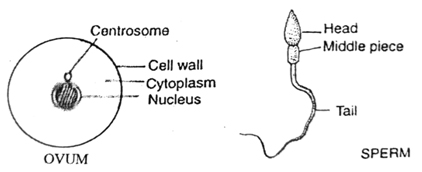
The major parts of a typical human cell are the plasma membrane, cytoplasm, nucleus, mitochondria, endoplasmic reticulum, Golgi apparatus, ribosomes, lysosomes, and other cellular organelles. Each part performs a specific function necessary for the survival and proper functioning of the cell.
- Describe mitosis cell division?
Ans: Mitosis is a type of cell division in which one parent cell divides to form two genetically similar daughter cells, usually having the same chromosome number as the parent cell. The nuclear division of mitosis occurs through four main stages:
(i) Prophase: Chromatin condenses into visible chromosomes, each consisting of two sister chromatids joined at the centromere. The nucleolus disappears, the nuclear envelope breaks down, and the spindle begins to form.
(ii) Metaphase: The chromosomes align at the equatorial plane of the cell and become attached to spindle fibres through their centromeres or kinetochores.
(iii) Anaphase: The sister chromatids separate at the centromeres and move towards opposite poles of the cell. Once separated, each chromatid is regarded as an individual daughter chromosome.
(iv) Telophase: The chromosomes reach the opposite poles and become less condensed. Nuclear envelopes form around the two groups of chromosomes, and the nucleoli reappear. Cytokinesis then divides the cytoplasm and produces two daughter cells.
- Write the differences between mitosis and meiosis cell division.
Ans: The differences between mitosis and meiosis cell division are:
| Mitosis Cell Division | Meiosis Cell Division |
| (i) It produces two daughter cells that are usually genetically similar to the parent cell and to each other. | (i) It produces four daughter cells that are usually genetically different from one another. |
| (ii) Mitosis generally occurs in somatic cells. | (ii) Meiosis occurs in cells that give rise to gametes or other reproductive cells. |
| (iii) Only one nuclear division occurs. | (iii) Two successive nuclear divisions occur: meiosis I and meiosis II. |
| (iv) The chromosome number is generally maintained. | (iv) The chromosome number is reduced by half during meiosis I. |
| (v) Crossing over between homologous chromosomes normally does not occur. | (v) Crossing over normally occurs during prophase I and contributes to genetic variation. |
| (vi) It is important for growth, development, and tissue repair. | (vi) It is important for sexual reproduction and the generation of genetic variation. |
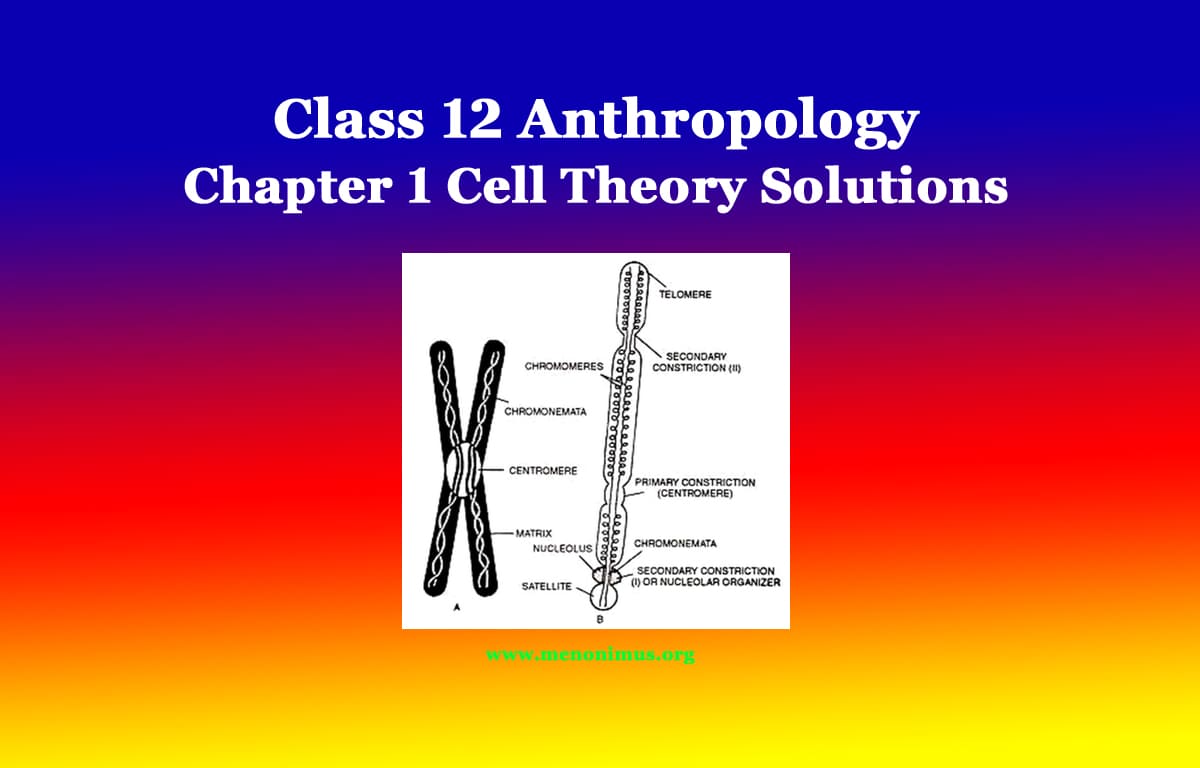
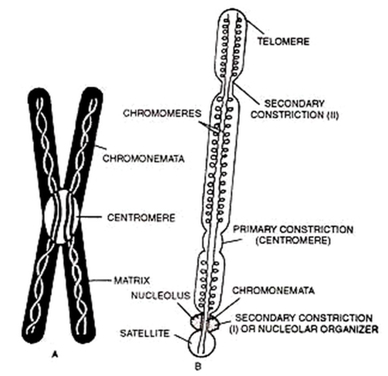
- Show the different parts of a human chromosome.
Ans:
- What are the different parts of a chromosome?
Ans: The different parts of a chromosome include the following:
(i) Chromatids: A duplicated chromosome consists of two sister chromatids joined together at the centromere.
(ii) Primary Constriction and Centromere: The primary constriction is the region where the centromere is located. The centromere plays an important role in chromosome movement during cell division by providing a site for the attachment of spindle fibres through the kinetochore.
(iii) Secondary Constriction: Some chromosomes possess a secondary constriction in addition to the primary constriction. Certain secondary constrictions contain nucleolar organiser regions (NORs), which are associated with the formation of the nucleolus.
(iv) Satellite: A satellite is a small chromosomal segment separated from the main body of the chromosome by a secondary constriction. Chromosomes possessing satellites are called SAT chromosomes.
(v) Telomere: Telomeres are the terminal regions at the ends of chromosomes. They protect chromosome ends and help prevent them from being recognised as broken DNA.
(vi) Short Arm and Long Arm: The two arms of a chromosome are designated as the short arm (p arm) and the long arm (q arm), according to their position relative to the centromere.
- What are the different types of nucleic acid and write their names?
Ans: There are two major types of nucleic acids:
(i) Deoxyribonucleic acid (DNA)
(ii) Ribonucleic acid (RNA)
- Who for the first time used the words mitosis meiosis?
Ans: The term “mitosis” was introduced by Walther Flemming in 1882. The term “meiosis” was proposed by J. B. Farmer and J. E. S. Moore in 1905.
- What is the meaning of the word chromosome?
Ans: The word “chromosome” is derived from the Greek words “chroma,” meaning “colour,” and “soma,” meaning “body.”
- Who used the word enzymes for the first time?
Ans: The term “enzyme” was introduced by the German physiologist Wilhelm Kühne in 1878. The word is derived from Greek and refers to a substance associated with fermentation.
- Write the functions of enzymes.
Ans: Enzymes are biological catalysts that speed up biochemical reactions in living organisms without being consumed in the reactions. Most enzymes are proteins, although some RNA molecules also have catalytic activity. Enzymes play essential roles in digestion, metabolism, energy production, biosynthesis, cellular regulation, and other biological processes.
The major functions of enzymes include:
(i) Signal Transduction: Certain enzymes, such as protein kinases, regulate cellular communication by adding phosphate groups to proteins and thereby controlling various cellular responses.
(ii) Digestion and Macromolecular Degradation: Digestive enzymes break down large molecules such as carbohydrates, proteins, and fats into smaller molecules that can be absorbed and utilised by the body. For example, amylases digest starch, while proteases digest proteins.
(iii) Energy Generation: Enzymes participate in the metabolic pathways through which cells obtain and utilise energy. ATP synthase is an important enzyme complex involved in the production of ATP, the major energy-carrying molecule of cells.
(iv) Ion Transport: Certain membrane proteins with enzymatic activity, such as the sodium-potassium ATPase, use energy from ATP to transport ions across the cell membrane against their concentration gradients.
(v) Defence and Detoxification: Enzymes participate in protective and detoxification processes by breaking down or modifying harmful substances. Enzymes such as catalase and various oxidoreductases help protect cells from harmful reactive substances.
(vi) Cell Regulation and Movement: Enzymes and ATP-dependent motor proteins contribute to the regulation of cellular activities and movement. ATPases provide energy for processes such as muscle contraction, intracellular transport, and the movement of cellular structures.
Other important functions of enzymes include:
(i) They help in the synthesis and breakdown of biomolecules.
(ii) They regulate many metabolic pathways.
(iii) They assist in DNA replication, RNA synthesis, and other essential cellular processes.
(iv) They participate in blood clotting and other physiological processes.
(v) They help maintain the normal functioning of cells and tissues.
Additional Questions & Answers(Class 12 Anthropology Chapter 1 Cell Theory Solutions)
Multiple Choice Questions (MCQ)
- Who discovered the cell?
(i) Robert Brown.
(ii) Watson.
(iii) Robert Hooke.
(iv) Antonie van Leeuwenhoek.
Ans: (iii) Robert Hooke.
- The study of cells is called –
(i) Anatomy.
(ii) Cytology.
(iii) Histology.
(iv) Physiology.
Ans: (ii) Cytology.
- The smallest unit of life is –
(i) Tissue.
(ii) Atom.
(iii) Organ.
(iv) Cell.
Ans: (iv) Cell.
- The powerhouse of the cell is –
(i) Lysosome.
(ii) Mitochondria.
(iii) Ribosome.
(iv) Golgi body.
Ans: (ii) Mitochondria.
- The jelly-like substance in a cell is –
(i) Chromatin.
(ii) Cytoplasm.
(iii) Nucleoplasm.
(iv) Chromoplasm.
Ans: (ii) Cytoplasm.
- Vacuoles are responsible for –
(i) Protein synthesis.
(ii) Storage.
(iii) Digestion.
(iv) Respiration.
Ans: (ii) Storage.
- Who discovered the nucleus?
(i) Robert Brown.
(ii) Watson.
(iii) Schleiden.
(iv) Schwann.
Ans: (i) Robert Brown.
- Mitosis results in –
(i) One cell.
(ii) Two different cells.
(iii) Four identical cells.
(iv) Two identical cells.
Ans: (iv) Two identical cells.
- Meiosis occurs in –
(i) Muscle cells.
(ii) Germ cells.
(iii) Skin cells.
(iv) Liver cells.
Ans: (ii) Germ cells.
- Reduction of chromosomes occurs in –
(i) Interphase.
(ii) Meiosis II.
(iii) Meiosis I.
(iv) Mitosis.
Ans: (iii) Meiosis I.
- Which phase comes before telophase in mitosis?
(i) Metaphase.
(ii) Prophase.
(iii) Anaphase.
(iv) Interphase.
Ans: (iii) Anaphase.
- Chromosomes are found in the –
(i) Golgi body.
(ii) Mitochondria.
(iii) Nucleus.
(iv) Cytoplasm.
Ans: (iii) Nucleus.
- The shape of DNA is –
(i) Circular.
(ii) Double helix.
(iii) Single helix.
(iv) Curved.
Ans: (ii) Double helix.
- Which of the following organelles is directly involved in the formation of the acrosome in sperm cells?
(i) Lysosome.
(ii) Mitochondria.
(iii) Golgi body.
(iv) Nucleus.
Ans: (iii) Golgi body.
- Which statement best describes the metaphase of mitosis?
(i) Centrosomes disappear.
(ii) Chromosomes align at the equator attached via kinetochores.
(iii) Chromosomes decondense and the nuclear envelope reappears.
(iv) Spindle fibers pull chromatids to opposite poles.
Ans: (ii) Chromosomes align at the equator attached via kinetochores.
Short Answer Type Questions
- What is a zygote? How does it develop into a human child?
Ans: A zygote is the fertilized egg formed by the fusion of a sperm and an egg. After fertilization, the zygote undergoes repeated cell divisions and develops into an embryo. The embryo continues to grow and develop into a human foetus and eventually into a baby.
- What are the two types of reproductive cells?
Ans: There are two types of reproductive cells, namely male reproductive cells (sperm) and female reproductive cells (ova or eggs).
- What is the cell membrane?
Ans: The cell membrane is a thin, living, selectively permeable membrane that surrounds the cell and separates its contents from the external environment.
- Which cells are the longest in the human body?
Ans: Nerve cells, or neurons, are among the longest cells in the human body.
- What is the full form of DNA?
Ans: DNA stands for Deoxyribonucleic Acid.
- What is fertilization?
Ans: Fertilization is the process in which a sperm fuses with an egg to form a zygote.
- What is yolk?
Ans: Yolk is the nutrient-rich yellow part of an egg. It contains proteins, fats, vitamins, minerals, and other nutrients that support the development of the embryo in many animals.
- Name a unicellular organism.
Ans: Amoeba is an example of a unicellular organism.
- What is the largest cell in the human body?
Ans: The ovum, or egg cell, is the largest cell in the human body.
- What is the cell membrane made of?
Ans: The cell membrane is mainly composed of a phospholipid bilayer with proteins, along with smaller amounts of carbohydrates and cholesterol.
- What are the sex chromosomes in males?
Ans: The sex chromosomes in a typical human male are XY.
- What are the sex chromosomes in females?
Ans: The sex chromosomes in a typical human female are XX.
- What is DNA and what is its function?
Ans: DNA, or deoxyribonucleic acid, is a type of nucleic acid that carries genetic information. It contains the hereditary information passed from parents to offspring and provides instructions for the development and functioning of living organisms.
- What is the approximate size range of human cells?
Ans: Human cells vary considerably in size. Most human cells are approximately 10–30 micrometres (µm) in diameter, although some cells are smaller or larger. The human ovum is about 100–120 µm in diameter and is the largest human cell by volume.
- How many types of nucleic acids are there, and what are they?
Ans: There are two major types of nucleic acids: Deoxyribonucleic Acid (DNA) and Ribonucleic Acid (RNA).
You May Like:
Educational Guide Books:
Class 12 Biology Concept Summary
Class 12 Alternative English Solutions
Class 12 Anthropology Solutions
Class 12 Home Science Solutions