Class 12 General Studies Solutions encourages students to look beyond textbooks and understand the world around them. It promotes scientific temper, constitutional awareness, environmental responsibility, appreciation of India’s cultural heritage, entrepreneurship, employability skills, and respect for human rights.
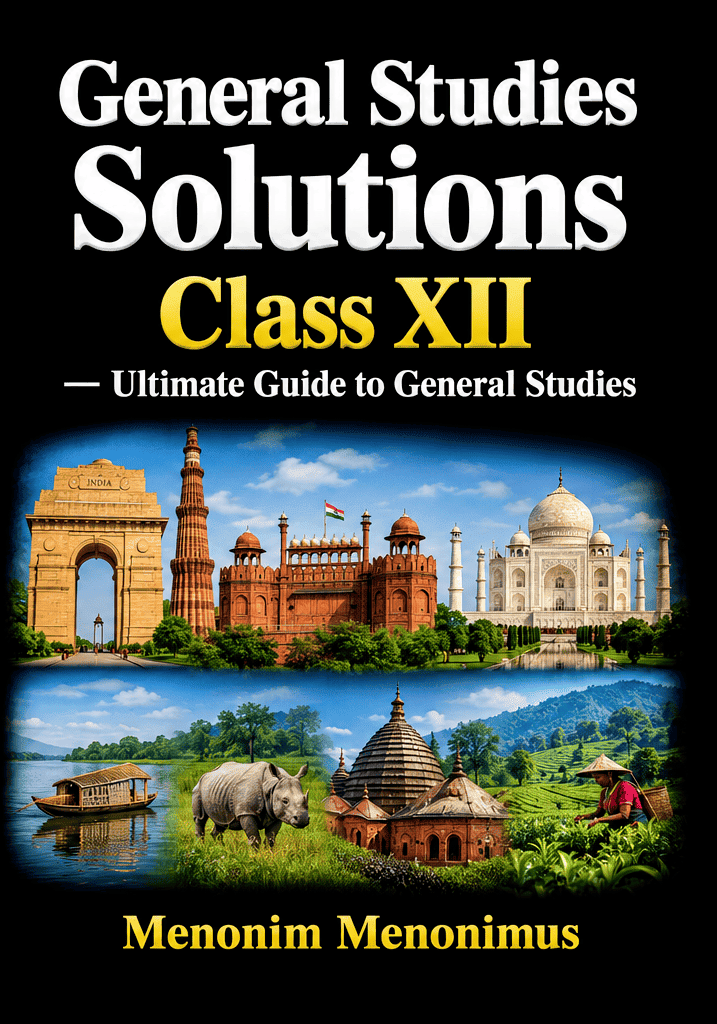
Class 12 General Studies Solutions
Class XII
Edited by
Menonim Menonimus
Menonimus Publishing
Copyright
Copyright © Menonim Menonimus
All rights reserved.
No part of this publication ‘General Studies’ may be reproduced, distributed, stored, transmitted, or used in any form or by any means—electronic, mechanical, photocopying, recording, scanning, or otherwise—without prior written permission from the copyright owner, except for brief quotations used for purposes such as review, criticism, or scholarly reference where permitted by applicable law.
This publication has been independently prepared by the author/publisher for educational and examination-preparation purposes.
Disclaimer
This book, General Studies Solutions, has been prepared for educational and examination-preparation purposes. Every reasonable effort has been made to ensure the accuracy and usefulness of the content, examples, formats, and exercises. However, requirements and conventions may vary among educational boards, examinations, and institutions. Readers are advised to follow the latest official guidelines applicable to them.
Preface
Education: Beyond Books, Towards a Brighter Future.
Knowledge is the light that guides us through life, but true education is much more than learning from textbooks or preparing for examinations. It awakens curiosity, builds character, broadens our horizons, and equips us to face the challenges of a changing world with confidence, wisdom, and responsibility. General Studies plays a vital role in this journey by combining knowledge, values, awareness, and practical skills to prepare students to become informed, responsible, and compassionate citizens.
Recognising the importance of holistic education, the Assam State School Education Board (ASSEB) has introduced General Studies as a compulsory subject for Class XII from the academic session 2026–2027 under its revised curriculum. The subject aims to develop scientific temper, strengthen constitutional values, promote environmental awareness, deepen appreciation of India’s rich cultural heritage, encourage entrepreneurship, enhance employability skills, and foster respect for human rights. It seeks not merely to educate students but also to prepare them for meaningful participation in society.
The subject carries 50 marks, assessed through written examination and project work. However, the marks are awarded in the form of grades and are not included in the overall examination result. The grading pattern is as follows:
Grade A: 80%–100% (40–50 marks)
Grade B: 60%–79% (30–39 marks)
Grade C: 40%–59% (20–29 marks)
Grade D: 0%–39% (0–19 marks)
Although these marks do not contribute to the overall examination result, the true significance of General Studies extends far beyond grades. Its real value lies in the awareness it creates, the values it nurtures, and the practical life skills it develops—qualities that help students grow into thoughtful individuals and responsible members of society.
To support comprehensive learning and effective examination preparation, the book includes Multiple Choice Questions (MCQs), Very Short Answer Questions, Long Answer Questions with solutions, and project work aligned with the NCERT syllabus. Its systematic presentation makes it a useful companion for classroom study, independent learning, examination preparation, and revision.
No book is ever beyond improvement. I warmly welcome constructive suggestions from teachers, students, and readers, whose valuable feedback will help make future editions more useful and effective. If this book succeeds in simplifying learning, broadening students’ understanding, and inspiring even a few young minds to become thoughtful, ethical, and responsible citizens, I shall consider my efforts truly worthwhile.
With best wishes to every student for success in learning, confidence in life, and a future filled with hope and opportunity.
Menonim Menonimus
Menonimus Publishing
Table of Contents
Chapter 1: North-East India and Its Neighbourhood
Chapter 2: Inculcation of Scientific Temper
Chapter 3: Cultural Heritage of India
Chapter 4: Importance of Co-curricular Activities (CCA)
Chapter 5: Indian Knowledge System
Chapter 6: Indian Constitution: Its Nature
Chapter 7: Nature and Environmental Conservation
Chapter 8: Commerce for Entrepreneurship Development
Chapter 9: Workforce Education and Employability Skills
Chapter 10: Human Rights
Sample Question Papers
Sample Question Paper-1
Sample Question Paper-2
Sample Question Paper-3
Chapter 1: North-East India and Its Neighbourhood
Questions with Solutions
A. Multiple-Choice Questions
- Which animal is notably associated with Kaziranga National Park?
(a) Asiatic lion
(b) Indian one-horned rhinoceros
(c) Snow leopard
(d) Blackbuck
Ans: (b) - Which traditional festival is celebrated in Mizoram?
(a) Chapchar Kut
(b) Bihu
(c) Hornbill Festival
(d) Wangala
Ans: (a) - Which state is popularly known as the ‘Land of the Rising Sun’ in India?
(a) Sikkim
(b) Assam
(c) Arunachal Pradesh
(d) Meghalaya
Ans: (c) - In which state is Mount Kanchenjunga located?
(a) Arunachal Pradesh
(b) Sikkim
(c) Nagaland
(d) Meghalaya
Ans: (b) - Which kingdom ruled Assam for approximately six centuries?
(a) Gupta Kingdom
(b) Ahom Kingdom
(c) Maurya Kingdom
(d) Mughal Empire
Ans: (b) - Which kingdom successfully resisted repeated Mughal invasions in Assam?
(a) Koch Kingdom
(b) Ahom Kingdom
(c) Tripura Kingdom
(d) Chutiya Kingdom
Ans: (b) - Which city is generally regarded as the largest urban centre in North-East India?
(a) Shillong
(b) Imphal
(c) Guwahati
(d) Agartala
Ans: (c) - Through which North-Eastern state does the Brahmaputra flow for a major part of its course in India?
(a) Mizoram
(b) Assam
(c) Tripura
(d) Nagaland
Ans: (b) - Which river system is another major river system of North-East India besides the Brahmaputra?
(a) Ganga
(b) Godavari
(c) Barak
(d) Narmada
Ans: (c) - In which state is Mawsynram located?
(a) Assam
(b) Meghalaya
(c) Manipur
(d) Mizoram
Ans: (b) - Which of the following countries share an international border with North-East India?
(a) Bangladesh
(b) Bhutan
(c) Myanmar
(d) All of these
Ans: (d) - Which country lies to the north of Arunachal Pradesh?
(a) Bhutan
(b) Bangladesh
(c) China
(d) Nepal
Ans: (c) - Kaziranga National Park is especially renowned for which animal?
(a) Tiger
(b) Indian one-horned rhinoceros
(c) Lion
(d) Red panda
Ans: (b) - In which state is Manas National Park situated?
(a) Assam
(b) Sikkim
(c) Meghalaya
(d) Tripura
Ans: (a) - Loktak Lake is located in which state?
(a) Assam
(b) Meghalaya
(c) Manipur
(d) Nagaland
Ans: (c) - The Sangai deer is the state animal of which state?
(a) Assam
(b) Manipur
(c) Mizoram
(d) Sikkim
Ans: (b) - Where is Tawang Monastery situated?
(a) Sikkim
(b) Arunachal Pradesh
(c) Meghalaya
(d) Nagaland
Ans: (b) - Which Indian state was the first to achieve fully organic status?
(a) Assam
(b) Meghalaya
(c) Sikkim
(d) Mizoram
Ans: (c) - In which state is the Hornbill Festival celebrated?
(a) Nagaland
(b) Tripura
(c) Assam
(d) Meghalaya
Ans: (a) - Bihu is the best-known festival of which state?
(a) Manipur
(b) Assam
(c) Mizoram
(d) Sikkim
Ans: (b) - Which state is famous for its living root bridges?
(a) Meghalaya
(b) Nagaland
(c) Tripura
(d) Assam
Ans: (a) - Which North-Eastern state is especially famous for tea production?
(a) Assam
(b) Sikkim
(c) Mizoram
(d) Manipur
Ans: (a) - Which Indian policy seeks to strengthen engagement with South-East Asia?
(a) Look West Policy
(b) Green India Policy
(c) Act East Policy
(d) Neighbourhood First Policy
Ans: (c) - For approximately how long did the Ahom Kingdom rule Assam?
(a) 200 years
(b) 400 years
(c) 600 years
(d) 800 years
Ans: (c) - Who among the following was a noted freedom fighter from North-East India?
(a) Rani Gaidinliu
(b) Bhagat Singh
(c) Bal Gangadhar Tilak
(d) Lala Lajpat Rai
Ans: (a) - Which neighbouring country shares the longest international boundary with the North-Eastern region of India?
(a) Nepal
(b) Bangladesh
(c) Sri Lanka
(d) Afghanistan
Ans: (b) - Which countries share international borders with Arunachal Pradesh?
(a) China
(b) Bhutan
(c) Myanmar
(d) All of these
Ans: (d) - Which country shares an international border with Nagaland?
(a) Nepal
(b) Myanmar
(c) Bangladesh
(d) Bhutan
Ans: (b) - Which North-Eastern state is bordered by Bangladesh on three sides?
(a) Assam
(b) Meghalaya
(c) Tripura
(d) Arunachal Pradesh
Ans: (c) - North-East India is often described as India’s what in relation to South-East Asia?
(a) Food Bowl
(b) Gateway to South-East Asia
(c) Industrial Belt
(d) Desert Region
Ans: (b) - Which activity is a major occupation across much of North-East India?
(a) Mining
(b) Agriculture
(c) Fishing
(d) Banking
Ans: (b) - Which industry has made Assam internationally well known?
(a) Cotton industry
(b) Tea industry
(c) Jute industry
(d) Sugar industry
Ans: (b) - Which important energy resource is found in significant quantities in Assam?
(a) Gold
(b) Petroleum
(c) Copper
(d) Uranium
Ans: (b) - North-East India is recognised as one of the world’s important what?
(a) Desert regions
(b) Biodiversity hotspots
(c) Industrial zones
(d) Mining belts
Ans: (b)
B. Very Short Answer-Type Questions
- What is meant by the ‘Chicken’s Neck’ of India?
Ans: It is the Siliguri Corridor, the narrow strip of land that connects North-East India with the rest of the country.
- Which North-Eastern state has the largest area?
Ans: Arunachal Pradesh.
- Name the principal river of North-East India.
Ans: The Brahmaputra River.
- Which state is called the ‘Land of the Rising Sun’?
Ans: Arunachal Pradesh.
- Which state is often called the gateway to North-East India?
Ans: Assam.
- Name any two countries neighbouring North-East India.
Ans: Bangladesh and Myanmar.
- Which state is particularly famous for tea production?
Ans: Assam.
- What is the capital of Meghalaya?
Ans: Shillong.
- Which national park is renowned for the Indian one-horned rhinoceros?
Ans: Kaziranga National Park.
- Name the lake in Manipur known for its floating phumdis.
Ans: Loktak Lake.
- Which state hosts the Hornbill Festival?
Ans: Nagaland.
- Which Indian state was the first to become fully organic?
Ans: Sikkim.
- Name one UNESCO World Heritage Site in Assam.
Ans: Kaziranga National Park.
- Which state is well known for living root bridges?
Ans: Meghalaya.
- Which river valley is central to Assam’s geography?
Ans: The Brahmaputra Valley.
- Why is North-East India strategically important?
Ans: It shares international borders with several countries and provides an important link in India’s engagement with South-East Asia.
- Which Government of India policy promotes stronger links with South-East Asia?
Ans: The Act East Policy.
- Name the two major river systems of North-East India.
Ans: The Brahmaputra and Barak river systems.
- Which state shares international borders with China, Bhutan, and Myanmar?
Ans: Arunachal Pradesh.
- Which North-Eastern state is almost surrounded by Bangladesh?
Ans: Tripura.
- What is a major occupation of people in North-East India?
Ans: Agriculture.
- Name one important natural resource found in Assam.
Ans: Petroleum.
- Which state is particularly known for its extensive bamboo resources and forests?
Ans: Mizoram is well known for its bamboo resources.
- What is the capital of Nagaland?
Ans: Kohima.
- Why is North-East India considered a biodiversity hotspot?
Ans: The region contains a great variety of plant and animal species and diverse ecosystems.
C. Short Answer-Type Questions
- Explain why North-East India is strategically important to India.
Ans: North-East India is strategically important because it shares international borders with Bangladesh, Bhutan, China, and Myanmar. Its location also makes it an important link between India and Southeast Asia. The region is significant for national security, border trade, connectivity, and regional cooperation.
- Mention four major features of North-East India.
Ans: (i) It comprises eight states, including Sikkim.
(ii) It has rich biodiversity and varied natural resources.
(iii) It is home to diverse cultures, languages, and traditions.
(iv) It shares international borders with several neighbouring countries.
- Write a brief note on the Ahom Kingdom.
Ans: The Ahom Kingdom ruled much of Assam for nearly six centuries. Its rulers resisted repeated Mughal invasions and played an important role in shaping the region’s political history, cultural traditions, and administration.
- List four important economic activities in North-East India.
Ans: (i) Agriculture
(ii) Tea cultivation
(iii) Petroleum and natural gas production
(iv) Tourism, handloom, and handicrafts
- How has the Government of India supported the development of North-East India?
Ans: The Government of India has supported the region through initiatives such as the Act East Policy and investments in roads, railways, airports, digital connectivity, tourism, and other infrastructure. These measures aim to improve connectivity and promote socio-economic development.
D. Long Answer-Type Questions (LAQs)
- Describe the geographical location and strategic importance of North-East India.
Ans: North-East India lies in the north-eastern part of the country and comprises eight states: Arunachal Pradesh, Assam, Manipur, Meghalaya, Mizoram, Nagaland, Sikkim, and Tripura. The region is connected to the rest of India through the Siliguri Corridor. It shares international borders with Bangladesh, Bhutan, China, and Myanmar; Nepal lies nearby to the west. This location gives the region considerable importance for national security, border management, international trade, and regional cooperation. It is also central to India’s Act East Policy and serves as an important land link between India and South-East Asia.
- Discuss the natural resources and economic importance of North-East India.
Ans: North-East India possesses varied natural resources, including forests, petroleum, natural gas, coal, limestone, bamboo, and abundant water resources. Agriculture remains a major source of livelihood, while the region is known for tea, rubber, spices, fruits, and other horticultural crops. Tourism, handloom, handicrafts, fisheries, and forest-based activities also support local livelihoods and economic growth. Sustainable use of these resources can create employment, strengthen local industries, and contribute to the region’s long-term development.
- Explain the historical heritage of North-East India and its contribution to India’s freedom struggle.
Ans: North-East India has a rich and diverse history associated with kingdoms such as the Ahom, Koch, Chutiya, Kachari, Manipur, and Tripura kingdoms. The Ahom rulers governed Assam for nearly six centuries and successfully resisted repeated Mughal invasions. People from the region also made important contributions to India’s freedom struggle. They included Maniram Dewan, Piyali Phukan, Kushal Konwar, Kanaklata Barua, Tirot Sing, and Rani Gaidinliu, among others. Since independence, the region has remained an integral part of India and has continued to develop through public initiatives, improved connectivity, and regional cooperation.
Practical-Based Assessment
Activities
On an outline map of India, locate and label all eight states of North-East India. Mark their capitals and identify the neighbouring countries that share international borders with the region. Then write two important facts about any two of the states.
Group Discussions
Discuss the topic, “Why is North-East India called the Gateway to South-East Asia?” Consider its strategic location, cultural diversity, natural resources, tourism potential, and the role of the Act East Policy in regional development. Present the main points of your group discussion to the class.
Project Work
- Explore the cultural and natural heritage of North-East India.
Collect pictures and information about any five tourist attractions or cultural landmarks in North-East India, such as Kaziranga National Park, Tawang Monastery, Loktak Lake, the living root bridges of Meghalaya, Cherrapunji, or Gangtok. Prepare a scrapbook or chart describing each place’s location, historical or cultural significance, tourism value, and importance for environmental conservation. 0 0 0
Chapter 2: Inculcation of Scientific Temper
Questions with Solutions
A. Multiple-Choice Questions
- What is meant by scientific temper?
(a) Blind acceptance of traditions
(b) Rational thinking based on observation and evidence
(c) Accepting religious beliefs without question
(d) Relying only on intuition
Ans: (b)
- Scientific temper encourages people to:
(a) Believe rumours
(b) Accept superstitions
(c) Question and verify facts
(d) Avoid logical thinking
Ans: (c)
- What is the foundation of scientific temper?
(a) Prejudice
(b) Blind faith
(c) Logic and evidence
(d) Emotions
Ans: (c)
- Which quality is essential for developing scientific temper?
(a) Curiosity
(b) Ignorance
(c) Fear
(d) Bias
Ans: (a)
- Scientific temper discourages:
(a) Critical thinking
(b) Observation
(c) Superstition
(d) Experimentation
Ans: (c)
- A scientifically minded person accepts a claim only after:
(a) It receives public approval
(b) Elders recommend it
(c) It is verified by evidence
(d) It matches personal preferences
Ans: (c)
- Article 51A(h) of the Constitution of India concerns:
(a) The Right to Education
(b) Fundamental Duties
(c) Directive Principles of State Policy
(d) Fundamental Rights
Ans: (b)
- According to Article 51A(h), citizens should develop:
(a) Patriotism alone
(b) Scientific temper, humanism, and the spirit of inquiry and reform
(c) Religious values alone
(d) Political awareness alone
Ans: (b)
- Which institution has a major role in developing scientific temper?
(a) Schools and educational institutions
(b) Banks
(c) Courts
(d) Industries
Ans: (a)
- Scientific temper helps people distinguish:
(a) Wealth from poverty
(b) Facts from misinformation
(c) Cities from villages
(d) Traditions from culture
Ans: (b)
- Which of the following is NOT a feature of scientific temper?
(a) Logical reasoning
(b) Critical thinking
(c) Blind belief
(d) Objectivity
Ans: (c)
- Scientific temper promotes:
(a) Innovation
(b) Rumours
(c) Intolerance
(d) Superstition
Ans: (a)
- Which is a benefit of scientific temper?
(a) Social discrimination
(b) Rational decision-making
(c) Blind acceptance
(d) Fear of change
Ans: (b)
- Artificial Intelligence (AI) is an example of:
(a) Ancient technology
(b) Contemporary technology
(c) Traditional knowledge
(d) None of these
Ans: (b)
- The Internet of Things (IoT) refers to:
(a) Internet banking alone
(b) Interconnected smart devices
(c) Television broadcasting
(d) Satellite communication alone
Ans: (b)
- Which technology is widely used in weather forecasting?
(a) Satellites
(b) Typewriters
(c) Telegraphs
(d) Radio alone
Ans: (a)
- Which sector has benefited greatly from telemedicine?
(a) Agriculture
(b) Healthcare
(c) Tourism
(d) Banking
Ans: (b)
- Technology has improved governance through:
(a) E-governance
(b) Manual records alone
(c) Postal services alone
(d) None of these
Ans: (a)
- Scientific temper contributes to:
(a) Environmental conservation
(b) Environmental degradation
(c) Wastage of resources
(d) Deforestation
Ans: (a)
- Which is essential for sustainable development?
(a) Excessive resource use
(b) A scientific approach
(c) Unrestrained exploitation of nature
(d) Ignoring environmental problems
Ans: (b)
- Which of the following is an example of cybercrime?
(a) Planting trees
(b) Phishing
(c) Blood donation
(d) Vaccination
Ans: (b)
- Identity theft is a form of:
(a) Social reform
(b) Cybercrime
(c) Environmental pollution
(d) A public health programme
Ans: (b)
- Which practice improves cyber safety?
(a) Sharing passwords
(b) Clicking unknown links
(c) Using strong passwords
(d) Ignoring software updates
Ans: (c)
- Scientific temper is essential because it:
(a) Promotes superstition
(b) Encourages evidence-based thinking
(c) Discourages inquiry
(d) Promotes prejudice
Ans: (b)
- The ultimate aim of developing scientific temper is to build:
(a) A superstitious society
(b) A progressive and responsible society
(c) A society guided by rumours
(d) A technologically backward society
Ans: (b)
- Which action best reflects scientific temper?
(a) Accepting claims without checking them
(b) Making decisions based on logic and evidence
(c) Following traditions blindly
(d) Believing rumours
Ans: (b)
- Which activity helps develop scientific temper among students?
(a) Rote learning alone
(b) Laboratory experiments and project work
(c) Memorising without understanding
(d) Avoiding discussions
Ans: (b)
- Which is an important quality of a scientifically minded person?
(a) Open-mindedness
(b) Prejudice
(c) Intolerance
(d) Blind obedience
Ans: (a)
- Scientific temper enables people to:
(a) Spread misinformation
(b) Solve problems rationally
(c) Reject scientific discoveries
(d) Ignore evidence
Ans: (b)
- Which is a major contribution of biotechnology?
(a) Improved crop varieties
(b) Postal communication
(c) Railway transport
(d) Printing technology
Ans: (a)
B. Very Short Answer-Type Questions
Q1. What is scientific temper?
Ans: Scientific temper is a rational way of thinking based on observation, logic, experimentation, and evidence.
Q2. What is the main objective of scientific temper?
Ans: Its main objective is to develop rational thinking and encourage decisions based on facts and evidence.
Q3. What is meant by the spirit of inquiry?
Ans: It is the habit of asking questions, investigating facts, and seeking logical explanations.
Q4. Which Article of the Constitution of India promotes scientific temper?
Ans: Article 51A(h).
Q5. Under which part of the Constitution is Article 51A(h) included?
Ans: It is included among the Fundamental Duties in Part IVA of the Constitution.
Q6. What is humanism?
Ans: Humanism emphasises human dignity, equality, compassion, and well-being.
Q7. Name two characteristics of scientific temper.
Ans: Curiosity and critical thinking.
Q8. What is evidence-based thinking?
Ans: It is the practice of forming conclusions after examining and verifying relevant evidence.
Q9. What is scientific literacy?
Ans: Scientific literacy is the ability to understand scientific ideas and apply scientific knowledge in everyday life.
Q10. What is sustainable development?
Ans: Sustainable development meets present needs without compromising the ability of future generations to meet their own needs.
Q11. How does scientific temper benefit society?
Ans: It promotes rational thinking, innovation, and social progress.
Q12. What is Artificial Intelligence (AI)?
Ans: Artificial Intelligence is the ability of computer systems or machines to perform tasks that normally require human intelligence.
Q13. What is the Internet of Things (IoT)?
Ans: The IoT is a network of physical devices connected to the internet that can collect and exchange data.
Q14. What is biotechnology?
Ans: Biotechnology uses living organisms, cells, or biological processes to develop useful products and applications.
Q15. What is e-governance?
Ans: E-governance is the use of digital technologies to deliver government services and improve public administration.
C. Short Answer-Type Questions (2 Marks Each)
Q1. What is scientific temper?
Ans: Scientific temper is a rational approach to thinking based on observation, logic, and evidence. It encourages people to question claims, analyse information, and verify facts rather than accept beliefs blindly.
Q2. Mention any two characteristics of scientific temper.
Ans: (i) Curiosity: asking questions and seeking knowledge.
(ii) Critical thinking: examining facts logically before reaching a conclusion.
Q3. State two uses of technology in contemporary society.
Ans: (i) In education, technology supports online learning and digital classrooms.
(ii) In healthcare, telemedicine and advanced diagnostic tools help improve access to medical services.
Q4. Mention two measures to protect oneself from cybercrime.
Ans: (i) Use strong, unique passwords and enable two-factor authentication where available.
(ii) Avoid suspicious links and do not share personal information with unverified sources.
Q5. Why is scientific temper important for national development?
Ans: Scientific temper encourages innovation, rational decision-making, and responsible citizenship. It also supports sustainable development and technological progress, contributing to the country’s overall development.
D. Long Answer-Type Questions (3–4 Marks Each)
Q1. What is scientific temper? Explain its importance in modern society.
Ans: Scientific temper is a rational approach to thinking based on observation, logic, experimentation, and evidence. It encourages people to question claims, analyse information, and verify facts instead of accepting beliefs blindly. It is important because it promotes critical thinking, innovation, and informed decision-making. It helps people recognise superstition and misinformation, supports sustainable development, and encourages the responsible use of science and technology for social progress.
Q2. Explain the role of education in developing scientific temper.
Ans: Education plays a vital role in developing scientific temper by encouraging students to reason logically, ask questions, and investigate claims. Classroom discussions, laboratory experiments, project work, and scientific activities nurture curiosity, observation, and critical thinking. Teachers can help students understand concepts instead of relying only on memorisation, while families can encourage reading, observation, and inquiry. In this way, education helps prepare responsible citizens who think scientifically.
Q3. Discuss four uses of technology in contemporary society.
Ans: Technology is essential in many areas of modern life. In education, it supports online learning and digital classrooms. In healthcare, telemedicine and diagnostic technologies can improve access to medical services. In agriculture, improved irrigation systems, weather forecasts, and biotechnology can support productivity. In governance, e-governance can make public services more accessible and transparent. These applications can improve quality of life and contribute to national development.
Practical-Based Assessment
Activities
- Identifying Scientific Thinking
Objective: To distinguish scientific thinking from superstition and blind belief.
Instructions: Read each situation and decide whether it demonstrates scientific temper or superstition. Give a reason for each response.
(a) A student checks information before sharing it on social media.
(b) A person refuses vaccination because of rumours.
(c) A farmer consults weather forecasts before sowing seeds.
(d) A family consults a doctor rather than relying on unverified remedies for a serious illness.
- Technology in Daily Life
Objective: To understand the role of technology in everyday life.
Instructions: Prepare a table of five technologies used in daily life. For each one, state (i) the technology, (ii) its use, and (iii) one benefit it provides to society.
Group Work
- Science for Social Development
Form groups of four or five students. Prepare a chart showing how science and technology have improved any four of these sectors:
(a) Education
(b) Healthcare
(c) Agriculture
(d) Communication
(e) Transportation
(f) Environmental conservation
Present your findings to the class.
- Cyber Safety Awareness
Work in groups to prepare a “Cyber Safety Guide for Students.” Include:
(a) Common cyber threats
(b) Safe online practices
(c) Password-safety tips
(d) Precautions when using social media
Display your guide on the classroom noticeboard.
Group Discussions
- “Scientific temper is more important today than ever before.”
Discuss this statement by explaining the importance of scientific temper in everyday life and national development.
- “Technology: A Boon or a Challenge?”
Discuss both the positive and negative effects of modern technology. Give suitable examples and suggest ways to ensure that technology is used responsibly.
Project Work
Project 1: Scientific Temper in Everyday Life
Observe your home, school, or neighbourhood and identify at least five examples of scientific temper in everyday life. Write a report of 500–700 words explaining how these practices improve health, safety, efficiency, or environmental conservation. Add relevant photographs or illustrations where possible. 0 0 0
Chapter 3: Cultural Heritage of India
Questions with Solutions
A. Multiple Choice Questions (Each 1 Mark)
- Which of the following best describes cultural heritage?
(a) Only historical monuments
(b) Only religious traditions
(c) The tangible and intangible inheritance of a society
(d) Only artistic achievements
Ans: (c) The tangible and intangible inheritance of a society
- Which of the following is an example of intangible cultural heritage?
- a) A fort
(b) A temple
(c) A manuscript
(d) A traditional folk song
Ans: (d) A traditional folk song
- The Indus Valley Civilisation is particularly noted for its achievements in:
(a) Parliamentary democracy
(b) Urban planning and drainage
(c) Modern industrial production
(d) Printing technology
Ans: (b) Urban planning and drainage
- Which of the following contributed significantly to the development of Indian philosophical traditions?
(a) The Vedas and Upanishads
(b) The Arthashastra alone
(c) Medieval travel accounts alone
(d) Modern scientific journals
Ans: (a) The Vedas and Upanishads
- Which two traditions played an important role in promoting devotion and interaction among different social communities during the medieval period?
(a) Bhakti and Sufi traditions
(b) Vedic and Mauryan traditions
(c) Jain and Gupta traditions
(d) Buddhist and colonial traditions
Ans: (a) Bhakti and Sufi traditions
- Which of the following is the most appropriate meaning of “Unity in Diversity” in the Indian context?
(a) Elimination of all regional cultures
(b) Cultural uniformity throughout India
(c) Coexistence of diverse cultures within a common national framework
(d) Separation of different cultural communities
Ans: (c) Coexistence of diverse cultures within a common national framework
- Which of the following can best contribute to the removal of social barriers?
(a) Cultural isolation
(b) Mutual understanding and respect
(c) Cultural superiority
(d) Social exclusion
Ans: (b) Mutual understanding and respect
- Why should cultural heritage not be accepted uncritically?
(a) All traditions are outdated
(b) Some traditional practices may promote discrimination or inequality
(c) Cultural traditions have no historical value
(d) Modern society does not need culture
Ans: (b) Some traditional practices may promote discrimination or inequality
- Which of the following is essential for equality of sexes?
(a) Equal opportunities and dignity
(b) Cultural uniformity
(c) Social separation
(d) Restriction of education
Ans: (a) Equal opportunities and dignity
- Which of the following is a classical dance tradition of Assam?
(a) Kathak
(b) Bharatanatyam
(c) Sattriya
(d) Odissi
Ans: (c) Sattriya
- Which of the following pairs is correctly matched?
(a) Sattriya — Assam
(b) Kathakali — Punjab
(c) Bharatanatyam — Rajasthan
(d) Odissi — Gujarat
Ans: (a) Sattriya — Assam
- Which of the following is an example of tangible cultural heritage?
(a) Folk song
(b) Oral tradition
(c) Historical monument
(d) Traditional knowledge
Ans: (c) Historical monument
- Which of the following is most directly associated with the preservation of historical and archaeological heritage in India?
(a) Archaeological Survey of India
(b) Election Commission of India
(c) Reserve Bank of India
(d) Finance Commission
Ans: (a) Archaeological Survey of India
- Which of the following is a major threat to India’s cultural heritage?
(a) Heritage education
(b) Community participation
(c) Pollution and neglect
(d) Cultural documentation
Ans: (c) Pollution and neglect
- How can cultural heritage contribute to economic development?
(a) By discouraging tourism
(b) Through tourism, handicrafts and creative activities
(c) By eliminating traditional occupations
(d) Through cultural isolation
Ans: (b) Through tourism, handicrafts and creative activities
- Which of the following is most important for the preservation of intangible cultural heritage?
(a) Preventing younger generations from learning traditions
(b) Documentation and transmission to future generations
(c) Replacing all traditional practices with modern ones
(d) Restricting cultural activities to museums
Ans: (b) Documentation and transmission to future generations
- What is the most appropriate relationship between cultural heritage and national identity?
(a) Cultural heritage weakens national identity
(b) Cultural heritage helps connect people with their historical and cultural roots
(c) National identity requires the rejection of regional cultures
(d) Cultural heritage is unrelated to national identity
Ans: (b) Cultural heritage helps connect people with their historical and cultural roots
- Which of the following best explains why cultural diversity does not necessarily weaken national unity?
(a) Diversity can coexist with common constitutional and national values
(b) Diversity eliminates national identity
(c) Different cultures must remain isolated
(d) National unity requires cultural uniformity
Ans: (a) Diversity can coexist with common constitutional and national values
- Which of the following is an important role of education in preserving cultural heritage?
(a) It disconnects students from their traditions
(b) It helps students understand and transmit cultural knowledge
(c) It prevents cultural interaction
(d) It discourages historical study
Ans: (b) It helps students understand and transmit cultural knowledge
- Which of the following is NOT a desirable approach to cultural heritage?
(a) Critical appreciation
(b) Preservation of valuable traditions
(c) Protection of discriminatory practices merely because they are old
(d) Transmission of cultural knowledge
Ans: (c) Protection of discriminatory practices merely because they are old
- Which of the following most directly promotes national integration through cultural heritage?
(a) Appreciation of the cultural contributions of different communities
(b) Rejection of regional identities
(c) Promotion of cultural superiority
(d) Social segregation
Ans: (a) Appreciation of the cultural contributions of different communities
- Which of the following is a significant responsibility of young people towards cultural heritage? (a) Ignoring traditional knowledge
(b) Learning, documenting and promoting valuable traditions
(c) Rejecting all traditional practices (d) Preserving only foreign cultural influences
Ans: (b) Learning, documenting and promoting valuable traditions
- Which statement best reflects the role of cultural heritage in nation building?
(a) It is useful only for entertainment
(b) It can strengthen shared values, social harmony and historical consciousness
(c) It prevents social reform
(d) It requires cultural uniformity
Ans: (b) It can strengthen shared values, social harmony and historical consciousness
- Which of the following represents a balanced approach to cultural heritage?
(a) Preserve everything without question
(b) Reject everything associated with the past
(c) Preserve valuable traditions while reforming harmful practices
(d) Replace regional cultures with a single culture
Ans: (c) Preserve valuable traditions while reforming harmful practices
- What is the central idea underlying the preservation of India’s cultural heritage?
(a) To prevent all social change
(b) To glorify only the past
(c) To preserve valuable cultural achievements while promoting an inclusive and progressive society
(d) To establish cultural uniformity
Ans: (c) To preserve valuable cultural achievements while promoting an inclusive and progressive society
B. Very Short Answer Type Questions (Each 1 Mark)
- What is meant by cultural heritage?
Ans: Cultural heritage refers to the tangible and intangible cultural inheritance passed from one generation to another.
- What are the two broad categories of cultural heritage?
Ans: The two broad categories are tangible cultural heritage and intangible cultural heritage.
- Give one example of tangible cultural heritage.
Ans: A historical monument is an example of tangible cultural heritage.
- Give one example of intangible cultural heritage.
Ans: A traditional folk song is an example of intangible cultural heritage.
- Why is India described as a land of cultural diversity?
Ans: India is described as a land of cultural diversity because it has numerous languages, religions, customs, traditions, art forms and lifestyles.
- What is meant by “Unity in Diversity”?
Ans: It means the coexistence of diverse cultural identities within a common national framework.
- How can cultural heritage promote social integration?
Ans: It promotes social integration by encouraging mutual understanding, respect and interaction among different communities.
- How can cultural heritage contribute to the removal of social barriers?
Ans: It can reduce social barriers by promoting shared values, mutual respect and understanding among different social groups.
- Why should cultural heritage be critically examined?
Ans: It should be critically examined because some inherited practices may promote discrimination, inequality or social exclusion.
- Mention one contribution of the Bhakti and Sufi traditions to Indian society.
Ans: They promoted devotion, love, spiritual equality and interaction among different communities.
- Why is equality of sexes important in relation to cultural heritage?
Ans: It ensures that cultural traditions are preserved and interpreted without discrimination against women or men.
- Name one classical dance form associated with Assam.
Ans: Sattriya.
- Name one institution responsible for the conservation of India’s archaeological heritage.
Ans: The Archaeological Survey of India.
- Mention one major threat to India’s cultural heritage.
Ans: Pollution is a major threat to India’s cultural heritage.
- How does education help preserve cultural heritage?
Ans: Education helps transmit knowledge of cultural traditions, history, languages and arts to younger generations.
- Why are young people important in preserving intangible cultural heritage?
Ans: Young people are important because they can learn, practise, document and transmit traditional knowledge to future generations.
- How can cultural heritage contribute to tourism?
Ans: Historical monuments, cultural festivals, traditional arts and heritage sites can attract tourists and generate economic activity.
- Why is cultural heritage important for national identity?
Ans: It connects people with their historical roots and strengthens their sense of identity and belonging.
- What is the relationship between cultural diversity and national unity?
Ans: Cultural diversity can strengthen national unity when different cultural identities coexist with common national and constitutional values.
- Mention one way in which globalisation can affect cultural heritage.
Ans: Globalisation may contribute to the decline of traditional languages, crafts, folk arts and customs.
- Why is community participation important in heritage preservation?
Ans: Local communities possess valuable knowledge and traditions and can actively protect and transmit their cultural heritage.
- How can cultural heritage contribute to nation building?
Ans: It can strengthen shared values, social harmony, historical consciousness and collective responsibility.
- Why should harmful cultural practices not be preserved merely because they are traditional?
Ans: Harmful practices should not be preserved because tradition cannot justify discrimination, inequality or violation of human dignity.
- What is the main difference between cultural preservation and cultural stagnation?
Ans: Cultural preservation protects valuable traditions, whereas cultural stagnation prevents necessary social change and reform.
- What is the ultimate purpose of preserving India’s cultural heritage?
Ans: The ultimate purpose is to preserve valuable cultural achievements and use them to build an inclusive, harmonious and progressive society.
C. Short Answer Type Questions (Each 2 Marks)
- What is cultural heritage? Explain its two main categories.
Ans: Cultural heritage refers to the traditions, customs, knowledge, values, artistic expressions, monuments and other achievements inherited from previous generations. It is broadly divided into tangible heritage, such as monuments, forts and sculptures, and intangible heritage, such as languages, music, dance, traditions and traditional knowledge.
- Why is India known for its rich cultural heritage?
Ans: India has a long history of thousands of years during which different civilizations, religions, languages and communities interacted with one another. This interaction produced a rich variety of literature, philosophy, architecture, music, dance, festivals, crafts, traditions and knowledge systems.
- Explain the significance of “Unity in Diversity” in India.
Ans: Unity in diversity means that people with different languages, religions, customs and traditions can live together within a common national framework. It strengthens national integration by encouraging mutual respect while allowing different cultural identities to flourish.
- How does cultural heritage help in removing social barriers?
Ans: Cultural heritage provides opportunities for people from different communities to interact through festivals, music, literature, art and cultural programmes. Such interaction promotes mutual understanding and reduces prejudice, discrimination and social distance.
- How did the Bhakti and Sufi traditions contribute to social harmony?
Ans: The Bhakti and Sufi traditions emphasised devotion, love, compassion and spiritual equality. They often challenged social divisions and communicated their ideas through languages understood by ordinary people, thereby encouraging interaction among different communities.
- Why is critical understanding necessary for the preservation of cultural heritage?
Ans: Not every traditional practice is necessarily beneficial or just. Some practices may promote discrimination or inequality. Therefore, valuable traditions should be preserved while harmful practices should be reformed or rejected in accordance with human dignity and equality.
- Explain the importance of equality of sexes in cultural development.
Ans: Equality of sexes ensures that men and women have equal dignity, rights and opportunities. Recognising women’s contributions to literature, science, art, politics and social reform makes cultural development more inclusive and promotes a just society.
- How does education contribute to the preservation of cultural heritage?
Ans: Education familiarises students with India’s history, languages, literature, arts, traditions and knowledge systems. It enables younger generations to understand, appreciate, practise and transmit valuable cultural heritage.
- How can cultural heritage contribute to economic development?
Ans: Cultural heritage can support tourism, handicrafts, traditional industries and creative activities. Historical sites, cultural festivals and traditional crafts can create employment opportunities and generate income for local communities.
- Explain the role of cultural heritage in nation building.
Ans: Cultural heritage strengthens historical consciousness, social harmony and a sense of collective identity. By promoting shared values while respecting diversity, it contributes to national integration and helps build an inclusive and progressive nation.
D. Long Answer Type Questions (Each 3-4 Marks
- Explain the importance of India’s cultural heritage in maintaining unity in diversity.
Ans: India’s cultural heritage is a product of thousands of years of interaction among different communities, religions, languages and regional traditions. It is reflected in India’s diverse festivals, literature, music, dance, architecture, customs and languages. Despite these differences, people share a common national identity and constitutional values. Cultural heritage encourages people to appreciate the traditions of other communities and promotes mutual respect and understanding. Thus, India’s cultural diversity becomes a source of strength rather than division. The idea of unity in diversity helps maintain national integration while allowing different cultural identities to flourish.
- How can cultural heritage contribute to the removal of social barriers and the promotion of equality of sexes?
Ans: Cultural heritage can help remove social barriers by bringing people from different communities together through festivals, literature, music, art and cultural activities. The Bhakti and Sufi traditions, for example, emphasised love, devotion and spiritual equality and helped challenge certain social divisions. Cultural heritage also includes the achievements of women in literature, philosophy, science, art, politics and social reform. Recognising these contributions promotes respect for women and supports equality of the sexes. However, harmful traditions that promote discrimination or inequality should be reformed or rejected. Thus, cultural heritage should be used to promote human dignity, equality and social harmony.
- Discuss the role of cultural heritage in nation building.
Ans: Cultural heritage plays an important role in nation building by connecting people with their history, traditions and collective identity. It strengthens historical consciousness and creates a sense of belonging to the nation. India’s diverse cultural traditions can promote mutual respect, social harmony and national integration when they are appreciated equally. Cultural heritage also contributes to education, tourism, handicrafts and creative industries, thereby supporting economic development. However, nation building requires both preservation and reform. Valuable traditions should be protected, while practices that promote discrimination or violate human dignity should be changed. Therefore, cultural heritage can help build an inclusive, harmonious and progressive nation.
- Explain the major threats to India’s cultural heritage and suggest measures for its preservation.
Ans: India’s cultural heritage faces several threats, including pollution, rapid urbanisation, neglect, encroachment, commercialisation, insensitive tourism and the decline of traditional languages and crafts. Historical monuments may be damaged, while intangible traditions may disappear when younger generations stop learning them. Effective preservation requires proper conservation of monuments and archaeological sites, documentation of traditional knowledge, promotion of cultural education and support for traditional artists and craftspeople. Museums, archives and digital technology can also help preserve cultural materials. Most importantly, local communities and young people should actively participate in heritage preservation. A balance between modern development and cultural conservation is essential.
- Explain how the preservation of cultural heritage can promote social integration and national development.
Ans: Cultural heritage provides a common platform through which people from different regions, religions and communities can interact and understand one another. Shared cultural experiences, festivals, literature, music, art and historical traditions can reduce prejudice and strengthen social harmony. Cultural heritage also contributes to education, tourism, handicrafts and creative industries, creating employment and supporting local economies. It strengthens national identity while respecting regional diversity. At the same time, preservation should be accompanied by critical thinking so that discriminatory or harmful practices are not continued merely because they are traditional. Therefore, responsible preservation of cultural heritage can promote social integration, economic development and nation building.
Practical-Based Assessment
Activities
- Heritage Identification
Objective: To help students identify and classify different forms of Indian cultural heritage.
Instructions:
- Divide the class into small groups.
- Give each group pictures or names of different cultural elements such as monuments, festivals, dances, languages, crafts and traditional practices.
- Ask students to classify them as tangible or intangible cultural heritage.
- Each group should explain the reasons for its classification.
- Discuss how each cultural element contributes to India’s cultural identity.
Expected Learning Outcome: Students will understand the difference between tangible and intangible cultural heritage and appreciate India’s cultural diversity.
- Cultural Heritage Around Us
Objective: To encourage students to identify and document local cultural heritage.
Instructions:
- Ask students to identify three cultural traditions, historical places, folk arts, crafts, festivals or traditional practices found in their locality.
- Students should collect basic information about each one from elders, books or reliable sources.
- They should prepare a short written description of each cultural element.
- Students may present their findings before the class.
- Discuss ways in which these cultural elements can be preserved for future generations.
Expected Learning Outcome: Students will develop awareness of their local cultural heritage and understand their responsibility towards its preservation.
Group Works
- Unity in Diversity
Objective: To understand how cultural diversity strengthens Indian unity.
Instructions:
- Divide the class into groups of 4–6 students.
- Assign each group a different region of India.
- Ask each group to collect information about the region’s language, food, dress, festivals, music, dance and traditional arts.
- Each group should prepare a chart showing the distinctive cultural features of its assigned region.
- Groups should present their charts to the class.
- Finally, discuss the similarities and differences among the regions.
Expected Learning Outcome: Students will understand that regional diversity can coexist with national unity.
- Heritage Preservation Plan
Objective: To develop problem-solving skills related to cultural heritage preservation.
Instructions:
- Divide students into groups.
- Ask each group to select one cultural heritage site or tradition that requires protection.
- Identify the major threats to its preservation.
- Prepare a practical plan for protecting and promoting it.
- The plan may include education, documentation, community participation, responsible tourism and the use of digital technology.
- Each group should present its plan to the class.
Expected Learning Outcome: Students will understand the challenges of heritage preservation and develop practical solutions.
Group Discussions
- “Is Every Tradition Worth Preserving?”
Discussion Points:
Students should discuss whether every traditional practice should be preserved simply because it is old. They should consider the difference between valuable traditions and harmful practices. The discussion should focus on equality, human dignity, social justice and the need for responsible cultural preservation.
Expected Learning Outcome: Students will develop critical thinking and understand that cultural heritage should be preserved with both respect and critical judgement.
- “Cultural Diversity: Strength or Challenge?”
Discussion Points:
Students should discuss whether India’s diversity of languages, religions, customs and traditions is a strength or a challenge. They should consider the importance of mutual respect, constitutional values, national integration and cultural tolerance.
Expected Learning Outcome: Students will understand the relationship between cultural diversity, unity in diversity and nation building.
Project Work
Project 1: Documentation of Local Cultural Heritage
Title: “Our Local Cultural Heritage”
Objective: To document and preserve information about an important cultural tradition, place, art form, craft, festival or practice of the local area.
Instructions:
- Select one important element of local cultural heritage.
- Collect information through books, newspapers, interviews with knowledgeable people and reliable sources.
- Describe its historical background and cultural significance.
- Explain how it is practised or preserved today.
- Identify the major threats to its survival.
- Suggest practical measures for its preservation.
- Include photographs, drawings or other relevant materials wherever possible.
- Present the completed project before the class.
Expected Outcome: Students will develop research skills and become aware of the importance of preserving local cultural heritage.
Project 2: “Unity in Diversity: A Study of Indian Culture”
Objective: To study the diversity of Indian culture and understand how it contributes to national unity.
Instructions:
- Select four different regions of India.
- Collect information about their languages, festivals, food, dress, music, dance, literature and traditional arts.
- Prepare a comparative table showing their major cultural features.
- Identify common values or cultural features that connect these diverse regions.
- Explain how cultural diversity contributes to unity in India.
- Discuss how cultural heritage can help remove social barriers, promote equality of sexes and contribute to nation building.
- Add suitable photographs, illustrations or maps.
- Present the project to the class.
Expected Outcome: Students will develop an appreciation of India’s cultural diversity and understand its importance in promoting social harmony, national integration and nation building.
0 0 0
Chapter 4: Importance of Co-curricular Activities (CCA)
Questions with Solutions
A. Multiple Choice Questions (Each 1 Mark)
- What is the primary purpose of co-curricular activities?
(a) To replace classroom teaching
(b) To promote only physical development
(c) To support the all-round development of students
(d) To reduce the importance of academic learning
Ans: (c) To support the all-round development of students
- Which statement best explains the meaning of co-curricular activities?
(a) Activities unrelated to education
(b) Activities conducted alongside the academic curriculum to support educational development
(c) Activities conducted only during holidays
(d) Activities intended only for talented students
Ans: (b) Activities conducted alongside the academic curriculum to support educational development
- Which of the following is NOT normally considered a co-curricular activity?
(a) Debate
(b) Recitation
(c) Classroom lecture on a prescribed chapter
(d) Drama
Ans: (c) Classroom lecture on a prescribed chapter
- Which of the following is a major difference between curricular and co-curricular activities?
(a) Curricular activities are academic, while co-curricular activities complement academic learning through practical experiences.
(b) Curricular activities are compulsory, while co-curricular activities have no educational value.
(c) Curricular activities develop only physical skills.
(d) Co-curricular activities are unrelated to education.
Ans: (a) Curricular activities are academic, while co-curricular activities complement academic learning through practical experiences.
- Which quality is most directly developed when students organise and lead a school programme?
(a) Leadership
(b) Memorisation
(c) Silence
(d) Dependence
Ans: (a) Leadership
- Which co-curricular activity is particularly associated with discipline, leadership and national responsibility?
(a) NCC
(b) Recitation
(c) Painting
(d) Essay writing
Ans: (a) NCC
- What does NCC stand for?
(a) National Cultural Council
(b) National Cadet Corps
(c) National Community Corps
(d) National Character Council
Ans: (b) National Cadet Corps
- Which organisation primarily provides opportunities for students to participate in community service?
(a) NCC
(b) NSS
(c) Scouts and Guides
(d) Literary Club
Ans: (b) NSS
- What does NSS stand for?
(a) National Social Service
(b) National Service Scheme
(c) National Student Society
(d) National Support Scheme
Ans: (b) National Service Scheme
- Which of the following is most closely associated with Scouts and Guides?
(a) Self-reliance and service
(b) Commercial training
(c) Competitive examination preparation
(d) Political campaigning
Ans: (a) Self-reliance and service
- Which activity is most directly useful for developing voice modulation and expressive ability?
(a) Recitation
(b) Gardening
(c) Drill
(d) Painting
Ans: (a) Recitation
- Debate primarily develops which combination of abilities?
(a) Critical thinking and communication
(b) Physical strength and endurance
(c) Drawing and painting
(d) Musical rhythm and coordination
Ans: (a) Critical thinking and communication
- Which activity most directly develops imagination through acting and character portrayal?
(a) Drama
(b) NCC
(c) Debate
(d) Sports
Ans: (a) Drama
- Which of the following is an important benefit of dance?
(a) Physical coordination and artistic expression
(b) Only memorisation
(c) Only written communication
(d) Reduction of social interaction
Ans: (a) Physical coordination and artistic expression
- Which co-curricular activity can particularly develop concentration, rhythm and emotional expression?
(a) Music
(b) Debate
(c) NSS
(d) Scouting
Ans: (a) Music
- Which of the following best explains the educational value of sports?
(a) They develop only physical strength.
(b) They develop fitness along with discipline, teamwork and perseverance.
(c) They reduce the need for academic learning.
(d) They are useful only for professional athletes.
Ans: (b) They develop fitness along with discipline, teamwork and perseverance.
- Which quality is commonly developed through group activities?
(a) Team spirit
(b) Social isolation
(c) Individual dependence
(d) Indifference
Ans: (a) Team spirit
- How do co-curricular activities contribute to communication skills?
(a) By limiting students’ interaction
(b) By providing opportunities for speaking, listening, presentation and expression
(c) By discouraging public performance
(d) By focusing only on written examinations
Ans: (b) By providing opportunities for speaking, listening, presentation and expression
- Which activity is most suitable for developing public-speaking confidence?
(a) Debate
(b) Gardening
(c) Drawing
(d) Silent reading
Ans: (a) Debate
- Which of the following is an important function of literary activities?
(a) Developing language proficiency and creativity
(b) Preventing students from reading
(c) Reducing analytical thinking
(d) Promoting physical fitness alone
Ans: (a) Developing language proficiency and creativity
- Which of the following is an example of a literary co-curricular activity?
(a) Poetry writing
(b) Drill practice
(c) Tree plantation
(d) Marching
Ans: (a) Poetry writing
- What is one important contribution of cultural activities?
(a) They promote appreciation of cultural diversity.
(b) They discourage cultural interaction.
(c) They replace academic education.
(d) They promote social separation.
Ans: (a) They promote appreciation of cultural diversity.
- How can co-curricular activities promote national integration?
(a) By encouraging students to remain within their own communities
(b) By bringing students from different backgrounds together
(c) By discouraging cultural diversity
(d) By promoting cultural superiority
Ans: (b) By bringing students from different backgrounds together
- Which activity is particularly associated with community awareness and social responsibility?
(a) NSS
(b) Debate
(c) Dance
(d) Music
Ans: (a) NSS
- Which of the following is a likely outcome of participation in NCC?
(a) Increased discipline and leadership
(b) Reduced sense of responsibility
(c) Social isolation
(d) Avoidance of teamwork
Ans: (a) Increased discipline and leadership
- Which of the following is a major contribution of Scouts and Guides?
(a) Development of self-reliance and service-mindedness
(b) Promotion of individualism without responsibility
(c) Avoidance of outdoor activities
(d) Reduction of teamwork
Ans: (a) Development of self-reliance and service-mindedness
- Which activity provides students with an opportunity to understand different characters and perspectives?
(a) Drama
(b) Drill
(c) Athletics
(d) Quiz
Ans: (a) Drama
- Why are co-curricular activities important for emotional development?
(a) They provide healthy opportunities for expression and interpersonal learning.
(b) They prevent students from interacting with others.
(c) They eliminate all competition.
(d) They focus only on academic performance.
Ans: (a) They provide healthy opportunities for expression and interpersonal learning.
- Which of the following best illustrates the development of time-management skills through CCAs?
(a) Balancing academic work with regular practice and activity responsibilities
(b) Avoiding all extracurricular commitments
(c) Spending all study time on activities
(d) Ignoring academic responsibilities
Ans: (a) Balancing academic work with regular practice and activity responsibilities
- How can co-curricular activities assist in career development?
(a) By helping students discover interests and develop transferable skills
(b) By restricting students to a single career
(c) By eliminating academic learning
(d) By preventing students from exploring their talents
Ans: (a) By helping students discover interests and develop transferable skills
- Which of the following is NOT a desirable objective of co-curricular activities?
(a) Developing confidence
(b) Developing teamwork
(c) Promoting social exclusion
(d) Developing leadership
Ans: (c) Promoting social exclusion
- What should be the main focus of CCA assessment?
(a) Only winning competitions
(b) Participation, effort, improvement and development of skills
(c) Only academic marks
(d) Only physical appearance
Ans: (b) Participation, effort, improvement and development of skills
- Why should co-curricular activities be inclusive?
(a) Every student should have an opportunity to develop according to their interests and abilities.
(b) Only highly talented students should participate.
(c) Participation should depend only on economic status.
(d) Activities should be limited to students with high academic marks.
Ans: (a) Every student should have an opportunity to develop according to their interests and abilities.
- Which of the following can be a challenge in implementing CCAs effectively?
(a) Adequate facilities
(b) Trained instructors
(c) Lack of time and resources
(d) Student participation
Ans: (c) Lack of time and resources
- Which role is most appropriate for teachers in co-curricular activities?
(a) To discourage participation
(b) To organise, guide, supervise and encourage students
(c) To allow only high-performing students to participate
(d) To replace all academic teaching with activities
Ans: (b) To organise, guide, supervise and encourage students
- Which activity can directly contribute to environmental awareness?
(a) Tree plantation
(b) Debate alone
(c) Recitation alone
(d) Music practice alone
Ans: (a) Tree plantation
- Why should CCAs not be regarded merely as entertainment?
(a) They contribute to the development of important knowledge, skills, values and attitudes.
(b) They are always more important than academic studies.
(c) They eliminate the need for examinations.
(d) They are unrelated to education.
Ans: (a) They contribute to the development of important knowledge, skills, values and attitudes.
- Which combination correctly represents the developmental contribution of CCAs?
(a) Music—creativity; Debate—critical thinking; Sports—teamwork
(b) Music—isolation; Debate—silence; Sports—passivity
(c) Drama—memorisation only; NCC—entertainment only; NSS—competition only
(d) Recitation—physical fitness only; Dance—academic achievement only; Debate—silence
Ans: (a) Music—creativity; Debate—critical thinking; Sports—teamwork
- Which statement best reflects the relationship between curricular and co-curricular activities?
(a) They are competing forms of education.
(b) Co-curricular activities should replace the curriculum.
(c) They are complementary components of a complete educational process.
(d) Co-curricular activities have no connection with education.
Ans: (c) They are complementary components of a complete educational process.
- What is the ultimate educational value of co-curricular activities?
(a) To produce only successful competitors
(b) To develop capable, confident, disciplined, creative and responsible individuals
(c) To reduce classroom learning
(d) To provide entertainment without educational purpose
Ans: (b) To develop capable, confident, disciplined, creative and responsible individuals
B. Very Short Answer Type Questions (Each 1 Mark)
- What are co-curricular activities?
Ans: Co-curricular activities are educational activities conducted alongside the regular academic curriculum to support the overall development of students.
- Why are co-curricular activities considered complementary to curricular activities?
Ans: They provide practical opportunities to develop skills, values and attitudes that complement academic learning.
- Mention any two major objectives of co-curricular activities.
Ans: The two major objectives are the development of leadership skills and communication skills.
- What is the primary contribution of CCAs to personality development?
Ans: CCAs promote the all-round development of students by developing intellectual, physical, emotional, social and creative abilities.
- What does NCC stand for?
Ans: NCC stands for National Cadet Corps.
- Mention any two qualities developed through NCC.
Ans: NCC develops discipline and leadership.
- What does NSS stand for?
Ans: NSS stands for National Service Scheme.
- What is the main purpose of NSS activities?
Ans: The main purpose of NSS activities is to encourage students to participate in community service and develop social responsibility.
- Mention one important quality developed through Scouts and Guides.
Ans: Scouts and Guides develop self-reliance.
- How does music function as a co-curricular activity?
Ans: Music develops creativity, concentration, memory, rhythm and emotional expression.
- Which co-curricular activity particularly develops the ability to present arguments logically?
Ans: Debate.
- What is one major skill developed through recitation?
Ans: Recitation develops expressive communication and public-speaking confidence.
- How does drama contribute to students’ development?
Ans: Drama develops imagination, creativity, communication, confidence and teamwork.
- Mention one physical benefit of dance as a CCA.
Ans: Dance improves physical coordination.
- How do sports contribute to personality development beyond physical fitness?
Ans: Sports develop discipline, teamwork, perseverance and respect for rules.
- What is the role of literary activities in education?
Ans: Literary activities develop language proficiency, creativity, reading ability and analytical thinking.
- How can CCAs help students overcome stage fear?
Ans: Regular participation in activities such as debate, drama and recitation gives students repeated experience of performing before an audience.
- How do CCAs develop time-management skills?
Ans: Students learn to balance academic work, practice, participation and other responsibilities.
- How can co-curricular activities promote national integration?
Ans: They bring students from different social, cultural and regional backgrounds together and promote mutual understanding.
- Why is inclusiveness important in co-curricular activities?
Ans: Inclusiveness ensures that students of different backgrounds and abilities receive equal opportunities for personal development.
- What is the role of teachers in CCAs?
Ans: Teachers organise, guide, supervise and encourage students in co-curricular activities.
- Mention one major challenge in conducting co-curricular activities.
Ans: Inadequate facilities or limited resources can be a major challenge.
- Why should CCA assessment consider participation and improvement?
Ans: Because the educational purpose of CCAs is personal development rather than merely winning competitions.
- How can CCAs contribute to career development?
Ans: They help students discover their interests and develop transferable skills such as communication, leadership, teamwork and creativity.
- Why should curricular and co-curricular activities be treated as complementary?
Ans: Curricular activities develop academic knowledge, while co-curricular activities provide practical experiences and help develop skills, values and personality.
C. Short Answer Type Questions (Each 2 Marks)
- What are co-curricular activities? Explain their importance in education.
Ans: Co-curricular activities are educational activities conducted alongside regular classroom learning. They are important because they help develop students’ skills, values, confidence, creativity, leadership and social abilities in addition to academic knowledge.
- Distinguish between curricular and co-curricular activities.
Ans: Curricular activities mainly involve formal academic learning through classroom teaching, assignments and examinations. Co-curricular activities complement this learning through activities such as NCC, NSS, sports, debate, music, drama, dance and literary activities.
- How do co-curricular activities contribute to the all-round development of students?
Ans: CCAs develop various aspects of personality, including intellectual, physical, emotional, social, moral and creative abilities. They also provide opportunities to develop communication, leadership, teamwork, discipline and problem-solving skills.
- How does NCC contribute to students’ development?
Ans: NCC develops discipline, physical fitness, leadership, teamwork, courage and a sense of national responsibility. It also provides students with opportunities to participate in organised training and activities that encourage responsible citizenship.
- Explain the importance of NSS as a co-curricular activity.
Ans: NSS provides students with opportunities to participate in community-service activities such as cleanliness drives, awareness programmes and environmental activities. It develops social responsibility, empathy, cooperation and awareness of community problems.
- How do Scouts and Guides contribute to character development?
Ans: Scouts and Guides promote discipline, self-reliance, cooperation, leadership and a spirit of service. Their activities encourage students to become responsible, helpful and capable of dealing with practical situations.
- How do music and dance contribute to students’ development?
Ans: Music develops creativity, concentration, memory and emotional expression, while dance improves physical fitness, coordination and confidence. Both also help students appreciate artistic and cultural traditions.
- What skills are developed through drama and recitation?
Ans: Drama develops imagination, creativity, communication, confidence and teamwork. Recitation develops pronunciation, voice modulation, memory, expressive ability and public-speaking confidence.
- Explain the educational value of debate.
Ans: Debate develops critical thinking, reasoning, communication and public-speaking skills. It teaches students to organise ideas, present arguments logically and respond respectfully to different viewpoints.
- How do sports and physical activities contribute to education?
Ans: Sports promote physical fitness, coordination and healthy habits. They also develop discipline, teamwork, perseverance, leadership and respect for rules, helping students develop emotional and social maturity.
D. Long Answer Type Questions (Each 3-4 Marks
- Explain the importance of co-curricular activities in the all-round development of students.
Ans: Co-curricular activities are an essential part of meaningful education because they complement classroom learning and provide practical opportunities for students to develop their personality. Activities such as sports, music, drama, debate, NCC, NSS, Scouts and Guides and literary activities develop communication, leadership, teamwork, creativity, discipline and confidence. They also promote physical fitness, emotional maturity, social responsibility and problem-solving abilities. CCAs help students discover their talents and interests and provide opportunities to learn through participation and experience. Thus, curricular and co-curricular activities together contribute to the intellectual, physical, emotional, social, moral and creative development of students.
- Explain the role of NCC, NSS and Scouts and Guides in the development of students.
Ans: NCC, NSS and Scouts and Guides make important contributions to students’ character and personality development. NCC promotes discipline, physical fitness, leadership, teamwork, courage and a sense of national responsibility. NSS provides opportunities for community service and develops social awareness, empathy, cooperation and responsibility towards society. Scouts and Guides promote self-reliance, discipline, leadership, practical skills, cooperation and a spirit of service. These organisations provide students with experiences beyond the classroom and help them become responsible and active citizens.
- Discuss the importance of music, drama, dance, debate and recitation as co-curricular activities.
Ans: Music, drama, dance, debate and recitation develop different but complementary abilities. Music develops creativity, concentration, memory and emotional expression. Drama develops imagination, communication, confidence, empathy and teamwork. Dance improves physical coordination, fitness, concentration and artistic expression. Debate develops critical thinking, logical reasoning, communication and the ability to consider different viewpoints. Recitation improves pronunciation, voice modulation, memory and public-speaking confidence. Together, these activities promote creativity, communication, cultural awareness and overall personality development.
- How do co-curricular activities contribute to national integration, social responsibility and responsible citizenship?
Ans: Co-curricular activities bring students from different social, cultural, linguistic and regional backgrounds together. Activities such as NCC, NSS, Scouts and Guides, sports and cultural programmes promote cooperation, mutual understanding and respect for diversity. NSS and community-service activities develop awareness of social problems and encourage students to serve society. Cultural activities help students appreciate India’s diverse traditions, while group activities develop teamwork and responsibility. Thus, CCAs strengthen social harmony, national integration and the qualities required for responsible citizenship.
- What are the major challenges in conducting co-curricular activities, and how can educational institutions make them more effective?
Ans: Major challenges include inadequate facilities, limited financial resources, shortage of trained instructors, lack of time, and excessive emphasis on academic performance. Some students may also have limited opportunities to participate because of social or economic barriers. Educational institutions can address these problems by preparing a balanced activity schedule, providing necessary facilities, training teachers, encouraging inclusive participation, and giving students a variety of activities according to their interests and abilities. Assessment should focus not only on winning but also on participation, effort, improvement, teamwork, creativity, and leadership. A balanced approach can make CCAs more meaningful and effective.
Practical-Based Assessment
Activities
Activity 1: Identify and Classify Co-curricular Activities
Objective: To help students understand the different types of co-curricular activities and their educational importance.
Instructions:
- Divide the students into small groups.
- Provide each group with the names of different activities such as NCC, NSS, Scouts and Guides, music, drama, dance, debate, recitation, sports, literary activities and community service.
- Ask students to classify these activities according to the major skills they develop, such as leadership, communication, creativity, discipline, teamwork, physical fitness and social responsibility.
- Each group should prepare a chart showing the activities and the skills developed through them.
- Groups should present their charts before the class.
Expected Learning Outcome: Students will understand that different co-curricular activities contribute to different aspects of personality development.
Activity 2: My Favourite Co-curricular Activity
Objective: To encourage students to identify their interests and understand the personal benefits of participation in CCAs.
Instructions:
- Ask each student to select one co-curricular activity in which they are interested.
- Students should write briefly about why they like the activity.
- They should identify at least three skills or qualities that can be developed through it.
- Students may explain their choices before the class.
- The class may discuss how different activities contribute to overall personality development.
Expected Learning Outcome: Students will become aware of their interests and understand the relationship between participation and skill development.
Group Works
Group Work 1: CCA Skills Development Chart
Objective: To identify the different skills and qualities developed through various co-curricular activities.
Instructions:
- Divide the class into groups of 4–6 students.
- Assign each group several co-curricular activities such as NCC, NSS, Scouts and Guides, music, drama, dance, debate, recitation, and sports.
- Ask each group to identify the major skills developed through each activity.
- Prepare a chart connecting each activity with qualities such as discipline, leadership, teamwork, communication, creativity, physical fitness and social responsibility.
- Each group should present its chart before the class.
- Discuss which activities develop multiple skills simultaneously.
Expected Learning Outcome: Students will understand the different educational benefits of co-curricular activities and recognise their contribution to all-round personality development.
Group Work 2: Plan a School CCA Programme
Objective: To develop students’ planning, teamwork, and leadership skills.
Instructions:
- Divide the students into groups of 5–7 members.
- Ask each group to design a one-day co-curricular programme for the school.
- The programme should include at least five activities, such as debate, recitation, music, dance, drama, sports, quiz or community service.
- Students should decide the sequence, time, participants, responsibilities, and basic requirements for each activity.
- Each group should prepare a written programme schedule.
- Groups should present their plans before the class.
- The class may discuss which plan is the most practical and inclusive.
Expected Learning Outcome: Students will develop planning, cooperation, leadership, communication, and organisational skills.
Group Discussions
Group Discussion 1: “Are Co-curricular Activities as Important as Academic Studies?”
Discussion Points:
- Discuss whether academic knowledge alone is sufficient for the complete development of a student.
- Examine how CCAs develop skills that may not be fully developed through classroom learning.
- Discuss the importance of communication, leadership, teamwork, creativity, and discipline.
- Consider whether excessive emphasis on academic marks can limit students’ overall development.
- Discuss how curricular and co-curricular activities can complement each other.
Expected Learning Outcome: Students will understand that academic learning and co-curricular activities are complementary components of a complete educational process.
Group Discussion 2: “Which Co-curricular Activities Are Most Useful for Nation Building?”
Discussion Points:
- Discuss the contributions of NCC, NSS, Scouts and Guides, sports and cultural activities.
- Examine how CCAs develop discipline, leadership, cooperation and social responsibility.
- Discuss how cultural activities promote respect for India’s diversity and national integration.
- Consider how community-service activities encourage responsible citizenship.
- Discuss why every student should be given opportunities to participate in suitable co-curricular activities.
Expected Learning Outcome: Students will understand how co-curricular activities can contribute to responsible citizenship, social harmony, national integration and nation building.
Project Work
Project 1: Survey of Co-curricular Activities in Our School
Title: “Role of Co-curricular Activities in Student Development”
Objective: To study the types of co-curricular activities available in the school and understand their contribution to students’ development.
Instructions:
- Prepare a list of co-curricular activities conducted in the school, such as NCC, NSS, Scouts and Guides, sports, music, drama, dance, debate, recitation and literary activities.
- Collect information about the number of students participating in different activities.
- Interview teachers and students about the benefits of participation in CCAs.
- Identify the major skills developed through different activities.
- Find out the difficulties students face in participating in CCAs.
- Suggest measures to increase participation and improve the facilities available.
- Present the findings in the form of a written report with suitable charts, photographs or illustrations.
- Present the project before the class.
Expected Learning Outcome: Students will develop research, observation, communication and analytical skills and understand the practical importance of co-curricular activities.
Project 2: Organising a Co-curricular Activity
Title: “Planning and Conducting a CCA Programme”
Objective: To provide students with practical experience in planning, organising and conducting a co-curricular activity.
Instructions:
- Form a student organising committee.
- Select one activity such as a debate, recitation, cultural programme, quiz, drama, music or sports event.
- Prepare a detailed plan including the date, venue, participants, rules, schedule, and required materials.
- Distribute responsibilities among group members, such as programme coordination, publicity, registration, stage management and documentation.
- Conduct the activity under the guidance of the teacher.
- Record the participation and major outcomes of the programme.
- Collect feedback from participants and observers.
- Prepare a final report describing the planning process, activities conducted, difficulties faced, achievements and suggestions for improvement.
- Present the report before the class.
Expected Learning Outcome: Students will develop leadership, teamwork, communication, time-management, decision-making and organisational skills through direct practical experience.
0 0 0
Chapter 5: Indian Knowledge System
Questions with Solutions
A. Multiple Choice Questions (Each 1 Mark)
- The Indian Knowledge System primarily refers to:
(a) Only religious knowledge
(b) The diverse body of knowledge developed in India
(c) Only modern scientific knowledge
(d) Only traditional medicine
Ans: (b) The diverse body of knowledge developed in India
- Which of the following is not traditionally included among the six orthodox schools of Indian philosophy?
(a) Nyaya
(b) Samkhya
(c) Buddhism
(d) Vedanta
Ans: (c) Buddhism
- Which Indian philosophical school is particularly associated with logic and reasoning?
(a) Nyaya
(b) Yoga
(c) Mimamsa
(d) Vedanta
Ans: (a) Nyaya
- The Vaisheshika school is particularly known for its:
(a) Theory of aesthetics
(b) Classification of reality and atomistic ideas
(c) Theory of drama
(d) Study of medicine
Ans: (b) Classification of reality and atomistic ideas
- The concepts of Purusha and Prakriti are central to:
(a) Nyaya
(b) Samkhya
(c) Mimamsa
(d) Charvaka
Ans: (b) Samkhya
- Which philosophical tradition is particularly associated with the Yoga Sutras of Patanjali?
(a) Yoga
(b) Vaisheshika
(c) Nyaya
(d) Mimamsa
Ans: (a) Yoga
- Which school primarily focuses on the interpretation of Vedic texts and ritual action?
(a) Mimamsa
(b) Samkhya
(c) Charvaka
(d) Vaisheshika
Ans: (a) Mimamsa
- Which of the following is a major tradition of Indian philosophical thought?
(a) Charvaka
(b) Renaissance
(c) Stoicism
(d) Existentialism
Ans: (a) Charvaka
- The concept of zero and the decimal place-value system are important contributions associated with:
(a) Indian mathematics
(b) Indian drama
(c) Indian medicine
(d) Indian architecture
Ans: (a) Indian mathematics
- Aryabhata is best known for his contributions to:
(a) Medicine and surgery
(b) Mathematics and astronomy
(c) Grammar and literature
(d) Architecture and sculpture
Ans: (b) Mathematics and astronomy
- Brahmagupta made important contributions to mathematical rules involving:
(a) Zero and negative numbers
(b) Musical scales
(c) Dance movements
(d) Temple construction
Ans: (a) Zero and negative numbers
- The Kerala school of mathematics is particularly associated with:
(a) Infinite series and mathematical astronomy
(b) Ayurveda
(c) Classical dance
(d) Political administration
Ans: (a) Infinite series and mathematical astronomy
- Indian astronomy developed mainly through:
(a) Mythological stories alone
(b) Systematic observation and mathematical calculation
(c) Artistic imagination
(d) Political debate
Ans: (b) Systematic observation and mathematical calculation
- Who recognised the Earth’s rotation as an explanation for the apparent daily movement of the stars?
(a) Aryabhata
(b) Sushruta
(c) Panini
(d) Kautilya
Ans: (a) Aryabhata
- The traditional Indian calendar is closely connected with:
(a) Astronomical observations
(b) Political elections
(c) Industrial production
(d) Modern technology
Ans: (a) Astronomical observations
- Which of the following is not one of Patanjali’s eight limbs of Yoga?
(a) Asana
(b) Pranayama
(c) Dharana
(d) Ayurveda
Ans: (d) Ayurveda
- Dhyana in the eightfold path of Yoga refers to:
(a) Meditation
(b) Physical posture
(c) Ethical discipline
(d) Breath regulation
Ans: (a) Meditation
- Which of the following is an important classical Ayurvedic text?
(a) Charaka Samhita
(b) Arthashastra
(c) Natya Shastra
(d) Ashtadhyayi
Ans: (a) Charaka Samhita
- Sushruta is particularly associated with the history of:
(a) Surgery
(b) Astronomy
(c) Grammar
(d) Music
Ans: (a) Surgery
- The Natya Shastra is traditionally associated with:
(a) Bharata Muni
(b) Aryabhata
(c) Panini
(d) Brahmagupta
Ans: (a) Bharata Muni
- The concept of rasa is primarily associated with:
(a) Indian aesthetics
(b) Indian astronomy
(c) Indian mathematics
(d) Indian administration
Ans: (a) Indian aesthetics
- Which two are the major traditions of Indian classical music?
(a) Hindustani and Carnatic
(b) Sattriya and Kathak
(c) Vedic and Buddhist
(d) Folk and tribal
Ans: (a) Hindustani and Carnatic
- In Indian classical music, raga is mainly related to:
(a) Melodic expression
(b) Political administration
(c) Medical treatment
(d) Town planning
Ans: (a) Melodic expression
- Tala in Indian music primarily refers to:
(a) Rhythmic organisation
(b) Literary composition
(c) Dance costume
(d) Musical instrument
Ans: (a) Rhythmic organisation
- Sattriya is a classical dance tradition associated with:
(a) Assam
(b) Kerala
(c) Rajasthan
(d) Punjab
Ans: (a) Assam
- Which civilisation provides important evidence of systematic ancient town planning in India?
(a) Harappan Civilisation
(b) Roman Civilisation
(c) Greek Civilisation
(d) Egyptian Civilisation
Ans: (a) Harappan Civilisation
- Which feature is particularly notable in Harappan urban settlements?
(a) Sophisticated drainage systems
(b) Modern railway networks
(c) Skyscrapers
(d) Concrete highways
Ans: (a) Sophisticated drainage systems
- The Arthashastra is traditionally associated with:
(a) Kautilya
(b) Sushruta
(c) Panini
(d) Patanjali
Ans: (a) Kautilya
- The Arthashastra mainly deals with:
(a) Statecraft and administration
(b) Classical dance
(c) Medical treatment
(d) Grammar
Ans: (a) Statecraft and administration
- Ashoka’s inscriptions provide important evidence concerning:
(a) Governance and public welfare
(b) Modern democracy
(c) Industrialisation
(d) Computer science
Ans: (a) Governance and public welfare
- The 73rd Constitutional Amendment Act, 1992 strengthened:
(a) Rural local self-government
(b) The Supreme Court
(c) The Union Public Service Commission
(d) The Parliament
Ans: (a) Rural local self-government
- Which institution is associated with rural local self-government in India?
(a) Panchayat
(b) Parliament
(c) Supreme Court
(d) Rajya Sabha
Ans: (a) Panchayat
- Panini’s Ashtadhyayi is an important work on:
(a) Sanskrit grammar
(b) Astronomy
(c) Medicine
(d) Governance
Ans: (a) Sanskrit grammar
- Which ancient centre became an important centre of Buddhist learning?
(a) Nalanda
(b) Mohenjo-daro
(c) Harappa
(d) Pataliputra
Ans: (a) Nalanda
- Traditional Indian water-management practices included:
(a) Wells, tanks and stepwells
(b) Nuclear reactors
(c) Modern dams only
(d) Railway canals
Ans: (a) Wells, tanks and stepwells
- Which of the following is an example of traditional Indian craft knowledge?
(a) Weaving
(b) Computer programming
(c) Satellite engineering
(d) Digital banking
Ans: (a) Weaving
- Which value is strongly emphasised in several Indian philosophical traditions?
(a) Non-violence
(b) Unlimited consumption
(c) Social isolation
(d) Material competition
Ans: (a) Non-violence
- A balanced study of the Indian Knowledge System requires:
(a) Blind acceptance of all traditional claims
(b) Rejection of all traditional knowledge
(c) Historical understanding and critical evaluation
(d) Acceptance of only modern ideas
Ans: (c) Historical understanding and critical evaluation
- The main purpose of studying IKS is to:
(a) Glorify the past without question
(b) Understand and critically evaluate India’s knowledge heritage
(c) Reject modern science
(d) Study only religious traditions
Ans: (b) Understand and critically evaluate India’s knowledge heritage
- Which statement best describes the modern relevance of IKS?
(a) It has relevance only to ancient history.
(b) It can contribute to interdisciplinary learning and cultural understanding.
(c) It should replace modern science.
(d) It is limited to religious education.
Ans: (b) It can contribute to interdisciplinary learning and cultural understanding.
B. Very Short Answer Type Questions (Each 1 Mark)
Q1. What is meant by Indian Knowledge System?
Ans: Indian Knowledge System refers to the diverse body of knowledge, ideas, practices, skills, and traditions developed in India over thousands of years.
Q2. Name the six orthodox schools of Indian philosophy.
Ans: Nyaya, Vaisheshika, Samkhya, Yoga, Mimamsa and Vedanta.
Q3. Which Indian philosophical school is mainly associated with logic and reasoning?
Ans: Nyaya.
Q4. What are Purusha and Prakriti?
Ans: Purusha represents consciousness, while Prakriti represents material nature in Samkhya philosophy.
Q5. What is pramana?
Ans: Pramana means a valid means or source of knowledge.
Q6. Name the two major traditions of Indian classical music.
Ans: Hindustani and Carnatic music.
Q7. What is a raga?
Ans: Raga is a framework of melodic expression in Indian classical music.
Q8. What is tala?
Ans: Tala is the rhythmic framework of Indian classical music.
Q9. Who composed the Aryabhatiya?
Ans: Aryabhata.
Q10. What is Aryabhata mainly known for?
Ans: Aryabhata is known for important contributions to mathematics and astronomy.
Q11. Which mathematician gave important rules involving zero and negative numbers?
Ans: Brahmagupta.
Q12. What is the significance of the decimal place-value system?
Ans: It provides a systematic method of representing and calculating numbers using positional values.
Q13. What is Vedic Mathematics?
Ans: Vedic Mathematics is a modern system of mathematical calculation popularised by Bharati Krishna Tirtha.
Q14. Name one important classical Ayurvedic text.
Ans: Charaka Samhita.
Q15. Who is particularly associated with ancient Indian surgery?
Ans: Sushruta.
Q16. What is meditation?
Ans: Meditation is a practice of training attention and awareness for mental discipline and concentration.
Q17. Name the text traditionally attributed to Patanjali that deals with Yoga.
Ans: Yoga Sutras.
Q18. Name the important classical Indian text on drama, dance, and aesthetics.
Ans: Natya Shastra.
Q19. What is rasa in Indian aesthetics?
Ans: Rasa refers to the aesthetic or emotional experience produced through artistic performance.
Q20. Which Indian classical dance form originated in the Vaishnavite monasteries of Assam?
Ans: Sattriya.
Q21. Which ancient civilisation is famous for systematic town planning in India?
Ans: The Harappan Civilisation.
Q22. Name one important feature of Harappan town planning.
Ans: Sophisticated drainage systems.
Q23. Who is traditionally associated with the Arthashastra?
Ans: Kautilya, also known as Chanakya.
Q24. What is the main subject of the Arthashastra?
Ans: Statecraft, governance, and administration.
Q25. What is the main significance of the 73rd Constitutional Amendment Act, 1992?
Ans: It strengthened the constitutional framework for rural local self-government through Panchayats.
C. Short Answer Type Questions (Every 2 Marks)
Q1. What is the Indian Knowledge System? Mention any two of its major areas.
Ans: The Indian Knowledge System is the diverse body of knowledge, ideas, practices, and traditions developed in India over thousands of years. It includes areas such as philosophy, mathematics, astronomy, medicine, yoga, arts, architecture and governance.
Q2. Mention any two important features of Indian philosophical traditions.
Ans: Indian philosophical traditions emphasise the search for knowledge, truth and liberation. They also give importance to reasoning, debate, ethical conduct and self-discipline.
Q3. Distinguish between Nyaya and Samkhya philosophy.
Ans: Nyaya is mainly concerned with logic, reasoning, and valid knowledge. Samkhya explains reality through the concepts of Purusha, representing consciousness, and Prakriti, representing material nature.
Q4. Mention two major contributions of Indian mathematics.
Ans: Indian mathematicians made important contributions to the decimal place-value system and the concept of zero. They also developed important methods in algebra, arithmetic and trigonometry.
Q5. What were the contributions of Aryabhata to Indian astronomy?
Ans: Aryabhata made important contributions to mathematical astronomy and explained astronomical phenomena through mathematical reasoning. He recognised the Earth’s rotation as an explanation for the apparent daily movement of the stars.
Q6. What is the importance of Yoga and meditation in the Indian Knowledge System?
Ans: Yoga combines physical, mental, and ethical practices, while meditation develops concentration and mental awareness. Together, they promote self-discipline, physical well-being, and mental development.
Q7. What are Charaka Samhita and Sushruta Samhita?
Ans: Charaka Samhita and Sushruta Samhita are two important classical texts of Ayurveda. Charaka is mainly associated with internal medicine, while Sushruta is particularly associated with surgery.
Q8. Explain the importance of raga and tala in Indian classical music.
Ans: Raga provides the framework for melodic expression in Indian classical music. Tala provides the rhythmic framework and organises the rhythm of a musical performance.
Q9. What is the importance of the Natya Shastra?
Ans: The Natya Shastra is an important classical Indian text on drama, dance, music and aesthetics. It also provides important ideas about artistic performance and the concept of rasa.
Q10. Mention two important features of Harappan town planning and explain their significance.
Ans: Harappan cities such as Harappa and Mohenjo-daro had planned streets and sophisticated drainage systems. These features indicate organised urban planning and advanced knowledge of sanitation and water management.
D. Long Answer Type Questions (Each 3-4 Marks
Q1. Explain the meaning, scope and importance of the Indian Knowledge System.
Ans: The Indian Knowledge System (IKS) refers to the diverse body of knowledge, ideas, practices, skills and traditions developed in India over thousands of years. Its scope extends across philosophy, mathematics, astronomy, medicine, yoga, literature, music, dance, architecture, agriculture, town planning and governance. Important sources include the Vedas, Upanishads, philosophical texts, scientific works, medical texts and the Arthashastra. IKS is important because it helps students understand India’s intellectual and cultural heritage, develop interdisciplinary thinking and appreciate traditional knowledge through historical and critical study.
Q2. Discuss the major contributions of Indian mathematicians and astronomers.
Ans: Indian mathematicians made important contributions to arithmetic, algebra, geometry and trigonometry. The decimal place-value system and the concept of zero are among the most significant contributions associated with Indian mathematics. Aryabhata made important contributions to mathematics and astronomy and recognised the Earth’s rotation as an explanation for the apparent daily movement of the stars. Brahmagupta developed important rules involving zero and negative numbers. Bhaskara II also made significant contributions to mathematics and astronomy. The Kerala school later made important contributions to infinite series and mathematical astronomy.
Q3. Explain the importance of Yoga, meditation and Ayurveda in the Indian Knowledge System.
Ans: Yoga is a major Indian tradition involving physical, mental and ethical practices. Patanjali’s Yoga Sutras present an eightfold path including ethical discipline, physical postures, breath regulation, concentration and meditation. Meditation develops attention, awareness and mental discipline. Ayurveda is a traditional Indian system of health and medicine that emphasises diet, lifestyle, prevention and treatment. Charaka Samhita and Sushruta Samhita are important classical texts, with Charaka associated mainly with internal medicine and Sushruta particularly associated with surgery. Together, these traditions represent important aspects of India’s historical knowledge of health and well-being.
Q4. Describe the contributions of Indian arts, town planning and architecture.
Ans: Indian civilisation developed rich traditions of music, dance, drama, painting, sculpture and architecture. The Natya Shastra is an important classical text dealing with drama, dance, music and aesthetics, while raga and tala are fundamental concepts in Indian classical music. India also has several classical dance traditions, including Bharatanatyam, Kathak, Odissi and Sattriya. The Harappan Civilisation provides important evidence of systematic town planning, including planned streets, drainage systems, wells and organised settlements. Later Indian architecture developed diverse forms such as stupas, temples, monasteries, forts, palaces and stepwells.
Q5. Explain the development of governance and public administration in the Indian tradition.
Ans: Indian political thought has a long history, with the Arthashastra, traditionally associated with Kautilya, being an important work on statecraft and administration. It discusses taxation, agriculture, trade, law, diplomacy, defence, administration and economic management. Ashoka’s inscriptions provide evidence of governance, public welfare, moral conduct and tolerance. Village-level institutions also played important roles in local administration in different periods and regions. In modern India, the 73rd Constitutional Amendment Act, 1992 strengthened rural local self-government through Panchayati Raj institutions. Thus, Indian traditions contain important ideas relating to administration, public welfare and local participation.
Practical-Based Assessment
Activities
- Knowledge Heritage Timeline
Students prepare a timeline showing major developments in the Indian Knowledge System, such as the Vedas, Panini, Sushruta, Aryabhata, Brahmagupta, Nalanda, Kautilya and the Kerala school of mathematics. They should mention one major contribution of each.
- Traditional Knowledge Survey
Students identify five traditional knowledge practices found in their locality, such as traditional medicine, agriculture, crafts, water management, music or dance. They should collect brief information about their origin, use and present-day relevance.
Group Works
- Indian Knowledge Exhibition
Divide the class into groups and assign each group one area of IKS, such as mathematics, astronomy, Ayurveda, Yoga, music, dance, architecture or governance. Each group prepares a chart or display explaining its major contributions and presents it to the class.
- Compare and Connect
Groups prepare a comparison chart showing how traditional Indian knowledge and modern knowledge address areas such as health, education, agriculture, water management, town planning and environmental conservation. Students should identify both similarities and differences.
Group Discussions
- “Can Traditional Knowledge Help Solve Modern Problems?”
Students discuss whether traditional knowledge of health, agriculture, water conservation, architecture and environmental management can contribute to solving present-day problems. They should support their views with examples.
- “How Should Indian Knowledge System Be Studied?”
Students discuss whether IKS should be studied mainly as cultural heritage, scientific knowledge, or both. They should consider the importance of historical evidence, scientific evaluation and critical thinking.
Project Work
- Study of an Indian Knowledge Tradition
Select one topic such as Vedic mathematics, Indian astronomy, Yoga, Ayurveda, classical music, classical dance, Harappan town planning or the Arthashastra. Prepare a project covering its origin, major features, important contributors, historical significance and relevance in the modern world.
- Indian Knowledge in My Locality
Conduct a field-based study of a traditional knowledge practice in your locality. It may relate to agriculture, medicine, food preservation, handicrafts, weaving, architecture, water management, music or dance. Interview knowledgeable local people, collect photographs or other evidence where appropriate, describe the practice and explain how it can be preserved or responsibly adapted for the present generation.
0 0 0
Chapter 6: Indian Constitution: Its Nature
Questions with Solutions
A. Multiple Choice Questions (Each 1 Mark)
- When was the Constitution of India adopted by the Constituent Assembly?
(a) 15 August 1947
(b) 26 November 1949
(c) 26 January 1950
(d) 9 December 1946
Ans: (b) 26 November 1949
- When did the Constitution of India come into force?
(a) 15 August 1947
(b) 26 November 1949
(c) 26 January 1950
(d) 26 January 1930
Ans: (c) 26 January 1950
- Which of the following correctly describes the Constitution of India?
(a) An ordinary law of the Parliament
(b) The supreme law of the country
(c) A set of judicial decisions
(d) A political manifesto
Ans: (b) The supreme law of the country
- Which words in the Preamble indicate that the ultimate source of constitutional authority is the people?
(a) Sovereign Socialist
(b) Justice, Liberty and Equality
(c) We, the People of India
(d) Democratic Republic
Ans: (c) We, the People of India
- Which of the following is not included in the description of India in the Preamble?
(a) Sovereign
(b) Socialist
(c) Federal
(d) Democratic
Ans: (c) Federal
- Which form of government is followed by India at the Union level?
(a) Presidential
(b) Parliamentary
(c) Monarchical
(d) Dictatorial
Ans: (b) Parliamentary
- Which feature best describes the nature of Indian federalism?
(a) Completely unitary
(b) Completely confederal
(c) Federal with certain unitary features
(d) Presidential federal
Ans: (c) Federal with certain unitary features
- The legislative powers of the Union and the States are mainly distributed through which part of the Constitution?
(a) The Preamble
(b) The Seventh Schedule
(c) The Eighth Schedule
(d) Part III
Ans: (b) The Seventh Schedule
- Which of the following is included in the Fundamental Rights?
(a) Right to Property as a Fundamental Right
(b) Right to Equality
(c) Right to Work
(d) Right to Vote as a Fundamental Right
Ans: (b) Right to Equality
- Fundamental Rights are primarily contained in which Part of the Constitution?
(a) Part II
(b) Part III
(c) Part IV
(d) Part IVA
Ans: (b) Part III
- The Directive Principles of State Policy are contained in:
(a) Part III
(b) Part IV
(c) Part IVA
(d) Part V
Ans: (b) Part IV
- Which of the following best describes the Directive Principles of State Policy?
(a) Legally enforceable rights
(b) Guidelines for governance and social and economic welfare
(c) Judicial orders
(d) Fundamental duties of citizens
Ans: (b) Guidelines for governance and social and economic welfare
- Fundamental Duties are contained in:
(a) Article 32
(b) Article 44
(c) Article 51A
(d) Article 368
Ans: (c) Article 51A
- How many Fundamental Duties are currently included in the Constitution of India?
(a) 9
(b) 10
(c) 11
(d) 12
Ans: (c) 11
- Which Constitutional Amendment originally introduced Fundamental Duties?
(a) 42nd Amendment Act, 1976
(b) 44th Amendment Act, 1978
(c) 73rd Amendment Act, 1992
(d) 86th Amendment Act, 2002
Ans: (a) 42nd Amendment Act, 1976
- Which Constitutional Amendment added the eleventh Fundamental Duty?
(a) 42nd Amendment Act, 1976
(b) 44th Amendment Act, 1978
(c) 73rd Amendment Act, 1992
(d) 86th Amendment Act, 2002
Ans: (d) 86th Amendment Act, 2002
- Which Fundamental Duty specifically requires citizens to abide by the Constitution?
(a) Article 51A(a)
(b) Article 51A(c)
(c) Article 51A(e)
(d) Article 51A(j)
Ans: (a) Article 51A(a)
- What does judicial review primarily mean?
(a) The power of Parliament to review court judgments
(b) The power of courts to examine the constitutionality of laws and governmental actions
(c) The power of citizens to amend the Constitution
(d) The power of the President to dissolve courts
Ans: (b) The power of courts to examine the constitutionality of laws and governmental actions
- Which institution is regarded as the highest court of India?
(a) Parliament
(b) High Court
(c) Supreme Court
(d) Election Commission
Ans: (c) Supreme Court
- Which principle means that no person is above the law?
(a) Judicial activism
(b) Rule of law
(c) Collective responsibility
(d) Universal adult suffrage
Ans: (b) Rule of law
- What is meant by single citizenship in India?
(a) Citizens can belong to only one political party
(b) Citizens have only Indian citizenship rather than separate State citizenship
(c) Only one person can be a citizen of a State
(d) Citizenship is granted only by the Union Parliament
Ans: (b) Citizens have only Indian citizenship rather than separate State citizenship
- Which Article primarily deals with the procedure for amendment of the Constitution?
(a) Article 14
(b) Article 21
(c) Article 32
(d) Article 368
Ans: (d) Article 368
- The Indian Constitution is described as a combination of rigidity and flexibility because:
(a) it cannot be amended at all
(b) every provision can be amended by a simple majority
(c) different provisions require different procedures for amendment
(d) only the judiciary can amend it
Ans: (c) different provisions require different procedures for amendment
- Which doctrine prevents Parliament from destroying the basic structure of the Constitution?
(a) Doctrine of Separation
(b) Doctrine of Basic Structure
(c) Doctrine of Parliamentary Sovereignty
(d) Doctrine of Collective Responsibility
Ans: (b) Doctrine of Basic Structure
- Which of the following is a feature of constitutionalism?
(a) Unlimited governmental power
(b) Government according to constitutional limitations
(c) Supremacy of the executive
(d) Absence of judicial review
Ans: (b) Government according to constitutional limitations
- Constitutional obligation primarily refers to:
(a) only the duties of government officials
(b) responsibilities to respect and follow constitutional principles
(c) only the Fundamental Rights of citizens
(d) the power of Parliament to make ordinary laws
Ans: (b) responsibilities to respect and follow constitutional principles
- Which constitutional value promotes equal treatment and opposes unjust discrimination?
(a) Equality
(b) Fraternity
(c) Sovereignty
(d) Federalism
Ans: (a) Equality
- Which of the following best expresses the relationship between Fundamental Rights and Fundamental Duties?
(a) They are completely unrelated
(b) Rights are important, but duties have no constitutional significance
(c) Rights and duties complement each other in a democratic society
(d) Duties can completely abolish Fundamental Rights
Ans: (c) Rights and duties complement each other in a democratic society
- Which of the following is an important feature of the Indian Constitution that promotes national unity?
(a) Dual citizenship
(b) Single citizenship
(c) Hereditary government
(d) Absence of Fundamental Rights
Ans: (b) Single citizenship
- Which statement best explains the nature of the Indian Constitution?
(a) It is only a legal document dealing with courts.
(b) It is only a political document dealing with elections.
(c) It is a comprehensive framework governing political, legal and social life.
(d) It is an ordinary law that can be changed by any State Legislature.
Ans: (c) It is a comprehensive framework governing political, legal and social life.
B. Very Short Answer Type Questions (Each 1 Mark)
- What is meant by the supremacy of the Constitution?
Ans: It means that the Constitution is the highest law of the country and all organs of government must function within its provisions.
- Why is India called a republic?
Ans: India is called a republic because its head of State, the President, is elected and does not hold office by hereditary succession.
- What is meant by constitutionalism?
Ans: Constitutionalism means that governmental power must be exercised according to the Constitution and within constitutional limitations.
- What is judicial review?
Ans: Judicial review is the power of courts to examine laws and governmental actions for their conformity with the Constitution.
- Why is the Indian Constitution described as federal with unitary features?
Ans: It divides powers between the Union and the States but also gives the Union strong powers in certain circumstances.
- What is constitutional obligation?
Ans: Constitutional obligation means the responsibility to respect, protect and follow the Constitution and its principles.
- Which Article contains the Fundamental Duties?
Ans: Article 51A contains the Fundamental Duties.
- Which Fundamental Duty requires citizens to abide by the Constitution?
Ans: Article 51A(a) requires citizens to abide by the Constitution.
- What is meant by the rule of law?
Ans: The rule of law means that everyone is subject to the law and no person is above the law.
- Why is the Indian Constitution described as both rigid and flexible?
Ans: It is both rigid and flexible because different constitutional provisions require different procedures for amendment.
- What is single citizenship?
Ans: Single citizenship means that Indian citizens have one common citizenship of India rather than separate citizenship of individual States.
- Which Article primarily deals with constitutional amendment?
Ans: Article 368 primarily deals with the procedure for constitutional amendment.
- What is the Basic Structure Doctrine?
Ans: It is the principle that Parliament cannot alter or destroy the basic structure of the Constitution through its amending power.
- What is the main purpose of Fundamental Rights?
Ans: Fundamental Rights protect individual liberty, equality and dignity.
- What is the main purpose of the Directive Principles of State Policy?
Ans: They provide guidelines to the State for promoting social and economic welfare and justice.
- Why is the Constitution important for national unity?
Ans: It provides a common constitutional framework based on equality, fraternity, common citizenship and Fundamental Rights.
- What does the term “We, the People of India” signify?
Ans: It signifies that the people of India are the ultimate source of constitutional authority.
- Why is the judiciary important in a constitutional democracy?
Ans: The judiciary interprets the Constitution, protects Fundamental Rights and ensures that governmental actions remain within constitutional limits.
- What is constitutional morality?
Ans: Constitutional morality means respecting and following the fundamental values and principles of the Constitution.
- Why are citizens’ duties important in a democracy?
Ans: Citizens’ duties promote responsible citizenship and help protect constitutional values, national unity and democratic order.
C. Short Answer Type Questions (Each 2 Marks)
- What is meant by the supremacy of the Constitution? Why is it important?
Ans: The supremacy of the Constitution means that the Constitution is the highest law of the country. All organs of government, including the legislature, executive and judiciary, must exercise their powers within the limits prescribed by it. It protects citizens from arbitrary exercise of governmental power and ensures constitutional governance.
- Why is the Indian Constitution described as federal with unitary features?
Ans: The Constitution divides legislative and administrative powers between the Union and the States, which gives it a federal character. However, the Union has stronger powers in certain areas, especially during emergencies. Features such as single citizenship and an integrated judicial system also strengthen its unitary character.
- Distinguish between Fundamental Rights and Directive Principles of State Policy.
Ans: Fundamental Rights are constitutionally guaranteed rights that protect individual liberty, equality and dignity and are enforceable by courts. The Directive Principles of State Policy are guidelines for governments to promote social and economic justice and public welfare. They are fundamental to governance but are not generally enforceable by courts.
- What is judicial review? How does it protect the Constitution?
Ans: Judicial review is the power of courts to examine laws and governmental actions to determine whether they conform to the Constitution. If an action violates constitutional provisions, the courts may declare it invalid to the extent of the inconsistency. Thus, judicial review protects constitutional supremacy and Fundamental Rights.
- Explain the meaning and importance of constitutional obligation.
Ans: Constitutional obligation means the responsibility of citizens and public institutions to respect and follow the Constitution. Citizens must respect constitutional values and perform their Fundamental Duties, while government institutions must exercise their powers within constitutional limits. It is essential for maintaining constitutional democracy and the rule of law.
D. Long Answer Type Questions (Each 3-4 Marks
- Explain the major features of the Indian Constitution.
Ans: The Indian Constitution has several distinctive features. It is a written and detailed Constitution and is the supreme law of the country. It establishes India as a Sovereign Socialist Secular Democratic Republic and provides for a parliamentary form of government. It has a federal structure with certain unitary features and distributes powers between the Union and the States. It guarantees Fundamental Rights, provides Directive Principles of State Policy and lays down Fundamental Duties. It also establishes an independent judiciary, provides for judicial review and follows the principle of the rule of law. The Constitution combines rigidity with flexibility so that it can maintain stability while adapting to changing circumstances.
- Explain the importance of Fundamental Rights, Directive Principles of State Policy and Fundamental Duties.
Ans: Fundamental Rights protect the liberty, equality and dignity of individuals and provide safeguards against arbitrary State action. The Directive Principles of State Policy guide governments in promoting social and economic justice, public welfare and a fair social order. Fundamental Duties remind citizens of their responsibilities towards the Constitution, nation, society and environment. Together, these three constitutional components create a balance between individual rights, governmental responsibilities and responsible citizenship.
- Explain the concept of constitutional obligation and its importance in a democracy.
Ans: Constitutional obligation means the responsibility of citizens, public authorities and institutions to respect and follow the Constitution. Citizens are expected to abide by the Constitution, respect its ideals and institutions, protect national unity, promote harmony, protect the environment and perform other Fundamental Duties. Government institutions are also constitutionally bound to exercise their powers within prescribed limits. Constitutional obligation is important because democracy cannot function properly without respect for constitutional values, rights, duties and the rule of law.
- Explain the federal and unitary features of the Indian Constitution.
Ans: The Indian Constitution has a federal structure because it divides powers between the Union and the States. The Constitution provides separate spheres of legislative authority through the Union List, State List and Concurrent List. However, it also contains strong unitary features. The Union has greater authority in certain circumstances, particularly during emergencies. India also has single citizenship, an integrated judicial system and constitutional mechanisms that strengthen the Union. Therefore, the Indian Constitution combines federal principles with unitary features to maintain both national unity and regional autonomy.
- How does the Indian Constitution promote democracy, social justice and national unity?
Ans: The Constitution promotes democracy by establishing representative institutions, regular elections, universal adult suffrage and a parliamentary system of government. It promotes social justice through Fundamental Rights, Directive Principles of State Policy and constitutional safeguards for disadvantaged sections of society. It promotes national unity through common citizenship, equality, fraternity and a common constitutional framework for the entire country. The Constitution therefore seeks to combine democratic participation, social justice and national integration.
Practical-Based Assessment
Activities
Activity 1: Preamble Reading
Students should read the Preamble aloud and identify the words Sovereign, Socialist, Secular, Democratic, Republic, Justice, Liberty, Equality and Fraternity. They should discuss the meaning and importance of each term.
Activity 2: Fundamental Duties
Students should prepare a chart showing the eleven Fundamental Duties under Article 51A and write one practical example of how each duty can be followed in everyday life.
Activity 3: Constitutional Values
Students should identify examples of justice, liberty, equality and fraternity from everyday school life and discuss how these values can be strengthened.
Activity 4: Constitution Day
Students may organise a Constitution Day programme on 26 November involving a Preamble-reading ceremony, speech, quiz, poster-making competition or group discussion on constitutional values.
Group Works
Group Work 1: Understanding Constitutional Features
Form groups of 4–5 students. Each group should prepare a chart showing the major features of the Indian Constitution. The chart should include the following:
- Supremacy of the Constitution
- Sovereign, Socialist, Secular, Democratic Republic
- Parliamentary form of government
- Federal structure with unitary features
- Fundamental Rights
- Directive Principles of State Policy
- Fundamental Duties
- Independent Judiciary and Judicial Review
- Rule of Law
- Constitutional amendment
Each group should explain its chart to the class and give one practical example of each feature.
Group Work 2: Rights, Duties and Constitutional Obligations
Form groups of 4–5 students. Each group should prepare a presentation on the relationship between Fundamental Rights, Fundamental Duties and Constitutional Obligations. Students should identify important rights and duties and explain how responsible citizens can uphold constitutional values in everyday life. The presentation should include examples related to equality, freedom, national unity, environmental protection, respect for public property and the rule of law.
Group Discussions
- “Rights and Duties Are Two Sides of the Same Coin”
Students should discuss whether citizens can enjoy their constitutional rights without fulfilling their constitutional duties. Each group should present arguments supporting the importance of both rights and duties in a democratic society. Students should use practical examples from school, family and society.
- “Is the Indian Constitution Federal or Unitary in Nature?”
Students should discuss the federal and unitary features of the Indian Constitution. One group may present arguments highlighting its federal features, while another may highlight its unitary features. At the end, students should explain why the Indian Constitution is generally described as federal in structure with certain unitary features.
Project Work
Prepare a project entitled “The Indian Constitution and Constitutional Values”.
The project may include the following sections:
Introduction to the Constitution
Historical background
The Preamble
Fundamental Rights
Directive Principles of State Policy
Fundamental Duties
Constitutional obligation
Importance of constitutional values
Role of students in protecting constitutional values
Conclusion
Students may support the project with photographs, charts, newspaper reports, quotations from the Constitution and examples from everyday life.
Chapter 7: Nature and Environmental Conservation
Questions with Solutions
A. Multiple Choice Questions (Each 1 Mark)
Q1. Which of the following best describes environmental conservation?
(a) Complete restriction of human activities
(b) Protection and sustainable use of natural resources
(c) Maximum exploitation of natural resources
(d) Conversion of forests into settlements
Ans: (b) Protection and sustainable use of natural resources
Q2. Which of the following is the primary foundation of life on Earth?
(a) Industry
(b) Technology
(c) Nature
(d) Urbanisation
Ans: (c) Nature
Q3. Nature learning primarily develops:
(a) Dependence on technology
(b) Environmental awareness and scientific curiosity
(c) Industrial skills
(d) Commercial awareness
Ans: (b) Environmental awareness and scientific curiosity
Q4. Which of the following is NOT a major cause of environmental degradation?
(a) Deforestation
(b) Pollution
(c) Afforestation
(d) Excessive resource use
Ans: (c) Afforestation
Q5. Which practice directly contributes to soil conservation?
(a) Deforestation
(b) Afforestation
(c) Overgrazing
(d) Excessive mining
Ans: (b) Afforestation
Q6. The principle of Reduce, Reuse and Recycle is mainly associated with:
(a) Wildlife management
(b) Waste management
(c) Energy production
(d) Soil formation
Ans: (b) Waste management
Q7. Which of the following is a renewable source of energy?
(a) Coal
(b) Petroleum
(c) Solar energy
(d) Natural gas
Ans: (c) Solar energy
Q8. Energy conservation primarily aims to:
(a) Increase unnecessary energy consumption
(b) Reduce efficient use of energy
(c) Avoid wastage and improve energy efficiency
(d) Increase dependence on fossil fuels
Ans: (c) Avoid wastage and improve energy efficiency
Q9. Which of the following is a major threat to wildlife?
(a) Habitat protection
(b) Afforestation
(c) Poaching
(d) Wildlife education
Ans: (c) Poaching
Q10. National parks are primarily established to:
(a) Promote industrialisation
(b) Protect wildlife and natural habitats
(c) Increase urban settlements
(d) Expand agricultural land
Ans: (b) Protect wildlife and natural habitats
Q11. Biodiversity refers to:
(a) Variety of minerals
(b) Variety of climates only
(c) Variety of living organisms and ecosystems
(d) Number of human settlements
Ans: (c) Variety of living organisms and ecosystems
Q12. In-situ conservation means conservation:
(a) Outside the natural habitat
(b) Within the natural habitat
(c) Only in laboratories
(d) Only in zoos
Ans: (b) Within the natural habitat
Q13. Which is an example of ex-situ conservation?
(a) National park
(b) Wildlife sanctuary
(c) Seed bank
(d) Biosphere reserve
Ans: (c) Seed bank
Q14. Which natural ecosystem plays an important role in regulating climate?
(a) Forest
(b) Road
(c) Factory
(d) Urban settlement
Ans: (a) Forest
Q15. Forests help reduce atmospheric carbon dioxide mainly by:
(a) Burning biomass
(b) Absorbing carbon dioxide through photosynthesis
(c) Producing fossil fuels
(d) Increasing industrial activity
Ans: (b) Absorbing carbon dioxide through photosynthesis
Q16. Which of the following is most closely associated with water conservation?
(a) Rainwater harvesting
(b) Deforestation
(c) Over-irrigation
(d) Water pollution
Ans: (a) Rainwater harvesting
Q17. Which activity can directly reduce household energy wastage?
(a) Leaving appliances switched on
(b) Using energy-efficient appliances
(c) Increasing unnecessary lighting
(d) Wasting fuel
Ans: (b) Using energy-efficient appliances
Q18. Which of the following is an important objective of wildlife conservation?
(a) Destruction of habitats
(b) Protection of biodiversity
(c) Expansion of hunting
(d) Promotion of illegal wildlife trade
Ans: (b) Protection of biodiversity
Q19. Which of the following can cause water pollution?
(a) Rainwater harvesting
(b) Wastewater discharge
(c) Afforestation
(d) Water recycling
Ans: (b) Wastewater discharge
Q20. Sustainable development seeks to:
(a) Meet present needs while protecting future generations
(b) Maximise resource exploitation
(c) Eliminate all development
(d) Increase environmental degradation
Ans: (a) Meet present needs while protecting future generations
Q21. Which of the following is an important role of forests?
(a) Increasing soil erosion
(b) Providing wildlife habitats
(c) Increasing air pollution
(d) Destroying biodiversity
Ans: (b) Providing wildlife habitats
Q22. Which activity is most harmful to wildlife?
(a) Habitat restoration
(b) Poaching
(c) Wildlife research
(d) Protected-area management
Ans: (b) Poaching
Q23. Which of the following best promotes responsible environmental behaviour among students?
(a) Nature learning
(b) Excessive consumption
(c) Wasteful use of resources
(d) Destruction of habitats
Ans: (a) Nature learning
Q24. Which of the following is a major environmental challenge?
(a) Biodiversity conservation
(b) Climate change
(c) Afforestation
(d) Recycling
Ans: (b) Climate change
Q25. Which method protects species in their natural surroundings?
(a) Ex-situ conservation
(b) In-situ conservation
(c) Artificial breeding only
(d) Laboratory conservation
Ans: (b) In-situ conservation
Q26. Which of the following is a suitable individual action for environmental conservation?
(a) Excessive use of plastic
(b) Wasting water
(c) Recycling waste
(d) Burning waste openly
Ans: (c) Recycling waste
Q27. Which factor is directly responsible for habitat loss?
(a) Deforestation
(b) Wildlife protection
(c) Reforestation
(d) Conservation education
Ans: (a) Deforestation
Q28. Which of the following is an example of sustainable resource use?
(a) Overexploitation of forests
(b) Efficient use of water
(c) Excessive mining
(d) Uncontrolled hunting
Ans: (b) Efficient use of water
Q29. Which institution can play an important role in developing environmental awareness among young people?
(a) School
(b) Factory only
(c) Shopping centre
(d) Transport station
Ans: (a) School
Q30. Environmental conservation is primarily a responsibility of:
(a) Governments only
(b) Scientists only
(c) Environmental organisations only
(d) Everyone
Ans: (d) Everyone
B. Very Short Answer Type Questions (Each 1 Mark)
Q1. What is meant by environmental conservation?
Ans: Environmental conservation means protecting and wisely managing the environment and its natural resources.
Q2. What is nature learning?
Ans: Nature learning is learning about nature through observation, experience and direct interaction with the natural environment.
Q3. What is environmental degradation?
Ans: Environmental degradation is the deterioration or decline in the quality of the natural environment.
Q4. Mention one major cause of environmental degradation.
Ans: Deforestation.
Q5. What are the 3Rs of waste management?
Ans: Reduce, Reuse and Recycle.
Q6. What is energy conservation?
Ans: Energy conservation means avoiding unnecessary energy use and using energy efficiently.
Q7. Name one renewable source of energy.
Ans: Solar energy.
Q8. What is wildlife conservation?
Ans: Wildlife conservation means protecting wild animals, plants and their natural habitats.
Q9. What is biodiversity?
Ans: Biodiversity is the variety of living organisms and ecosystems found in an area or on Earth.
Q10. What is in-situ conservation?
Ans: In-situ conservation means protecting species in their natural habitats.
Q11. What is ex-situ conservation?
Ans: Ex-situ conservation means protecting species outside their natural habitats.
Q12. Give one example of ex-situ conservation.
Ans: A seed bank.
Q13. Mention one major threat to wildlife.
Ans: Poaching.
Q14. Name one protected area established for wildlife conservation.
Ans: National park.
Q15. How do forests help control climate?
Ans: Forests absorb carbon dioxide and help regulate the climate.
Q16. What is afforestation?
Ans: Afforestation is the planting of trees on land that has not recently been under forest cover.
Q17. Mention one method of conserving water.
Ans: Rainwater harvesting.
Q18. What is sustainable development?
Ans: Sustainable development meets present needs without compromising the needs of future generations.
Q19. Mention one benefit of nature learning.
Ans: It develops environmental awareness.
Q20. State one role of students in environmental conservation.
Ans: Students can participate in tree plantation and other environmental protection activities.
C. Short Answer Type Questions (Each 2 Marks)
Q1. What is environmental conservation? Why is it important?
Ans: Environmental conservation means protecting and wisely managing the natural environment and its resources. It is important because it maintains ecological balance, protects biodiversity and ensures the availability of resources for future generations.
Q2. What is nature learning? Mention two of its benefits.
Ans: Nature learning means learning about nature through direct observation, experience and interaction with the natural environment. It develops environmental awareness and improves observation, curiosity and scientific thinking.
Q3. Mention two major causes of environmental degradation.
Ans: Two major causes are deforestation and pollution. Excessive use of natural resources, industrialisation and improper waste disposal are also important causes.
Q4. What is energy conservation? Mention two ways to conserve energy.
Ans: Energy conservation means reducing unnecessary energy consumption and using energy efficiently. Energy can be conserved by using energy-efficient appliances and switching off electrical devices when they are not required.
Q5. What is wildlife conservation? Why is it necessary?
Ans: Wildlife conservation means protecting wild animals, plants and their natural habitats. It is necessary to protect biodiversity, maintain ecological balance and prevent the extinction of species.
Q6. Distinguish between in-situ and ex-situ conservation.
Ans: In-situ conservation protects species in their natural habitats, such as national parks and wildlife sanctuaries. Ex-situ conservation protects species outside their natural habitats, such as zoos, botanical gardens and seed banks.
Q7. How do forests contribute to environmental conservation?
Ans: Forests provide habitats for wildlife, prevent soil erosion and help regulate the water cycle. They also absorb carbon dioxide and contribute to climate regulation.
Q8. What role can students play in environmental conservation?
Ans: Students can participate in tree plantation, cleanliness drives, recycling and nature-awareness programmes. They can also conserve water and electricity and encourage others to adopt environmentally responsible habits.
D. Long Answer Type Questions (Each 3-4 Marks
Q1. Explain the importance of nature and environmental conservation.
Ans: Nature provides essential resources such as air, water, food, soil and energy. Environmental conservation protects these resources and maintains ecological balance. It helps preserve biodiversity, reduce pollution and protect ecosystems. Conservation also ensures that natural resources remain available for future generations. Therefore, protecting nature is essential for human survival, health and sustainable development.
Q2. Explain the importance and impact of nature learning.
Ans: Nature learning means learning about the natural environment through observation, exploration and direct experience. It develops environmental awareness and encourages students to understand the relationship between humans and nature. It improves observation, curiosity, scientific thinking and problem-solving skills. It also develops respect and responsibility towards living organisms and encourages environmentally friendly behaviour.
Q3. Explain the importance of energy conservation and mention some ways to conserve energy.
Ans: Energy conservation means reducing unnecessary energy consumption and using energy efficiently. It reduces pressure on natural resources, lowers energy costs and helps reduce pollution and greenhouse gas emissions. Energy can be conserved by switching off unused appliances, using energy-efficient devices, making use of natural light, using public transport and adopting renewable energy sources such as solar and wind energy.
Q4. What is wildlife conservation? Explain its importance and methods.
Ans: Wildlife conservation means protecting wild animals, plants and their natural habitats. It is important for maintaining biodiversity and ecological balance and for preventing the extinction of species. Wildlife can be conserved by protecting forests and other habitats, establishing national parks and wildlife sanctuaries, preventing poaching and illegal wildlife trade, and implementing species-protection programmes. Public awareness and community participation are also essential for successful wildlife conservation.
Q5. Explain the role of individuals and students in environmental conservation.
Ans: Environmental conservation is a shared responsibility. Individuals and students can conserve water and electricity, reduce the use of plastic, reuse and recycle materials, plant trees and keep their surroundings clean. Students can also participate in nature clubs, cleanliness drives, tree plantation programmes and environmental awareness campaigns. Such actions help develop responsible environmental behaviour and contribute to the protection of nature for future generations.
Practical-Based Assessment
Activities
- Nature Observation
Students should visit a garden, park or nearby natural area and observe different plants, insects, birds, trees and other natural features. They should record at least ten observations and write briefly about the importance of each in the ecosystem.
- Energy Conservation Survey
Students should observe the use of electricity and other forms of energy in their classroom or home for one day. They should identify at least five examples of energy wastage and suggest practical ways to reduce it.
Group Works
- Prepare an Environmental Poster
Divide the class into small groups. Each group should prepare a poster on one topic such as Save Water, Save Energy, Protect Wildlife, Stop Pollution or Plant More Trees. The groups should display and explain their posters to the class.
- 3R Campaign
Divide students into groups and ask them to identify common waste materials found in the school. Each group should classify the waste according to Reduce, Reuse and Recycle and suggest practical ways of managing it.
Group Discussions
- Can Human Development and Nature Conservation Go Together?
Students should discuss whether economic and technological development can take place without causing serious damage to nature. They should present arguments and examples supporting their views.
- Who Is Responsible for Environmental Conservation?
Students should discuss the responsibilities of individuals, students, communities, industries and governments in protecting the environment. At the end, the group should prepare a common conclusion.
Project Work
Project 1: Environmental Conservation Audit of the School
Students should conduct a simple environmental audit of their school. They should examine water use, electricity use, waste management, plastic use, greenery and cleanliness. They should identify environmental problems and prepare a report containing practical recommendations for improvement.
Project 2: Local Biodiversity Documentation
Students should document the plants, birds, insects and other living organisms found in their locality. They should record their common names, habitats and importance. Students may include photographs or drawings and prepare a project report explaining the importance of protecting local biodiversity.
0 0 0
Chapter 8: Commerce for Entrepreneurship Development
Questions with Solutions
A. Multiple Choice Questions (Each 1 Mark)
- Which of the following best describes entrepreneurship?
(a) Only buying and selling goods
(b) Identifying opportunities and creating value
(c) Maintaining business records only
(d) Providing banking services only
Ans: (b) Identifying opportunities and creating value
- Which subject is most directly concerned with recording and analysing business transactions?
(a) Marketing
(b) Accounting
(c) Insurance
(d) Transportation
Ans: (b) Accounting
- Which of the following is an auxiliary to trade?
(a) Manufacturing
(b) Farming
(c) Banking
(d) Mining
Ans: (c) Banking
- The primary purpose of a business plan is to:
(a) Eliminate all business risks
(b) Provide a systematic plan for the proposed business
(c) Avoid financial records
(d) Replace marketing activities
Ans: (b) Provide a systematic plan for the proposed business
- Which of the following is an important entrepreneurial skill?
(a) Risk avoidance in every situation
(b) Opportunity recognition
(c) Dependence on others for decisions
(d) Avoidance of innovation
Ans: (b) Opportunity recognition
- Which area of commerce education helps an entrepreneur determine profit or loss?
(a) Accounting
(b) Transportation
(c) Communication
(d) Warehousing
Ans: (a) Accounting
- E-commerce primarily involves:
(a) Exchange of goods only in physical markets
(b) Buying and selling through electronic networks
(c) Production of agricultural goods
(d) Government administration
Ans: (b) Buying and selling through electronic networks
- Which technology enables customers to make payments electronically?
(a) Digital payment system
(b) Warehousing system
(c) Transport system
(d) Production system
Ans: (a) Digital payment system
- Which of the following is an example of digital marketing?
(a) Newspaper storage
(b) Social media marketing
(c) Physical warehousing
(d) Manual bookkeeping
Ans: (b) Social media marketing
- Which technology helps entrepreneurs analyse customer and sales patterns?
(a) Data analytics
(b) Transportation
(c) Insurance
(d) Packaging
Ans: (a) Data analytics
- Cloud-based accounting is useful mainly for:
(a) Recording and managing financial information digitally
(b) Manufacturing physical products
(c) Transporting goods
(d) Producing electricity
Ans: (a) Recording and managing financial information digitally
- Which of the following is a major concern in e-commerce?
(a) Cybersecurity
(b) Physical farming
(c) Crop cultivation
(d) Road construction
Ans: (a) Cybersecurity
- Financial literacy refers to the ability to:
(a) Avoid all financial activities
(b) Understand and manage financial matters effectively
(c) Depend entirely on borrowed money
(d) Eliminate business expenses
Ans: (b) Understand and manage financial matters effectively
- Which of the following is an important component of financial literacy?
(a) Cash-flow management
(b) Product manufacturing
(c) Road construction
(d) Warehousing only
Ans: (a) Cash-flow management
- A business may face financial difficulties even when profitable because of poor:
(a) Cash-flow management
(b) Product design
(c) Advertising only
(d) Transportation only
Ans: (a) Cash-flow management
- Which of the following is a formal source of finance for entrepreneurs?
(a) Commercial bank
(b) Personal friendship
(c) Informal conversation
(d) Customer feedback
Ans: (a) Commercial bank
- Which activity helps an entrepreneur understand customer needs?
(a) Market research
(b) Bookkeeping only
(c) Warehousing
(d) Insurance
Ans: (a) Market research
- Which of the following is NOT normally a component of a business plan?
(a) Target market
(b) Financial requirements
(c) Expected revenue
(d) Personal entertainment schedule
Ans: (d) Personal entertainment schedule
- Which technology can assist in demand forecasting?
(a) Artificial intelligence
(b) Warehousing
(c) Transportation
(d) Packaging
Ans: (a) Artificial intelligence
- Which of the following protects digital business information from unauthorised access?
(a) Cybersecurity
(b) Advertising
(c) Distribution
(d) Merchandising
Ans: (a) Cybersecurity
- Entrepreneurship contributes directly to:
(a) Employment generation
(b) Reduction of innovation
(c) Elimination of competition
(d) Elimination of markets
Ans: (a) Employment generation
- Which of the following is an example of a digital payment method?
(a) QR-based payment
(b) Physical warehousing
(c) Manual transportation
(d) Product packaging
Ans: (a) QR-based payment
- Business ethics primarily promotes:
(a) Unfair competition
(b) Responsible and fair business conduct
(c) Misleading customers
(d) Financial negligence
Ans: (b) Responsible and fair business conduct
- Which activity connects theoretical commerce knowledge with real business situations?
(a) Field-based project
(b) Memorisation alone
(c) Avoidance of practical work
(d) Elimination of business studies
Ans: (a) Field-based project
- Which of the following is a benefit of e-commerce for entrepreneurs?
(a) Wider market reach
(b) Complete elimination of competition
(c) Guaranteed profit
(d) Elimination of business risks
Ans: (a) Wider market reach
- Which financial concept is particularly important for meeting day-to-day business obligations?
(a) Cash flow
(b) Advertising
(c) Branding
(d) Packaging
Ans: (a) Cash flow
- Which of the following helps an entrepreneur evaluate the financial position of a business?
(a) Financial statements
(b) Social media posts
(c) Product advertisements
(d) Customer slogans
Ans: (a) Financial statements
- Which skill enables an entrepreneur to respond effectively to changing market conditions?
(a) Adaptability
(b) Rigidity
(c) Inaction
(d) Dependence
Ans: (a) Adaptability
- Which of the following is a major limitation of purely theoretical commerce education?
(a) Lack of practical exposure
(b) Excessive business experience
(c) Too much entrepreneurial activity
(d) Excessive industry interaction
Ans: (a) Lack of practical exposure
- The ultimate aim of modern commerce education for entrepreneurship development is to develop individuals who are:
(a) Only job seekers
(b) Financially, digitally and entrepreneurially competent
(c) Dependent entirely on others
(d) Uninterested in innovation
Ans: (b) Financially, digitally and entrepreneurially competent
B. Very Short Answer Type Questions (Each 1 Mark)
- What is meant by entrepreneurship?
Ans: Entrepreneurship is the process of identifying opportunities, organising resources, taking calculated risks and creating value.
- What is commerce education?
Ans: Commerce education provides knowledge and skills related to business, trade, finance, accounting, marketing and management.
- What is e-commerce?
Ans: E-commerce is the buying and selling of goods and services through electronic networks.
- What is financial literacy?
Ans: Financial literacy is the ability to understand and manage financial matters effectively.
- What is opportunity recognition?
Ans: Opportunity recognition is the ability to identify a potential business opportunity from market needs or problems.
- Why is accounting important for entrepreneurs?
Ans: It helps entrepreneurs record transactions, determine profit or loss and control expenses.
- What is digital marketing?
Ans: Digital marketing is the promotion of products or services through digital platforms and technologies.
- What is cash-flow management?
Ans: Cash-flow management is the planning and control of cash inflows and outflows of a business.
- What is a business plan?
Ans: A business plan is a systematic document describing a proposed business, its objectives, market, finance and operations.
- What is cybersecurity?
Ans: Cybersecurity refers to measures taken to protect digital systems, information and transactions from unauthorised access and threats.
- What is the role of data analytics in entrepreneurship?
Ans: It helps entrepreneurs analyse customer behaviour, sales patterns and market trends for better decisions.
- What is meant by digital payment?
Ans: Digital payment is the electronic transfer of money for purchasing goods, services or making other transactions.
- Why is financial literacy important for entrepreneurs?
Ans: It helps entrepreneurs make informed decisions about saving, borrowing, investment, expenses and cash flow.
- What is market research?
Ans: Market research is the systematic collection and analysis of information about customers, competitors and market conditions.
- What is business ethics?
Ans: Business ethics refers to principles of honesty, fairness and responsibility followed in business activities.
- What is the importance of marketing knowledge for an entrepreneur?
Ans: It helps an entrepreneur understand customer needs, promote products and develop suitable pricing strategies.
- Name one formal source of entrepreneurial finance.
Ans: Commercial banks are a formal source of entrepreneurial finance.
- How does entrepreneurship contribute to the economy?
Ans: Entrepreneurship contributes to economic development by creating employment, income and innovation.
- What is cloud-based accounting?
Ans: Cloud-based accounting is the use of internet-based software to record, manage and access accounting information.
- Why is practical learning important in commerce education?
Ans: Practical learning connects theoretical knowledge with real business situations and develops entrepreneurial skills.
C. Short Answer Type Questions (Each 2 Marks)
- Explain the relationship between commerce education and entrepreneurship development.
Ans: Commerce education provides knowledge of accounting, finance, marketing, economics, banking and business law. This knowledge helps entrepreneurs identify opportunities, prepare business plans, manage resources and make informed business decisions.
- State two importance of commerce education for entrepreneurship development.
Ans: Commerce education develops financial and business management skills. It also helps students understand markets, customers, taxation, marketing and sources of finance, thereby preparing them to establish and manage enterprises.
- How does accounting knowledge help an entrepreneur?
Ans: Accounting helps an entrepreneur record business transactions and determine profit or loss. It also helps in controlling expenses, preparing financial statements and assessing the financial position of the enterprise.
- Explain the role of technology in modern commerce education.
Ans: Technology makes commerce education more practical through e-commerce platforms, digital payments, cloud accounting, data analytics and online learning tools. It also develops the digital skills required for operating modern businesses.
- What is the importance of financial literacy for entrepreneurs?
Ans: Financial literacy enables entrepreneurs to prepare budgets, manage cash flow and evaluate borrowing and investment decisions. It also helps them understand interest, credit, taxation and financial risks.
- How does e-commerce create opportunities for entrepreneurs?
Ans: E-commerce enables entrepreneurs to sell products and services through digital platforms and reach customers beyond their local markets. It can reduce dependence on physical infrastructure and expand market opportunities.
- Explain the importance of digital marketing in entrepreneurship.
Ans: Digital marketing enables entrepreneurs to promote products through social media, search engines, email and online advertising. It helps businesses reach targeted customers and build customer relationships at comparatively lower cost.
- Why is cybersecurity important in e-commerce?
Ans: Cybersecurity protects customer information, payment details, business accounts and other digital assets from unauthorised access and fraud. It also helps build trust and confidence in online transactions.
D. Long Answer Type Questions (Each 3-4 Marks)
- Explain the importance of commerce education for entrepreneurship development.
Ans: Commerce education provides essential knowledge of accounting, finance, marketing, economics, banking, taxation and business law. It helps aspiring entrepreneurs identify business opportunities, prepare business plans and manage financial and other resources. It also develops skills such as decision-making, communication, problem-solving, risk assessment and market analysis. Thus, commerce education helps transform business ideas into viable enterprises and promotes self-employment and employment generation.
- Explain the role of technological intervention in e-commerce education.
Ans: Technology has transformed the teaching and learning of e-commerce. Students can learn about online marketplaces, digital payment systems, digital marketing, cloud-based accounting and customer relationship management. Data analytics helps them understand sales and customer behaviour, while artificial intelligence can support demand forecasting and business analysis. Cybersecurity education also teaches students how to protect digital transactions and business information. Therefore, technological intervention makes e-commerce education more practical and relevant to modern entrepreneurship.
- What is financial literacy? Explain its importance in entrepreneurship.
Ans: Financial literacy is the ability to understand and effectively manage financial information and financial services. It helps entrepreneurs prepare budgets, manage cash flow, understand loans and interest, evaluate investments and control business expenses. It also enables them to select suitable sources of finance and recognise financial risks and fraud. Therefore, financial literacy is essential for sound financial decision-making and the long-term sustainability of an enterprise.
- Explain how e-commerce and digital marketing contribute to entrepreneurship.
Ans: E-commerce allows entrepreneurs to buy and sell goods and services through digital platforms and reach customers beyond geographical boundaries. Digital marketing enables entrepreneurs to promote products through social media, search engines, email and online advertising. These technologies can reduce some traditional barriers to market entry and help small businesses reach targeted customers. Thus, e-commerce and digital marketing create new opportunities for innovation, market expansion and business growth.
- Discuss the role of commerce education in developing a successful entrepreneur.
Ans: Commerce education develops the knowledge and competencies required to establish and manage a business. Accounting and finance help entrepreneurs manage money, while marketing helps them understand customers and promote products. Business law and taxation provide awareness of legal responsibilities, and economics helps them understand markets and business conditions. Practical activities such as projects, internships and business simulations further develop decision-making, problem-solving and entrepreneurial skills. Therefore, effective commerce education can produce financially literate, technologically competent and responsible entrepreneurs.
Practical-Based Assessment
Activities
- E-Commerce Business Idea Activity
Students identify a simple product or service that can be sold online. They prepare a brief plan covering the target customers, price, digital platform, payment method and marketing strategy.
- Financial Literacy Activity
Students prepare a simple monthly budget showing income, expenditure, savings and possible business investment. They identify areas where unnecessary expenditure can be reduced.
Group Works
- Business Plan Preparation
Divide the class into small groups. Each group selects a business idea and prepares a brief business plan covering product, target market, finance, pricing, marketing and possible risks.
- Digital Business Model
Each group selects a local product and designs a simple e-commerce model for selling it online. The group identifies the customers, online platform, payment method, delivery system and promotional strategy.
Group Discussions
- “Is e-commerce creating more opportunities for small entrepreneurs?”
Students discuss the advantages and challenges of e-commerce, including wider markets, digital payments, competition, cybersecurity and delivery problems.
- “Why is financial literacy essential for an entrepreneur?”
Students discuss budgeting, savings, credit, loans, investment, cash flow, financial risks and fraud prevention.
Project Work
- E-Commerce Entrepreneurship Project
Students select a local product or service and prepare a complete e-commerce proposal. The project should include the business idea, target customers, market research, pricing, digital marketing strategy, payment method, delivery system, estimated costs, expected revenue and possible risks.
- Financial Literacy and Entrepreneurial Finance Project
Students study the financial requirements of a small business. They prepare a budget, identify possible sources of finance, estimate costs and revenue, prepare a simple cash-flow statement and explain how financial literacy can help the entrepreneur avoid financial problems.
Chapter 9: Workforce Education and Employability Skills
Questions with Solutions
A. Multiple Choice Questions (Each 1 Mark)
- What is the primary purpose of workforce education?
(a) To provide only academic knowledge
(b) To prepare individuals for employment and career development
(c) To eliminate practical training
(d) To focus only on examinations
Ans: (b) To prepare individuals for employment and career development
- Which of the following best defines employability skills?
(a) Skills required only for technical occupations
(b) Knowledge, abilities and attitudes needed for effective employment
(c) Skills required only for entrepreneurship
(d) Skills used only in academic examinations
Ans: (b) Knowledge, abilities and attitudes needed for effective employment
- Which of the following is a soft skill?
(a) Welding
(b) Programming
(c) Communication
(d) Machine operation
Ans: (c) Communication
- Which skill enables an employee to work effectively with colleagues?
(a) Teamwork
(b) Bookkeeping
(c) Programming
(d) Data entry
Ans: (a) Teamwork
- Which of the following is an example of a digital skill?
(a) Operating a computer and using productivity software
(b) Operating a traditional handloom
(c) Physical transportation of goods
(d) Manual construction
Ans: (a) Operating a computer and using productivity software
- Industry-specific skills are primarily related to:
(a) General personal behaviour
(b) Technical requirements of a particular occupation
(c) Social communication only
(d) Personal entertainment
Ans: (b) Technical requirements of a particular occupation
- Which skill helps an employee analyse information and reach a reasoned conclusion?
(a) Critical thinking
(b) Physical strength
(c) Memorisation
(d) Recreation
Ans: (a) Critical thinking
- Which of the following is most closely associated with effective use of time at work?
(a) Time management
(b) Digital citizenship
(c) Industrial training
(d) Technical drawing
Ans: (a) Time management
- What is the main purpose of practical training?
(a) To replace all theoretical learning
(b) To connect theoretical knowledge with workplace applications
(c) To reduce workplace exposure
(d) To eliminate skill development
Ans: (b) To connect theoretical knowledge with workplace applications
- Which of the following provides direct exposure to workplace practices?
(a) Internship
(b) Written examination
(c) Textbook reading only
(d) Classroom attendance
Ans: (a) Internship
- What does adaptability enable an employee to do?
(a) Avoid all workplace changes
(b) Respond effectively to changing conditions
(c) Reject new technologies
(d) Avoid learning new skills
Ans: (b) Respond effectively to changing conditions
- Which of the following is an element of professionalism?
(a) Irregularity
(b) Unreliability
(c) Punctuality
(d) Negligence
Ans: (c) Punctuality
- Which skill is particularly important for resolving workplace disagreements constructively?
(a) Emotional intelligence
(b) Data entry
(c) Machine operation
(d) Typing speed
Ans: (a) Emotional intelligence
- What does digital citizenship mainly involve?
(a) Responsible and safe participation in the digital environment
(b) Avoiding all digital technologies
(c) Using technology without restrictions
(d) Sharing confidential information online
Ans: (a) Responsible and safe participation in the digital environment
- Which of the following is a basic cybersecurity practice?
(a) Sharing passwords with colleagues
(b) Opening unknown links
(c) Protecting confidential information
(d) Downloading files from unknown sources
Ans: (c) Protecting confidential information
- Which of the following is an example of an industry-specific skill for an accounting professional?
(a) Financial reporting
(b) General conversation
(c) Time management
(d) Team participation
Ans: (a) Financial reporting
- What is the primary purpose of industry-academia collaboration?
(a) To separate education from industry
(b) To align education with changing industry requirements
(c) To reduce practical training
(d) To eliminate internships
Ans: (b) To align education with changing industry requirements
- What does upskilling mean?
(a) Learning completely unrelated skills
(b) Improving existing skills
(c) Leaving employment
(d) Avoiding professional development
Ans: (b) Improving existing skills
- What does reskilling mean?
(a) Developing skills for a different type of work
(b) Repeating the same skill continuously
(c) Avoiding technological change
(d) Reducing professional knowledge
Ans: (a) Developing skills for a different type of work
- Which of the following best supports lifelong employability?
(a) Continuous learning
(b) Avoiding training
(c) Depending only on existing knowledge
(d) Rejecting technological development
Ans: (a) Continuous learning
- Which skill enables an employee to express ideas clearly and understand information from others?
(a) Communication
(b) Manufacturing
(c) Programming
(d) Accounting
Ans: (a) Communication
- Which of the following is NOT a soft skill?
(a) Leadership
(b) Teamwork
(c) Critical thinking
(d) Machine operation
Ans: (d) Machine operation
- Which of the following is an important component of digital literacy?
(a) Using spreadsheets
(b) Avoiding computers
(c) Ignoring digital security
(d) Rejecting online communication
Ans: (a) Using spreadsheets
- Why is workplace ethics important?
(a) It encourages dishonest practices
(b) It creates trust and responsible professional behaviour
(c) It eliminates accountability
(d) It promotes misuse of organisational resources
Ans: (b) It creates trust and responsible professional behaviour
- Which of the following best illustrates problem-solving?
(a) Ignoring a workplace problem
(b) Identifying causes and evaluating possible solutions
(c) Blaming others without investigation
(d) Avoiding decision-making
Ans: (b) Identifying causes and evaluating possible solutions
- Which of the following is a major challenge of workforce education?
(a) Skill mismatch between education and industry
(b) Excessive practical exposure
(c) Too much industry interaction
(d) Continuous curriculum improvement
Ans: (a) Skill mismatch between education and industry
- Which combination provides the strongest foundation for employability?
(a) Academic knowledge only
(b) Technical skills only
(c) Soft skills, digital skills and industry-specific skills
(d) Examination skills only
Ans: (c) Soft skills, digital skills and industry-specific skills
- Which activity allows learners to practise workplace tasks in a controlled environment?
(a) Simulation-based training
(b) Memorisation
(c) Passive reading
(d) Unstructured discussion
Ans: (a) Simulation-based training
- How does workforce education contribute to economic development?
(a) By reducing workforce productivity
(b) By developing a skilled and productive workforce
(c) By discouraging employment
(d) By reducing innovation
Ans: (b) By developing a skilled and productive workforce
- Which statement best describes effective workforce education?
(a) It focuses exclusively on theoretical knowledge.
(b) It focuses only on technical skills.
(c) It combines knowledge, practical training and employability skills.
(d) It focuses only on digital technology.
Ans: (c) It combines knowledge, practical training and employability skills.
B. Very Short Answer Type Questions (Each 1 Mark)
- What is workforce education?
Ans: Workforce education is education and training that prepares individuals for employment, career development and productive participation in the workforce.
- What are employability skills?
Ans: Employability skills are the knowledge, abilities and attitudes required to obtain and perform employment effectively.
- What is a soft skill?
Ans: A soft skill is a personal, interpersonal or behavioural ability that supports effective workplace performance.
- What is a digital skill?
Ans: A digital skill is the ability to use digital technologies effectively, safely and responsibly.
- What is an industry-specific skill?
Ans: It is a specialised technical skill required for performing tasks in a particular occupation or industry.
- Why is adaptability important in the workplace?
Ans: Adaptability enables employees to respond effectively to changing technologies, work practices and workplace conditions.
- What is meant by professional behaviour?
Ans: Professional behaviour refers to responsible, respectful and appropriate conduct in the workplace.
- What is critical thinking?
Ans: Critical thinking is the ability to analyse information carefully and make reasoned judgments.
- What is the role of teamwork in employability?
Ans: Teamwork enables employees to cooperate with colleagues and work towards common organisational objectives.
- What is workplace ethics?
Ans: Workplace ethics refers to moral principles that guide responsible and honest professional behaviour.
- What is digital citizenship?
Ans: Digital citizenship means responsible, ethical and safe participation in the digital environment.
- Why is cybersecurity awareness necessary for employees?
Ans: It helps employees protect confidential information, digital accounts and workplace systems from cyber threats.
- What is practical training?
Ans: Practical training is learning that enables individuals to apply theoretical knowledge to real or simulated workplace situations.
- What is an internship?
Ans: An internship is a period of practical workplace experience undertaken to develop occupational and professional skills.
- What is industry-academia collaboration?
Ans: It is cooperation between educational institutions and industries to align education and training with workplace requirements.
- What is upskilling?
Ans: Upskilling means improving or enhancing existing skills for better performance in the current occupation.
- What is reskilling?
Ans: Reskilling means developing new skills to prepare an individual for a different type of work.
- Why is lifelong learning important?
Ans: Lifelong learning helps individuals remain employable by continuously updating their knowledge and skills.
- What is emotional intelligence?
Ans: Emotional intelligence is the ability to understand and manage one’s emotions and respond appropriately to others.
- How does workforce education support economic development?
Ans: It develops a skilled and productive workforce, thereby supporting employment, productivity, innovation and economic growth.
C. Short Answer Type Questions (Each 2 Marks)
- Explain the importance of workforce education.
Ans: Workforce education prepares individuals for employment by developing practical, technical and employability skills. It also helps workers adapt to technological changes and improves productivity and career opportunities.
- Distinguish between soft skills and industry-specific skills.
Ans: Soft skills are personal and interpersonal abilities such as communication, teamwork and leadership. Industry-specific skills are specialised technical abilities required to perform tasks in a particular occupation or industry.
- Explain the importance of digital skills in employability.
Ans: Digital skills enable employees to use computers, software, internet services and digital platforms effectively. They also help workers communicate, handle data and perform technology-based workplace tasks.
- How does practical training improve employability?
Ans: Practical training connects theoretical knowledge with real workplace situations. It develops job-specific competence, confidence and familiarity with workplace procedures.
- Why are communication and teamwork important in the workplace?
Ans: Communication enables employees to exchange information, ideas and instructions clearly. Teamwork helps employees cooperate, share responsibilities and achieve common organisational objectives.
- Differentiate between upskilling and reskilling.
Ans: Upskilling means improving existing skills to perform better in the current occupation. Reskilling means acquiring new skills to prepare for a different type of job or occupation.
- Explain the importance of industry-academia collaboration.
Ans: Industry-academia collaboration helps educational institutions understand current and future workplace skill requirements. It also provides opportunities for internships, apprenticeships, industry visits and practical training.
- Why is lifelong learning necessary for employability?
Ans: Technology and workplace requirements change continuously. Lifelong learning enables individuals to update their knowledge, acquire new skills and remain competitive in the labour market.
D. Long Answer Type Questions (Each 3-4 Marks)
- Explain the meaning and importance of workforce education.
Ans: Workforce education refers to education and training that prepares individuals for employment, career development and productive participation in the workforce. It provides theoretical knowledge, practical training and occupational skills. It improves job readiness, productivity and adaptability to technological changes. It also supports entrepreneurship, self-employment and economic development by creating a skilled workforce.
- Explain the three major categories of employability skills.
Ans: Employability skills can be broadly classified into soft skills, digital skills and industry-specific skills. Soft skills include communication, teamwork, leadership, problem-solving, critical thinking and adaptability. Digital skills involve the effective and safe use of computers, software, internet services and digital platforms. Industry-specific skills are specialised technical abilities required for particular occupations. Together, these skills enable individuals to perform effectively in modern workplaces.
- Discuss the importance of soft skills in the workplace.
Ans: Soft skills are essential for effective professional behaviour and workplace relationships. Communication enables employees to exchange information clearly, while teamwork promotes cooperation and achievement of common goals. Problem-solving and critical thinking help employees deal with workplace challenges and make sound decisions. Leadership, adaptability, emotional intelligence and professionalism further help individuals manage responsibilities and respond effectively to changing workplace conditions.
- Explain the importance of digital skills and industry-specific skills for employability.
Ans: Digital skills enable employees to use computers, software, internet services, digital communication tools and online platforms effectively and safely. Industry-specific skills provide the specialised technical knowledge required for particular occupations, such as accounting, programming, healthcare or construction. Digital skills support modern work processes, while industry-specific skills enable employees to perform occupational tasks efficiently. Both are therefore essential for job readiness and workplace productivity.
- Explain how workforce education can improve employment and economic development.
Ans: Workforce education develops a skilled, productive and adaptable workforce by combining academic knowledge, practical training, soft skills, digital skills and industry-specific skills. Internships, apprenticeships and industry collaboration provide practical workplace exposure. Continuous learning helps workers adapt to technological and occupational changes. A skilled workforce improves productivity, supports entrepreneurship and self-employment, increases employment opportunities and contributes to overall economic development.
Practical-Based Assessment
Activities
- Employability Skills Self-Assessment
Students prepare a simple checklist of their soft skills, digital skills and industry-specific skills. They identify their strengths and two skills that they need to improve.
- Workplace Communication Activity
Students perform a short workplace role-play, such as a job interview, team meeting, customer interaction or supervisor-employee conversation. The class observes communication, teamwork, professionalism and problem-solving skills.
Group Works
- Skill Mapping for a Career
Divide students into groups. Each group selects a profession such as accountant, teacher, nurse, software developer or entrepreneur. They prepare a skill map showing the soft skills, digital skills and industry-specific skills required for that profession.
- Workplace Problem-Solving Task
Each group receives a workplace situation, such as a missed deadline, customer complaint, team conflict or cybersecurity threat. The group identifies the problem, suggests possible solutions and presents the best solution to the class.
Group Discussions
- “Are academic qualifications alone sufficient for employment?”
Students discuss the importance of practical skills, soft skills, digital skills, industry-specific skills and workplace experience alongside academic qualifications.
- “Which is more important: technical skills or soft skills?”
Students discuss whether technical competence can be effective without communication, teamwork, adaptability and professional behaviour.
Project Work
- Employability Skills Survey
Students conduct a small survey among employees, teachers, professionals or local businesses to identify the most important soft, digital and industry-specific skills required for employment. They present the findings in a report with suitable conclusions.
- Career Skills Development Plan
Students select a career of their choice and prepare a personal skill-development plan. The project should identify the required soft skills, digital skills and industry-specific skills, the student’s existing strengths, skill gaps, methods of improvement and a proposed timeline for skill development.
Chapter 10: Human Rights
Questions with Solutions
A. Multiple Choice Questions (Each 1 Mark)
Q1. What is the fundamental basis of human rights?
(a) Economic status
(b) Citizenship
(c) Human dignity
(d) Political power
Ans: (c) Human dignity
Q2. Which document is regarded as a landmark international declaration of human rights?
(a) United Nations Charter
(b) Universal Declaration of Human Rights
(c) Geneva Convention
(d) Paris Agreement
Ans: (b) Universal Declaration of Human Rights
Q3. In which year was the Universal Declaration of Human Rights adopted?
(a) 1945
(b) 1947
(c) 1948
(d) 1950
Ans: (c) 1948
Q4. Which organisation adopted the Universal Declaration of Human Rights?
(a) World Bank
(b) United Nations
(c) International Monetary Fund
(d) World Trade Organization
Ans: (b) United Nations
Q5. Which principle means that human rights belong to all people without discrimination?
(a) Universality
(b) Sovereignty
(c) Federalism
(d) Nationalism
Ans: (a) Universality
Q6. Which Fundamental Right guarantees equality before the law in India?
(a) Right to Freedom
(b) Right to Equality
(c) Right against Exploitation
(d) Cultural and Educational Rights
Ans: (b) Right to Equality
Q7. The Fundamental Rights of the Indian Constitution are mainly contained in:
(a) Part I
(b) Part II
(c) Part III
(d) Part IV
Ans: (c) Part III
Q8. Which Article of the Indian Constitution guarantees equality before law and equal protection of laws?
(a) Article 12
(b) Article 14
(c) Article 19
(d) Article 21
Ans: (b) Article 14
Q9. Article 21 of the Indian Constitution primarily protects:
(a) Freedom of religion
(b) Right to property
(c) Life and personal liberty
(d) Cultural rights
Ans: (c) Life and personal liberty
Q10. Which Fundamental Right prohibits trafficking in human beings and forced labour?
(a) Right to Equality
(b) Right to Freedom
(c) Right against Exploitation
(d) Right to Freedom of Religion
Ans: (c) Right against Exploitation
Q11. Which institution is specifically concerned with the promotion and protection of human rights in India?
(a) Election Commission of India
(b) National Human Rights Commission
(c) Finance Commission
(d) Union Public Service Commission
Ans: (b) National Human Rights Commission
Q12. The National Human Rights Commission of India was established under:
(a) The Protection of Human Rights Act, 1993
(b) The Human Rights Act, 1948
(c) The Fundamental Rights Act, 1950
(d) The Civil Rights Act, 1960
Ans: (a) The Protection of Human Rights Act, 1993
Q13. Which of the following best expresses the relationship between human rights and democracy?
(a) Democracy limits individual rights
(b) Human rights provide a foundation for democratic participation
(c) Human rights are unrelated to democracy
(d) Democracy gives rights only to elected representatives
Ans: (b) Human rights provide a foundation for democratic participation
Q14. Which right enables individuals to express their opinions subject to reasonable constitutional restrictions?
(a) Freedom of speech and expression
(b) Right to equality
(c) Right against exploitation
(d) Right to education
Ans: (a) Freedom of speech and expression
Q15. Which of the following is an example of a social and economic dimension of human rights?
(a) Right to vote
(b) Right to education
(c) Right to contest elections
(d) Freedom of speech
Ans: (b) Right to education
Q16. The principle of non-discrimination requires that:
(a) only citizens should receive rights
(b) rights should depend on economic status
(c) people should not be denied rights on prohibited discriminatory grounds
(d) political leaders should receive special rights
Ans: (c) people should not be denied rights on prohibited discriminatory grounds
Q17. Which of the following is most closely associated with the concept of human dignity?
(a) Treating individuals as valuable human beings
(b) Giving privileges to powerful persons
(c) Restricting access to justice
(d) Denying freedom of expression
Ans: (a) Treating individuals as valuable human beings
Q18. Which Sustainable Development Goal is directly concerned with reducing inequalities?
(a) SDG 3
(b) SDG 5
(c) SDG 10
(d) SDG 16
Ans: (c) SDG 10
Q19. SDG 16 primarily promotes:
(a) Industrial development
(b) Peace, justice, and strong institutions
(c) Climate action alone
(d) Agricultural production
Ans: (b) Peace, justice, and strong institutions
Q20. Which SDG focuses specifically on gender equality?
(a) SDG 2
(b) SDG 4
(c) SDG 5
(d) SDG 8
Ans: (c) SDG 5
Q21. The Assam Right to Public Services Act, 2012 primarily aims to:
(a) regulate elections
(b) ensure timely delivery of notified public services
(c) protect forests
(d) regulate private businesses
Ans: (b) ensure timely delivery of notified public services
Q22. The importance of the Right to Public Services lies mainly in promoting:
(a) secrecy and administrative delay
(b) transparency and accountability
(c) political privilege
(d) judicial supremacy
Ans: (b) transparency and accountability
Q23. Which law specifically protects children from sexual assault, sexual harassment, and sexual exploitation?
(a) Juvenile Justice Act
(b) POCSO Act
(c) Domestic Violence Act
(d) Right to Education Act
Ans: (b) POCSO Act
Q24. The POCSO Act, 2012 protects children below:
(a) 14 years
(b) 16 years
(c) 18 years
(d) 21 years
Ans: (c) 18 years
Q25. On which date did the POCSO Act, 2012 come into force?
(a) 15 August 2012
(b) 2 October 2012
(c) 14 November 2012
(d) 26 January 2013
Ans: (c) 14 November 2012
Q26. Which feature of the POCSO Act is intended to facilitate speedy trials of offences against children?
(a) Special Courts
(b) Consumer Courts
(c) Lok Adalats
(d) Family Courts
Ans: (a) Special Courts
Q27. Which of the following best demonstrates the connection between human rights and sustainable development?
(a) Economic growth without social justice
(b) Development that respects dignity, equality, and environmental well-being
(c) Development limited to urban areas
(d) Industrialisation without environmental safeguards
Ans: (b) Development that respects dignity, equality, and environmental well-being
Q28. Which principle of human rights implies that rights are interconnected and cannot generally be viewed in isolation?
(a) Indivisibility
(b) Federalism
(c) Secularism
(d) Majoritarianism
Ans: (a) Indivisibility
Q29. Why is access to justice important for the protection of human rights?
(a) It allows rights violations to remain unchallenged
(b) It provides mechanisms for seeking legal remedies
(c) It removes the need for laws
(d) It gives unlimited power to public officials
Ans: (b) It provides mechanisms for seeking legal remedies
Q30. Which statement most accurately describes the relationship among human rights, good governance, and sustainable development?
(a) They operate independently of one another
(b) Good governance can strengthen the protection of rights and support sustainable development
(c) Sustainable development requires restrictions on all human rights
(d) Human rights are relevant only during political elections
Ans: (b) Good governance can strengthen the protection of rights and support sustainable development
B. Very Short Answer Type Questions (Each 1 Mark)
Q1. What are human rights?
Ans: Human rights are the basic rights and freedoms inherent in every human being.
Q2. What is meant by the universality of human rights?
Ans: It means that human rights belong equally to all people, irrespective of their status or background.
Q3. In which year was the Universal Declaration of Human Rights adopted?
Ans: 1948.
Q4. Which organisation adopted the Universal Declaration of Human Rights?
Ans: The United Nations.
Q5. What is the main purpose of human rights?
Ans: The main purpose of human rights is to protect human dignity, freedom, equality, and justice.
Q6. Which Part of the Indian Constitution contains Fundamental Rights?
Ans: Part III.
Q7. Which Article of the Indian Constitution guarantees equality before law?
Ans: Article 14.
Q8. Which Article protects life and personal liberty?
Ans: Article 21.
Q9. What does the principle of non-discrimination mean?
Ans: It means that no person should be denied rights on discriminatory grounds.
Q10. What is the National Human Rights Commission?
Ans: The National Human Rights Commission is a statutory body established to promote and protect human rights in India.
Q11. Under which Act was the National Human Rights Commission established?
Ans: The Protection of Human Rights Act, 1993.
Q12. What is meant by human dignity?
Ans: Human dignity means recognising and respecting the inherent worth and value of every person.
Q13. Which SDG aims to achieve gender equality?
Ans: SDG 5.
Q14. Which SDG focuses on reducing inequalities?
Ans: SDG 10.
Q15. What is the main objective of SDG 16?
Ans: Its objective is to promote peace, justice, and strong and accountable institutions.
Q16. What is the main purpose of the Assam Right to Public Services Act, 2012?
Ans: It aims to ensure the timely and accountable delivery of notified public services to citizens.
Q17. What does POCSO stand for?
Ans: Protection of Children from Sexual Offences.
Q18. Who are protected under the POCSO Act, 2012?
Ans: Children below 18 years of age are protected under the Act.
Q19. What are Special Courts under the POCSO Act intended to ensure?
Ans: They are intended to facilitate the speedy trial of offences against children.
Q20. Why are human rights important for sustainable development?
Ans: Human rights ensure dignity, equality, justice, and access to basic opportunities, which are essential for inclusive and sustainable development.
C. Short Answer Type Questions (Each 2 Marks)
Q1. What are human rights? Why are they important?
Ans: Human rights are the basic rights and freedoms that belong to every person by virtue of being human. They are important because they protect human dignity, equality, freedom, justice, and security and enable people to live a meaningful and dignified life.
Q2. Explain the principle of universality of human rights.
Ans: Universality means that human rights belong to every person without distinction. These rights apply equally to all individuals irrespective of caste, religion, gender, race, language, nationality, or social status.
Q3. What is the significance of the Universal Declaration of Human Rights?
Ans: The Universal Declaration of Human Rights, adopted by the United Nations in 1948, established a common international standard for the protection of human dignity and fundamental freedoms. It has played an important role in shaping international human rights law and national legal systems.
Q4. How does the Indian Constitution protect human rights?
Ans: The Indian Constitution protects human rights mainly through Fundamental Rights contained in Part III. These include the Right to Equality, Right to Freedom, Right against Exploitation, freedom of religion, cultural and educational rights, and the Right to Constitutional Remedies.
Q5. What is the role of the National Human Rights Commission in India?
Ans: The National Human Rights Commission promotes and protects human rights in India. It can inquire into alleged violations of human rights, examine safeguards provided by law, and recommend appropriate measures to the concerned authorities.
Q6. Explain the relationship between human rights and sustainable development.
Ans: Human rights and sustainable development are closely interconnected. Sustainable development requires equality, dignity, access to education and healthcare, justice, and a safe environment. Therefore, protecting human rights is essential for achieving inclusive and sustainable development.
Q7. What is the importance of the Assam Right to Public Services Act, 2012?
Ans: The Act aims to ensure timely delivery of notified public services to citizens. It promotes transparency and accountability in administration and provides mechanisms for dealing with delays or failures in the delivery of public services.
Q8. How does the POCSO Act, 2012 protect children?
Ans: The POCSO Act protects children below 18 years from sexual assault, sexual harassment, and sexual exploitation. It provides child-friendly procedures and establishes Special Courts to facilitate the speedy trial of offences against children.
D. Long Answer Type Questions (Each 3-4 Marks)
Q1. Explain the meaning, importance, and major features of human rights.
Ans: Human rights are the basic rights and freedoms that belong to every human being by virtue of being human. They are essential for living a life of dignity, freedom, equality, and justice. Human rights protect individuals from discrimination, exploitation, violence, and arbitrary exercise of power. Their major features include universality, equality, non-discrimination, indivisibility, and interdependence. They apply to all people irrespective of caste, religion, gender, race, language, nationality, or social status. Respect for human rights promotes democracy, social justice, peace, and harmonious development.
Q2. Discuss the importance of the Universal Declaration of Human Rights (UDHR).
Ans: The Universal Declaration of Human Rights was adopted by the United Nations General Assembly on 10 December 1948. It established a common international standard for human rights and fundamental freedoms. The UDHR recognises important rights such as the right to life, liberty and security, equality before the law, freedom of expression, freedom of religion, and the right to education and work. Although it is a declaration rather than a treaty, it has greatly influenced international human rights law and the constitutions and laws of many countries. It continues to serve as an important foundation for promoting human dignity, equality, freedom, and justice throughout the world.
Q3. Explain the relationship between human rights and sustainable development.
Ans: Human rights and sustainable development are closely interconnected. Sustainable development aims to improve the quality of life of present generations while protecting the interests of future generations. This requires respect for human dignity, equality, justice, and access to basic needs such as education, healthcare, clean water, decent work, and a safe environment. Several Sustainable Development Goals directly support human rights, including SDG 1 on poverty, SDG 3 on health and well-being, SDG 4 on quality education, SDG 5 on gender equality, SDG 10 on reduced inequalities, and SDG 16 on peace, justice, and strong institutions. Thus, human rights are essential for achieving inclusive and sustainable development.
Q4. Explain the importance of the Assam Right to Public Services Act, 2012 in promoting good governance.
Ans: The Assam Right to Public Services Act, 2012 aims to ensure the timely and efficient delivery of notified public services to citizens. It specifies time limits for delivering such services and provides mechanisms for appeal when services are delayed or denied. The Act also promotes accountability by making responsible officials answerable for failures in service delivery. By reducing unnecessary delays and improving transparency, the Act strengthens the relationship between citizens and public authorities. It therefore contributes to good governance and helps citizens exercise their rights to essential government services.
Q5. Discuss the main features and importance of the Protection of Children from Sexual Offences (POCSO) Act, 2012.
Ans: The Protection of Children from Sexual Offences (POCSO) Act, 2012 is a special law enacted to protect children below 18 years from sexual assault, sexual harassment, and sexual exploitation. The Act provides child-friendly procedures for reporting, investigation, and trial of offences. It also provides for Special Courts to facilitate the speedy trial of cases involving children. The Act is important because children are particularly vulnerable to abuse and exploitation. By providing legal protection and child-sensitive procedures, the POCSO Act helps safeguard children’s dignity, safety, and well-being.
Practical-Based Assessment
Activities
1: Human Rights Awareness Survey
Students will conduct a short survey among classmates, family members, or neighbours to find out how much people know about basic human rights. They will prepare five questions on topics such as equality, freedom, education, dignity, and protection from exploitation. The findings should be presented in the classroom and discussed.
2: Rights in Everyday Life
Students will identify five situations from everyday life in which human rights are either respected or violated. For each situation, they will mention the right involved and explain briefly how it is protected or violated. The activity will help students connect the concepts of human rights with real-life situations.
Group Works
1: Human Rights Charter
Divide the class into small groups. Each group will prepare a “Human Rights Charter” containing ten important rights that every person should enjoy. The group should explain why each selected right is important and present the charter before the class.
2: Human Rights and Laws
Divide students into groups and assign each group one of the following: Fundamental Rights, Universal Declaration of Human Rights, National Human Rights Commission, Assam Right to Public Services Act, or POCSO Act. Each group will prepare a short presentation explaining its purpose, major provisions, and importance in protecting human rights.
Group Discussions
1: “Human Rights Are Essential for a Peaceful Society”
Students will discuss whether a society can remain peaceful and just when people’s basic rights are not protected. They should support their views with suitable examples from everyday life.
2: “Development Without Human Rights Is Not True Development”
Students will discuss the relationship between human rights and sustainable development. They should consider education, healthcare, equality, employment, environmental protection, and access to justice while presenting their arguments.
Project Work
1: Human Rights Awareness Project
Students will prepare a project on “Human Rights Awareness in My Community”. They should collect information about people’s awareness of basic human rights through interviews or a simple questionnaire. The project should include an introduction, objectives, methodology, findings, photographs or charts where possible, and suggestions for improving human rights awareness.
2: Laws for the Protection of Human Rights
Students will prepare a comparative project on any three laws or legal frameworks related to human rights, such as the Universal Declaration of Human Rights, the Assam Right to Public Services Act, 2012, and the POCSO Act, 2012. They should explain the purpose, major provisions, beneficiaries, and significance of each and conclude by showing how these measures contribute to a just and humane society.
Sample Question Papers
Sample Question Paper-1
Class XII
Internal Written Examination
Full Marks: 30
Time: 1 Hour 30 Minutes
Instructions:
- Answer all questions in Sections A and B.
- Answer the questions as directed in Sections C and D.
- Figures in the margin indicate the marks allotted.
Suggested Mark Distribution:
Section A: MCQ – 8 × 1 = 8
Section B: VSA – 6 × 1 = 6
Section C: Short Answer – 4 × 2 = 8
Section D: Long Answer – 2 × 4 = 8
Total = 30 Marks
Section – A
Multiple Choice Questions (8 × 1 = 8 Marks)
Q1. Which of the following states is included in North-East India?
(a) Rajasthan
(b) Assam
(c) Gujarat
(d) Punjab
Q2. Scientific temper primarily encourages a person to:
(a) accept every belief without question
(b) rely only on tradition
(c) develop a rational and questioning attitude
(d) reject all forms of knowledge
Q3. Which of the following is an important element of India’s cultural heritage?
(a) Cultural uniformity
(b) Diversity of traditions
(c) Rejection of local customs
(d) Elimination of regional languages
Q4. Which of the following is a major objective of co-curricular activities?
(a) To discourage teamwork
(b) To promote holistic development
(c) To reduce students’ participation
(d) To replace classroom learning completely
Q5. The Indian Knowledge System includes knowledge related to:
(a) only modern technology
(b) only religious practices
(c) various traditional systems of knowledge
(d) only Western education
Q6. The Constitution of India establishes India as a:
(a) monarchy
(b) democratic republic
(c) military state
(d) colonial state
Q7. Which of the following is essential for environmental conservation?
(a) Uncontrolled exploitation of natural resources
(b) Sustainable use of resources
(c) Excessive deforestation
(d) Pollution of water bodies
Q8. Which skill is particularly important for employability?
(a) Poor communication
(b) Time management
(c) Avoidance of teamwork
(d) Resistance to learning
Section B
Very Short answer-Type Questions (6 × 1 = 6 Marks)
Q9. Name any one neighbouring country of North-East India.
Q10. What is meant by scientific temper?
Q11. Mention one feature of India’s cultural heritage.
Q12. What is meant by co-curricular activities?
Q13. What is entrepreneurship?
Q14. What is meant by human rights?
Section C
Short answer-Type Questions (4 × 2 = 8 Marks)
Q15. Explain any two ways in which North-East India is important in India’s relations with its neighbouring countries.
Q16. Mention two benefits of developing scientific temper among students.
Q17. State any two important features of the Indian Constitution.
Q18. Explain any two ways in which environmental conservation is important for human life.
Section D
Long Answer-Type Questions (2 × 4 = 8 Marks)
Q19. Explain the importance of Human Rights in maintaining human dignity, equality, freedom and social justice.
Or
Explain the major opportunities and challenges of entrepreneurship development in India.
Q20. Explain the importance of Workforce Education and Employability Skills in preparing students for employment and career development.
Or
Discuss the importance of co-curricular activities in the holistic development of students.
0 0 0
Sample Question Paper-2
Class XII
Internal Written Examination
Full Marks: 30
Time: 1 Hour 30 Minutes
The figures in the margin indicate full marks for the questions.
Section – A
Multiple Choice Questions (8 × 1 = 8 Marks)
Q1. Which geographical feature makes North-East India strategically important?
(a) Its location near several international borders
(b) Its distance from neighbouring countries
(c) Its complete isolation from South Asia
(d) Its absence of natural resources
Q2. Which of the following is contrary to scientific temper?
(a) Questioning evidence
(b) Logical reasoning
(c) Blind acceptance of claims
(d) Observation and experimentation
Q3. The cultural heritage of India is characterised by:
(a) uniformity
(b) cultural diversity
(c) absence of traditions
(d) rejection of regional cultures
Q4. Which of the following is an example of a co-curricular activity?
(a) Classroom lecture only
(b) Debate competition
(c) Written examination
(d) Textbook reading only
Q5. Which of the following is associated with the Indian Knowledge System?
(a) Traditional knowledge and practices
(b) Only industrial production
(c) Only modern political institutions
(d) Only contemporary technology
Q6. Which institution is the supreme law-making body at the Union level in India?
(a) Parliament
(b) Election Commission
(c) Supreme Court
(d) Finance Commission
Q7. Sustainable development aims to:
(a) satisfy present needs while protecting future generations
(b) maximise resource exploitation
(c) eliminate all human activities
(d) increase environmental pollution
Q8. Which of the following is an important quality of an entrepreneur?
(a) Initiative
(b) Fear of innovation
(c) Inability to take decisions
(d) Avoidance of responsibility
Section B
Very Short Answer-Type Questions (6 × 1 = 6 Marks)
Q9. Name any one country that shares an international border with Assam.
Q10. What is rational thinking?
Q11. What is meant by cultural heritage?
Q12. Mention one benefit of participating in co-curricular activities.
Q13. What is meant by employability?
Q14. Name any one fundamental right guaranteed by the Constitution of India.
Section C
Short answer-Type Questions (4 × 2 = 8 Marks)
Q15. Mention two important characteristics of the North-East region of India.
Q16. Explain two ways of developing scientific temper among students.
Q17. Mention two contributions of the Indian Knowledge System to society.
Q18. State two important measures for protecting the environment.
Section D
Short answer-Type Questions (2 × 4 = 8 Marks)
Q19. Explain the importance of entrepreneurship development in creating employment and promoting economic development.
Or
Explain the importance of Human Rights for the protection of individual dignity and equality.
Q20. Explain the major employability skills required by students for successful career development.
Or
Discuss the importance of the Indian Constitution in maintaining democracy, justice and equality in India.
0 0 0
Sample Question Paper-3
Class XII
Internal Written Examination
Full Marks: 30
Time: 1 Hour 30 Minutes
The figures in the margin indicate full marks for the questions
Section – A
Multiple Choice Questions (8 × 1 = 8 Marks)
Q1. Which of the following is a major characteristic of North-East India?
(a) Rich cultural and ethnic diversity
(b) Complete cultural uniformity
(c) Absence of tribal communities
(d) Lack of geographical diversity
Q2. Scientific temper is closely associated with:
(a) superstition
(b) evidence-based reasoning
(c) prejudice
(d) blind faith
Q3. Which of the following helps preserve India’s cultural heritage?
(a) Protection of monuments and traditions
(b) Destruction of historical sites
(c) Neglect of traditional knowledge
(d) Abandonment of indigenous languages
Q4. Co-curricular activities can help students develop:
(a) teamwork and leadership
(b) social isolation
(c) lack of confidence
(d) unwillingness to participate
Q5. Which of the following is an important feature of the Indian Knowledge System?
(a) Integration of knowledge and practical life
(b) Complete rejection of traditional knowledge
(c) Dependence on a single discipline
(d) Separation of knowledge from society
Q6. Which principle is central to the Indian Constitution?
(a) Equality
(b) Hereditary monarchy
(c) Colonial rule
(d) Absolute authority
Q7. Which activity directly contributes to environmental conservation?
(a) Afforestation
(b) Deforestation
(c) Overfishing
(d) Wasteful consumption
Q8. Which of the following is an employability skill?
(a) Communication
(b) Indiscipline
(c) Poor time management
(d) Refusal to cooperate
Section B
Very Short answer-Type Questions (6 × 1 = 6 Marks)
Q9. What is meant by India’s neighbourhood?
Q10. What is evidence-based thinking?
Q11. Name one form of India’s intangible cultural heritage.
Q12. What is teamwork?
Q13. Define entrepreneurship.
Q14. What is environmental conservation?
Section C
Short answer-Type Questions (4 × 2 = 8 Marks)
Q15. Explain two ways in which North-East India contributes to India’s cultural diversity.
Q16. Why is scientific temper important in everyday life? Give two reasons.
Q17. Explain two important functions of the Constitution.
Q18. Mention two ways in which students can contribute to environmental conservation.
Section D
Short answer-Type Questions (4 × 2 = 8 Marks)
Q19. Discuss the role of co-curricular activities in developing leadership, teamwork, creativity and personality among students.
Or
Explain the importance of the Indian Knowledge System in understanding India’s intellectual and cultural traditions.
Q20. Explain the importance of human rights in promoting freedom, equality and social justice.
Or
Discuss the relationship between workforce education, employability skills and career development.
0 0 0
List of Some Books by M. Menonimus:
Poetry Books
- Rainbow Tomorrow Night
- A Heart Full of Golden Hopes
- Evergreen Loves
- For My Countrymen
- If You Go Away
- In Search of a White Heart
- In the Light of Candle
- In the River of Blood
- Lovelia
- My Dear a Heart
- My Native Land
- The Lost Reminiscence
- Under the Starry Sky
- The Little Girl and the Stars
- Loves and Songs
- My Casual Poems
- An Orphan and Other Poems in Prose
Novels
- The Weight of Monsoon Flowers
Literary Criticism
- World Short Story Criticism
- World Poetry Criticism
- World Drama Criticism
- World Novel Criticism
- World Essay Criticism
- Indian English Poetry Criticism
- Indian English Poets and Poetry: Chief Features
- Emily Dickinson’s Poetry-A Thematic Study
- Walt Whitman’s Poetry-A Thematic Study
- Critical Essays on English Poetry
- Tawfiq al-Hakim’s Novel: Return of the Spirit-An Analytical Study
- Tawfiq al-Hakim’s Novel: ‘Yawmiyyat Naib Fil Arayaf’-An Analytical Study
- Analytical Studies of Some Arabic Short Stories
- A Brief History of Arabic Literature: Pre-Islamic Period (500 AD-622 AD)
- A Brief History of Arabic Literature: Early Islamic Period (622 AD-661 AD)
- Reviews of William Shakespeare’s Works
- Reviews of Charles Dickens’ Works
- Reviews of John Milton’s Literary Works
- Reviews of Some Iconic Travelogues
- Shakespeare’s Sonnets-Critical Studies
- Analytical Studies of Selected Poems of Sarojini Naidu
- Analytical Studies of Selected Poems of Rabindranath Tagore
- Analytical Studies of Selected Indian English Poems
- Reviews of Selected Motivational Books
- Origin, Evolution & Functions of Literature
- Essays on Shakespeare and His Time …
Linguistics
- A Brief History of the English Language
- Essays on Linguistics
- Learners’ English Dictionary
Short Story Books
- The Fugitive Father and Other Stories
- The Prostitute and Other Stories
- Neha’s Confession
- Juvenile Stories and Essays
Autobiography
- A Few Pages of My Lost Diary
Biography
- The World Writers-Brief Biographies
- Introduction to World Writers
- Introduction to World Personalities
- Love of Reputed Persons
- Brief Biographies of Prominent Bengali Writers
- Brief Biographies of Eminent Monarchs
- Brief Biographies of Ancient Thinkers and Writers
- Brief Biographies of Eminent Generals and Conquerors
- Biographies of Writers Around the World
- Introduction to Men of Letters
Non-Fiction
- Love Letters to Liza
- Let’s Look Into
- Articles on Contemporary Affairs
- Gleaned Essays
- Educational Psychology: A Comprehensive Study
- The Human Psychology: A Comprehensive Study…
- The Scariest Hunted Places in India
- The Origin and Evolution of God
Science & Technology
- Select Essays on Technology
- Essays on Science and Technology
- Interactive SEO Guide
- Tips For Best SEO
Motivational Books
- Earn One Million Dollars a Month
- Earn Million Dollars Using ChatGPT
- The Millionaire Mindset
- YouTube Millionaire Blueprint
- Success Stories of Millionaire YouTubers
- On Becoming a Public Speaker…
- The Zuckerberg Blueprint
- How the Top Students Write in the Exam
- Why to Begin With Why?
- Japanese Ikigai
- The Necessity of Memorization
- Build Your Personality
- How to Make Friends
- Unlock the Future Within You
- How to Live a Peaceful Life
- The Meaning of Life
- Habits of Highly Successful People
- The Evils of Love Affairs in Student Life
Health Education
- Masturbation: How Much Harmful
- The Science of Love…
- The Evils of Love Affairs
- Beauty Tips For Winter
- The Miracles of Walking
Academic Books
- Advertisement Writing
- The Art of Amplification Writing
- Note Making
- The Art of Paragraph Writing
- Notice Writing
- Passage Comprehension
- The Art of Poster Writing
- The Art of Letter Writing
- Report Writing
- Story Writing
- Substance Writing
- School Essays Part-I
- School Essays Part-II
- School English Grammar Part-I
- School English Grammar Part-II…
- How to Take Notes in Class
- How to Increase General Knowledge
Children Books
- My First Hindi-English Alphabet
Academic Guide Books
- Class XI Biology Mind Map
- Class XI Chemistry Mind Map
- Class XI Physics Mind Map
- Class XI Biology Concept Summary
- Class XI Chemistry Mind Map
- Class XI Physics Mind Map
- Class XII Biology Mind Map
- Class XII Chemistry Mind Map
- Class XII Physics Mind Map
- Class XII Biology Concept Summary
- Class XII Chemistry Mind Map
- Class XII Physics Mind Map
- Class XII Alternative English
- Class XII English Solutions
- Class XII Anthropology Solutions
- Class XII Home Science Solutions
- Class XII Employability Skills Solutions
- Class XII Automotive Solutions
- Class XII General Studies Solutions
The above-listed books are available on the author’s official website: www.menonimus.org
N.B. If you find the book Class 12 General Studies Solutions helpful, please share your feedback with us.
The End