The Art of Amplification Writing. The Art of Amplification Writing is a practical guide for students to learn how to expand statements, quotations, proverbs, and paradoxes clearly and logically using simple language, relevant details, illustrations, and examples.
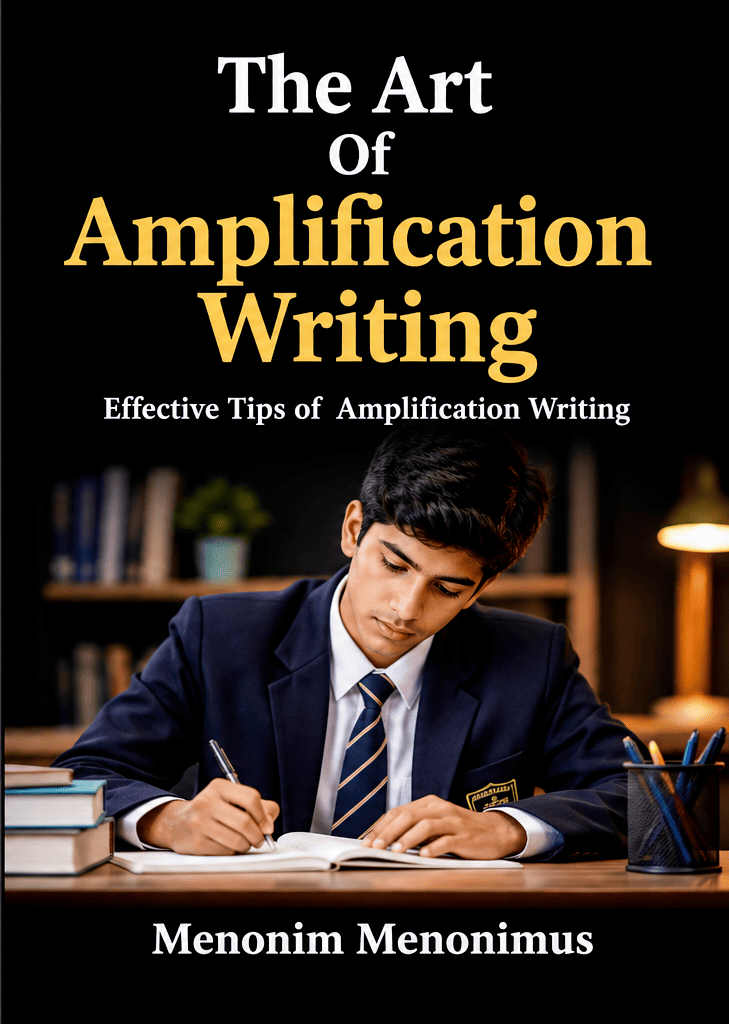
The Art of Amplification Writing
(Tips for Writing Amplification)
By
Menonim Menonimus
Internet Edition
www.menonimus.com
Copyright
The Art of Amplification Writing by Menonim Menonimus. Internet Edition.
Published by www.menonimus.com.
Website: www.menonimus.com
Email: [email protected]
All rights reserved.
Preface
Amplification writing is the expansion of a statement, quotation, proverb, or paradox in a clear and logical form. The purpose is to explain the meaning of the given statement, develop the thought behind it, and support it with relevant details, illustrations, and examples. A good amplification has unity and coherence, avoids unnecessary material, and uses simple language that readers can understand easily. Hope that the student community would like the book ‘The Art of Amplification Writing’.
Contents: The Art of Amplification Writing
Service to Man Is Service to God
Necessity Is the Mother of Invention
A Thing of Beauty Is a Joy for Ever
A Stitch in Time Saves Nine
Handsome Is That Handsome Does
Knowledge Is Power
The Child Is the Father of Man or Morning Shows the Day
He Prays Best Who Loves Best
Prevention Is Better Than Cure
Sweet Are the Uses of Adversity
Rome Was Not Built in a Day
Self-Help Is the Best Help
United We Stand, Divided We Fall
A Friend in Need Is a Friend Indeed
Cowards Die Many Times Before Their Death
Where There Is a Will There Is a Way
A Little Learning Is a Dangerous Thing
A Man Is Known by the Company He Keeps
Uneasy Lies the Head That Wears a Crown
We Live in Deeds, Not in Years
Better Alone Than in Bad Company
An Idle Brain Is a Devil’s Workshop
Waste Not, Want Not
Black Will Take No Other Hue
A Rolling Stone Gathers No Moss
Empty Vessels Sound Much
Pride Goes Before a Fall
A Smiling Face Never Looks Bad
Man Does Not Live by Bread Alone
Man’s Worst Enemy Is His Tongue
Experience Is the Best Teacher
Hurry Spoils the Curry
Look Before You Leap
Justice Delayed, Justice Denied
To Err Is Human
All That Glitters Is Not Gold
Face Is the Index of Mind
A Bird in the Hand Is Worth Two in the Bush
Actions Speak Louder Than Words
All Is Well That Ends Well
As You Sow, So Shall You Reap
Better Late Than Never
Charity Begins at Home
Cleanliness Is Next to Godliness
Every Cloud Has a Silver Lining
Fortune Favours the Brave
God Helps Those Who Help Themselves
Honesty Is the Best Policy
Make Hay While the Sun Shines
No Pains, No Gains
Once Bitten, Twice Shy
Practice Makes Perfect
Slow and Steady Wins the Race
The Pen Is Mightier Than the Sword
Time and Tide Wait for None
Too Many Cooks Spoil the Broth
A Good Beginning Makes a Good Ending
An Introduction to The Art of Amplification Writing
Tips for Amplification Writing
Roughly to say ‘amplification’ means thought expansion. In a literary practice, ‘Amplification’ refers to the elaboration of a statement in a logical order. To an amplification, more information is added in support of the statement undertaken to amplify. It clarifies the meaning of a statement.
While doing the task of amplification, we should bear in mind the following steps and tips.
First, read the given statement (quotation, proverb, paradox, etc.) several times, slowly and carefully till you grasp the meaning and significance of the statement.
Secondly, reading should be followed by thinking. The thought of the statement should be mentally developed. The relevant details, illustrations, examples, parallel saying etc. should be thought out and arranged systematically and logically.
Thirdly, a draft of the thought expansion should be prepared where the meaning of the given statement should be explained in brief and then arguments, illustrations, examples, should be put forward. In brief to say, an amplification should have three parts: introduction, explanation and conclusion in itself.
Fourthly, everything superfluous should be eschewed carefully. There should not be even a single word or detail while does not have a direct connection with the topic.
Fifthly, there should have coherence and unity of thought. Sentences should follow each other in a logical order. Every sentence should come out naturally and spontaneously out of the previous one. In an amplification, every sentence must take the thought ahead.
Sixthly, the language should be simple and easy to comprehend. The ambiguous or bombastic words and phrases should be avoided.
Seventhly, the rough draft should be revised one or two times and mistakes of grammar and spelling should be carefully corrected.
Eighth, after the above-mentioned steps are over, the fair copy should be made.
There is no hard and fast rule regarding the length of an amplification. If some length is prescribed in writing an academic amplification, then it must be strictly maintained. Otherwise, about one hundred to two words would do. 0 0 0