How We Wrote in the Exam takes you into the real examination experiences of 7 top students. Through their inspiring stories, discover how they prepared, approached questions, managed time, organised ideas, and wrote answers effectively.
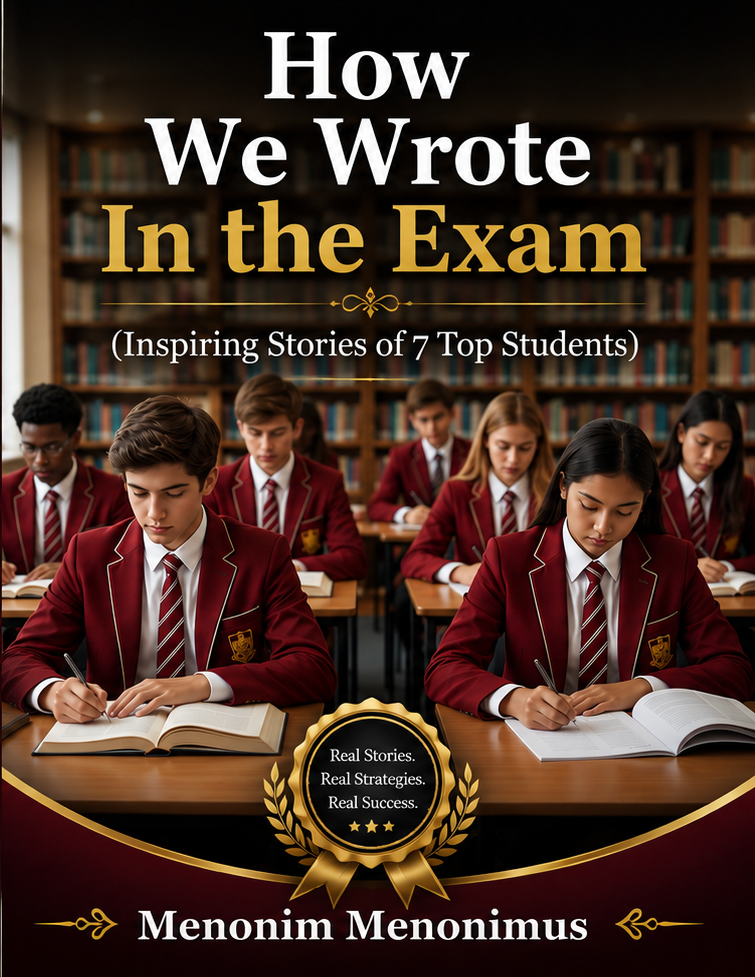
How We Wrote in the Exam
(Inspiring Stories of 7 Top Students about How They Prepared and Wrote in the Exam)
By
Menonim Menonimus
Copyright
Copyright © Menonim Menonimus.
All rights reserved.
Internet Edition
No part of this publication (How We Wrote in the Exam) may be reproduced, distributed, stored in a retrieval system, or transmitted in any form or by any means, including electronic, mechanical, photocopying, recording, scanning, or otherwise, without the prior written permission of the copyright owner, except for brief quotations used in reviews, criticism, scholarly works, or other uses permitted by applicable copyright law.
This publication is intended for educational and inspirational purposes. The contents, characters, names, situations, and experiences presented in this book are part of the author’s work and should not be construed as professional, legal, or academic advice.
The author and publisher have made reasonable efforts to ensure the accuracy of the information presented in this book ‘How We Wrote in the Exam’. However, no warranty or guarantee is made regarding the completeness or suitability of the content for any particular purpose.
Menonim Menonimus
Dedication
To every young dreamer who dares to aim for the highest marks—
may you discover that success is not about studying harder, but studying smarter.
May this book ‘How We Wrote in the Exam’ inspire you to think wisely, write brilliantly, and turn your dreams into outstanding achievement.
Preface to How We Wrote in the Exam
An examination is more than a test of memory. It is an opportunity to demonstrate understanding, organise ideas, and communicate knowledge clearly. Yet even students who have studied their lessons thoroughly may find it difficult to express what they know effectively when faced with an examination paper. The difference often lies not only in what they know, but in how they write.
How We Wrote in the Exam has been written with this simple but important reality in mind.
In the examination hall, a student is required to do several things at once: understand the questions, recall relevant knowledge, decide what to include, organise the answer, manage time, and present the response clearly. A weakness in any one of these areas can prevent a student from receiving the marks that their knowledge deserves.
One of the distinctive features of this book is that it brings together the first-hand experiences of seven topper students. Each of these students describes how they prepared for their examinations and how they actually wrote their answers in the examination hall. Their accounts provide a practical insight into their preparation methods, study habits, approach to the question paper, time management, answer-writing practices, and ways of presenting their knowledge. You may like: 100% Successful Study Method
These first-hand accounts add a practical dimension to the book. Rather than relying solely on general advice or theoretical discussion, the reader can learn from students who have experienced the challenges and demands of examinations and achieved outstanding results. Their experiences also show that there is no single formula for success. Different students may follow different methods, organise their preparation differently, and approach answer writing differently.
The purpose of presenting these experiences is therefore not to suggest that every student should imitate the toppers exactly. Instead, their accounts are intended to encourage students to observe, reflect and identify useful practices that can be adapted to their own subjects, abilities, circumstances and learning styles. Their experiences provide examples to think about, not rules to follow blindly.
The book also examines the practical art of examination writing. It considers how to read and understand questions, how to identify what a question requires, how to plan and structure answers, how to decide what information is relevant, how to avoid unnecessary writing, and how clarity, accuracy, relevance and proper organisation can strengthen an answer.
The title How We Wrote in the Exam reflects the central idea of the book. Examination writing is a common experience shared by generations of students. We have all faced the question paper, searched our memory for the right words, wondered how much to write, watched the clock, and tried to make the best possible use of the time available. By looking closely at this process and learning from the experiences of others, students can approach examinations with greater confidence and purpose.
This book ‘How We Wrote in the Exam’ does not present examination success as a matter of tricks, shortcuts or memorised formulas. It emphasises a more fundamental principle: knowledge becomes meaningful in an examination when it is communicated effectively. A good answer is not necessarily the longest answer, nor is it simply a collection of facts. It is an answer that understands the question, addresses what is required, contains relevant information, and presents that information clearly and logically.
Although the immediate purpose of this book is to help students prepare for examinations and write better answers, the skills discussed here extend far beyond the examination hall. The ability to understand a question, think clearly, select relevant information, organise ideas and communicate them precisely is valuable in higher education, professional life and everyday communication.
I have written this book ‘How We Wrote in the Exam’ with the hope that students will begin to look at the answer sheet differently. It is not merely a collection of blank pages waiting to be filled. It is the medium through which a student communicates knowledge, understanding and thought to the examiner.
The experiences of the seven toppers remind us that excellence can be achieved through different paths, but certain qualities remain important: disciplined preparation, clear understanding, thoughtful writing, effective time management and the ability to communicate knowledge with precision.
Therefore, when you enter the examination hall, do not think only about how many answers you have memorised. Think also about how effectively you can express what you know.
Read carefully. Think clearly. Write precisely. Present intelligently.
Because in an examination, knowing the answer is only part of the achievement. Knowing how to prepare, how to think, and how to write the answer effectively is what completes it.
Menonim Menonimus
Table of Contents
Copyright
Dedication
Preface
Chapter 1: The Examination
Chapter 2: I Am Adil
Chapter 3: I Am Babul
Chapter 4: I Am Sunil
Chapter 5: I Am Didul
Chapter 6: I Am Yusuf
Chapter 7: I Am Haru
Chapter 8: I Am Jabil
Chapter 9: The Seven of Us
List of Books by M. Menonimus
To continue reading….