
Class 12 English: Memories of Childhood Solutions. Class 12 English Memories of Childhood Solutions with complete answers, clear explanations, important questions, and exam-ready notes to help students understand the chapter and prepare confidently for exams.
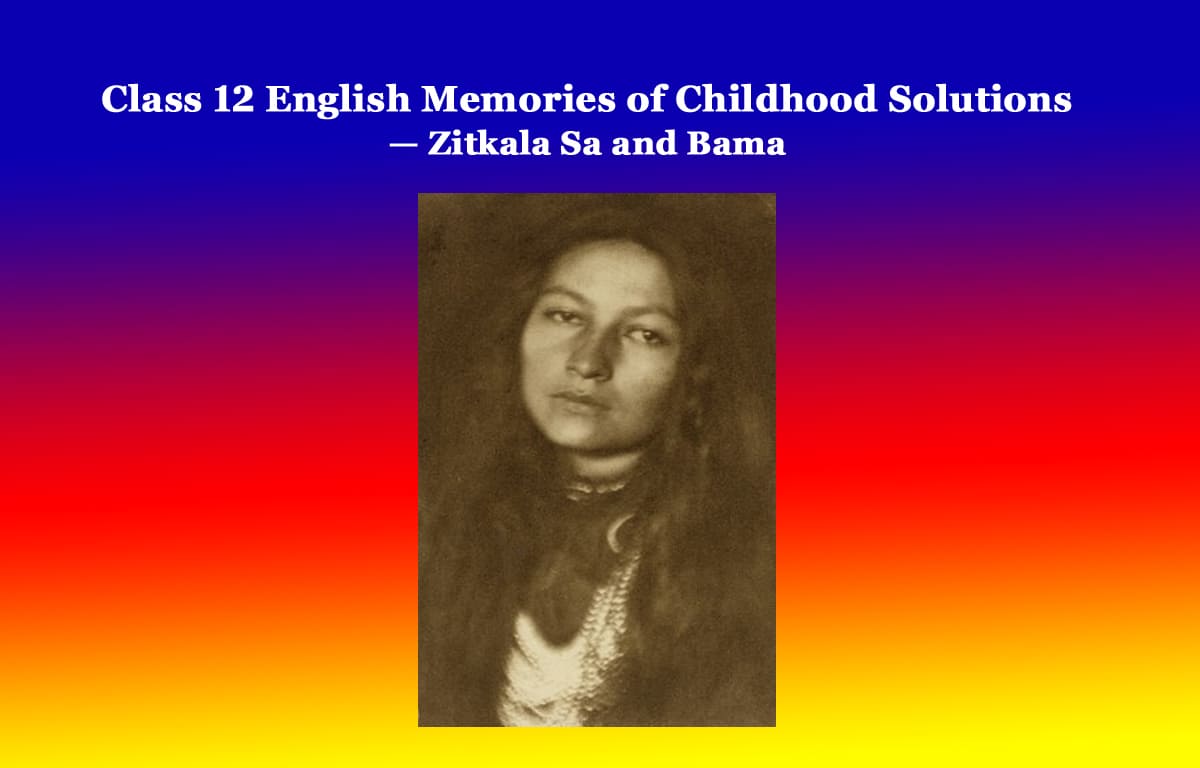
Class 12 English Memories of Childhood Solutions
TEXTUAL QUESTION-ANSWERS
A. Reading with Insight (Each bearing 7 Marks)
1. The two accounts that you read above are based in two distant cultures. What is the commonality of theme found in both of them?
or
Compare and contrast the stories of Zitkala-Sa and Bama. H. S. ’20
Ans: ‘Memories of Childhood’ bears two biographical episodes of two women; one is of an American native woman, and the other is of Indian Tamil Dalit woman. Both the women belong to two distinct cultures but the themes of the two accounts are almost the same, and that is caste discrimination.
The Native American woman, Zitkala-Sa, portrays how she became a victim of cultural and racial discrimination. The Americans treated the Native people with a sense of superiority and tried to impose their customs and traditions on them. The narrator’s hair was cut against her wishes, without regard for her feelings or dignity. She resisted until she was overpowered, but there was no one to comfort her.
In the same way, Bama experienced caste discrimination in Indian society. One day, while returning from school, she saw a person carrying a packet of food by a string so that he would not touch it. She found the practice disturbing and resolved to study hard to overcome the limitations imposed by caste.
Thus both the women in their childhood were the victims of social injustice.
2. It may take long time for oppression to be resisted, but the seeds of rebellion are sowed early in life. Do you agree that injustice in any form can’t escape being noticed even by children?
Ans: The two biographical episodes in the ‘Memories of Childhood’ deal with the theme of social injustice. One is of American society and the other is of Indian society.
The Americans think that their culture and tradition are superior to those of the natives. Hence, being agitated by their vain sense of superiority, they compelled the natives to accept their ways of life. They did not consider the feelings of the native Americans. They made the narrator’s hair cut short against her protest.
In the other incident, the custom of untouchability prevailing in Indian society comes to light. One day, the narrator Bama happened to notice that a Dalit person was carrying a pack of food on a string so that he could not touch it. She felt it was disgusting and rebelled.
Both the narrators were small girls. Yet they happened to face the cruelty done to the lower or poorer class of people in society by other people. The two episodes show us that injustice of any kind can’t escape being noticed even by the children.
3. Bama’s experience is that of a victim of the caste system. What kind of discrimination does Zitkala Sa’s experience depict? What are their responses to their respective situations?
Ans: ‘Memories of Childhood’ bears two biographical episodes of two women; one is of an American native woman, and the other is of an Indian Tamil Dalit woman. Both the women belong to two distinct cultures, but the theme of the two accounts is almost the same, and that is caste discrimination.
The native American woman named Zitkala-Sa portrays in her account how she became a victim of class distinction. The Americans treated the natives with a sense of superiority over them. They tried to impose their cultural traditions and whims on the ways of others. They made the children behave according to their customs and thus hurt the feelings of dignity and respect of the native Americans. The narrator’s hair was cut off without showing any regard for her feelings. She was forced to sit on a chair, tied to it, and her long hair was cut off. She rebelled until she got overpowered. There was no one to comfort her.
In the same way, another girl by the name of Bama experienced caste discrimination in Indian society. One day, while returning from school, she saw a person carrying a packet of food on a string so that he could not touch it. The girl felt it was disgusting. She rebelled and set to study better to show that caste did not determine the ability of a person.
Thus, both the women in their childhood experienced social injustice because of class discrimination.
ADDITIONAL QUESTION-ANSWERS (Class 12 English Memories of Childhood Solutions)
A. Short Answer type Questions. (Each bearing 2 Marks)
Q.1. How did Zitkala Sa feel uncomfortable in the dining room?
Ans: The narrator, Zitkala-Sa, felt uneasy. When the bell rang, she pulled out the chair and sat down. But others did not do that. She felt confused. When the bell rang for the second time, then all were seated. The narrator noticed that she was being watched keenly by a pale woman. So she felt quite uncomfortable in the dining room.
Q.2. How did Zitkala-Sa hide herself? Did she succeed?
or
How did Zitkala-Sa feel on the first day in the land of apple? What did she do to escape the plight? H S ’24
Ans: Zitkala-Sa felt uncomfortable on the first day in the land of apples. She went to a large room and hid herself under a bed. But her effort proved abortive. The people looked under the bed and found her out of her hiding place. Then she was pulled along the stairs, tied her fast to a chair, and with force cut her long hair.
Q.3. What is the message of the first episode, ‘The Cutting of My Long Hair’?
Ans: The episode portrays the racial discrimination in American society. The White people in America tried to impose their own tradition and lifestyle upon the native Americans. They did not think that the natives were willing to adopt a new custom imposed upon them by force. It hurt their feelings and dignity.
Q.4. Why was Annan not amused by Bama’s story?
Ans: When Bama told Annan the story of a Dalit person carrying a packet of food by a string, she regarded it as something amusing. Annan, however, was not amused because he understood the system of untouchability prevailing in society.
Q.5. What did Annan say about the community to Bama, the narrator?
or
How did Annan explain the elder man’s action to Bama? H. S. ’20
Ans: Annan told Bama that they belonged to a ‘low caste’. The people of this community were treated with disgust and hatred by the people of high castes. Thus, they had been treated badly. He said that when the members of this low caste would be able to get a high education, then people would come to them of their own accord, and only then would the attitude of people towards the low caste change.
6. Why did it take Bama to reach home in 30 minutes instead of 10 minutes? H. S. ’20
Ans: One day Bama, while coming back home from school, happened to notice that a Dalit person was carrying a pack of food on a string so that he could not touch it. After seeing this, she became sad and thoughtful. So it took Bama to reach home in 30 minutes instead of 10 minutes. 0 0 0
N.B. If you like Class 12 English Memories of Childhood Solutions, please share your thoughts.
Books on Linguistics by M. Menonimus:
- A Brief History of the English Language
- Essays on Linguistics
- My Imageries
- Felicitous Expression: Some Examples
- Learners’ English Dictionary