
Has Women’s Cricket in India Received the Recognition it Deserves? There are 2 essays, read them well and send your feedback.
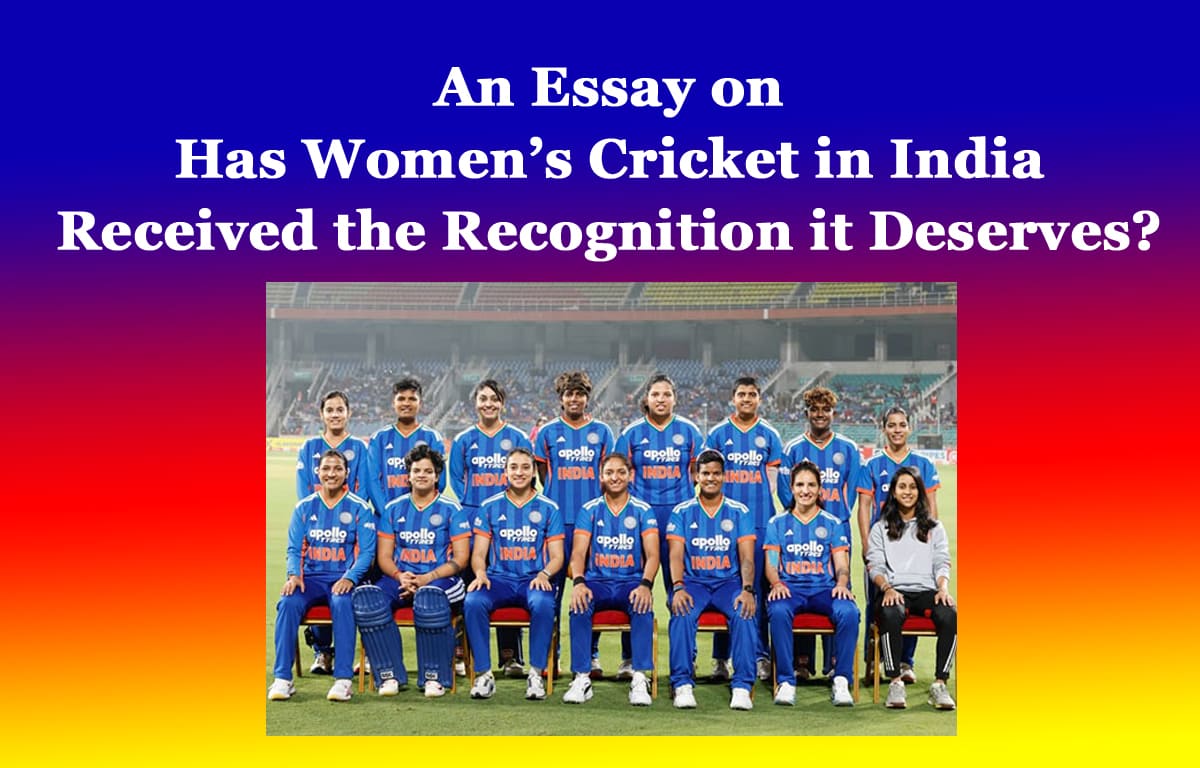
Has Women’s Cricket in India Received the Recognition it Deserves?
Introduction: Cricket in India is not merely a sport but a cultural phenomenon. While men’s cricket has enjoyed immense popularity, wealth, and media attention for decades, women’s cricket has historically remained in the shadows. In recent years, however, the landscape has begun to change. This raises an important question: has women’s cricket in India finally received the recognition it truly deserves?
Historical Neglect of Women’s Cricket: For a long time, women’s cricket in India suffered from systemic neglect. Limited funding, lack of infrastructure, and minimal media coverage restricted its growth. Unlike male cricketers, women players often struggled for basic facilities and financial stability. Matches were rarely broadcast, and public awareness remained low, which prevented the sport from gaining a strong fan base.
Rise in Popularity and Achievements: The turning point came with remarkable performances by the Indian women’s team in international tournaments. Their journey to the finals of the 2017 ICC Women’s World Cup captured national attention. Players like Mithali Raj, Jhulan Goswami, and Harmanpreet Kaur became household names. Their dedication and success challenged long-standing stereotypes and inspired young girls across the country to pursue cricket.
Role of Media and Commercialization: Media coverage has significantly improved in recent years, contributing to greater visibility. The introduction of leagues such as the Women’s Premier League (WPL) has further boosted popularity and provided financial opportunities for players. Sponsorships and endorsements are gradually increasing, indicating a shift in public and corporate perception.
Government and Institutional Support: The Board of Control for Cricket in India (BCCI) has taken steps to promote women’s cricket by improving pay structures and organizing more matches. Equal match fees for men and women cricketers marked a progressive move. Training facilities and grassroots development programs are also being expanded, though gaps still exist.
Challenges That Remain: Despite progress, women’s cricket in India still faces several challenges. The level of recognition is not yet equal to men’s cricket. Media coverage, though improved, is still inconsistent. Pay disparities in league contracts, fewer matches, and limited domestic exposure continue to hinder full development. Social barriers and lack of encouragement at the grassroots level also persist.
Conclusion: While women’s cricket in India has made significant strides and gained more recognition than ever before, it cannot yet be said that it has received the recognition it fully deserves. The journey toward equality is ongoing. With sustained support, increased investment, and a shift in societal attitudes, women’s cricket can achieve the status and respect it rightfully merits. 0 0 0
Has Women’s Cricket in India Received the Recognition it Deserves Essay (2)
Introduction
For decades, women’s cricket in India existed in the shadow of the men’s game—underfunded, under-broadcast, and largely ignored by mainstream audiences. In recent years, however, the sport has undergone a remarkable transformation. Yet the question remains: has this progress translated into the recognition women cricketers truly deserve, or does inequality persist beneath the surface?
The Historical Struggle
Women’s cricket in India was, for much of its history, sustained by the determination of individual players rather than institutional support. Pioneers like Diana Edulji and Shantha Rangaswamy often paid out of their own pockets to represent the country, at a time when television coverage of their matches was virtually nonexistent. The sport operated on the margins, with little commercial investment or public attention.
Milestones Toward Recognition
The turning point came in October 2022, when the BCCI announced equal match fees for centrally contracted men’s and women cricketers—Rs 15 lakh for a Test, Rs 6 lakh for an ODI, and Rs 3 lakh for a T20, a decision then-captain Mithali Raj called historic. This was followed by the launch of the Women’s Premier League (WPL) in 2023, which brought record-breaking player bids and a media rights deal reportedly worth Rs 951 crore, marking real commercial viability for women’s cricket. On the global stage, the ICC’s 2025 Women’s ODI World Cup carried a record $13.88 million prize pool, with the winner earning more than the men’s 2023 World Cup champions. India’s own triumph in that tournament, led by Harmanpreet Kaur, pushed the team into the national spotlight as never before.
The Recognition Gap That Remains
Despite these gains, meaningful disparities persist. Under BCCI’s central contracts, a Grade A male cricketer earns Rs 5 crore annually compared to just Rs 0.5 crore for a woman in the same grade—a roughly 900 percent gap that continues across every contract tier. Commercially, the gap is just as stark: the IPL’s brand value grew 13 percent to reach Rs 1 trillion last year, while the WPL’s valuation rose only 8 percent, to around Rs 1,350 crore. Representation in cricket’s governing structures also lags behind—the ICC’s elite panels of match referees and umpires include no women at all, with just one female umpire on its 43-member development panel.
A Story of Progress, Not Parity
Women’s cricket in India has undoubtedly come further in the last five years than in the previous five decades combined. Full stadiums, growing viewership, and a World Cup victory have given young girls genuine role models and a visible career path in the sport. But equal pay on paper has not yet translated into equal investment, equal media coverage, or equal institutional power. As one industry observer put it, pay parity alone is “not enough to change the game.”
Conclusion
Women’s cricket in India has received more recognition than ever before—but not yet the recognition it deserves. The sport has moved from invisibility to genuine celebration, powered by landmark decisions like pay equity and the WPL’s success. Yet the persistent gaps in commercial value, contract earnings, and administrative representation show that true parity remains a work in progress, not an achieved goal.
N.B. If you like Has Women’s Cricket in India Received the Recognition it Deserves, plese share your feedback.