
Effects of Rising Sea Levels on Coastal Communities in India Essay. Discover how rising sea levels threaten India’s coastal communities—from displacement and livelihoods to climate resilience. Read the full essay now. There are 2 essays; read them and let us know which one you like more.
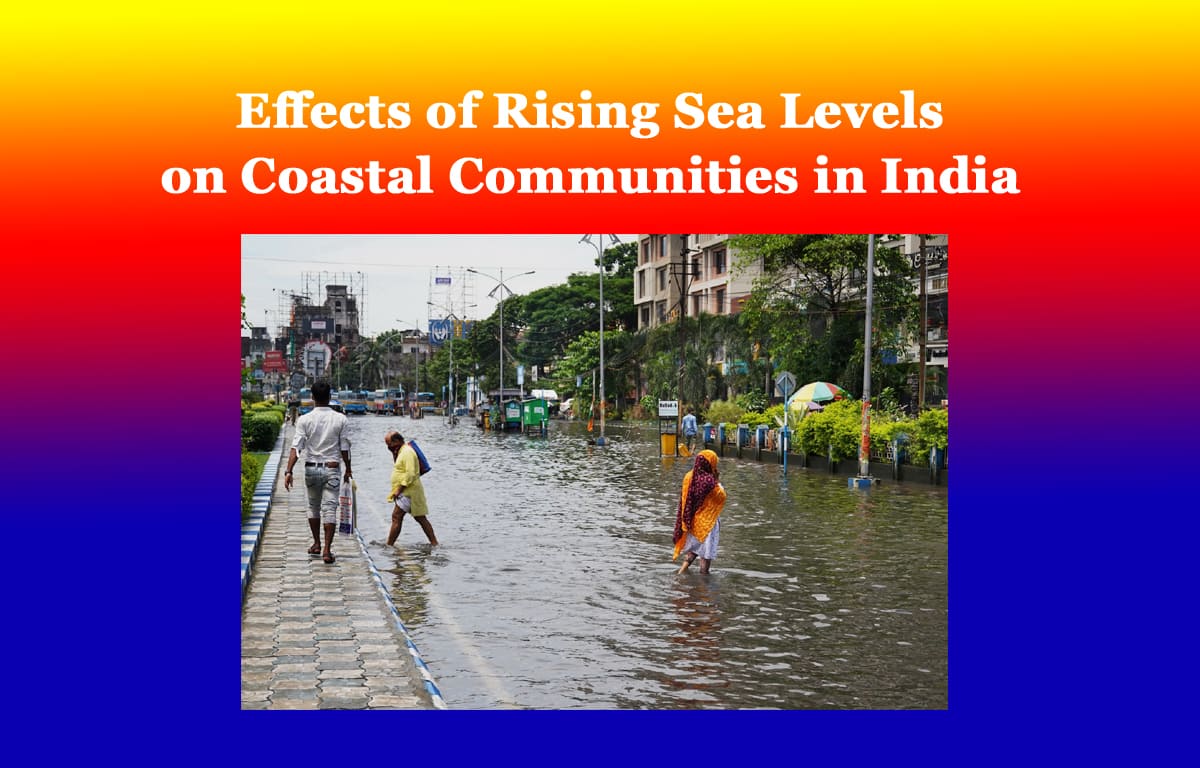
Effects of Rising Sea Levels on Coastal Communities in India Essay
Introduction: India has a vast coastline of over 7,500 kilometers, home to millions of people and major cities like Mumbai, Chennai, and Kolkata. However, global warming is causing sea levels to rise, posing a direct threat to these coastal regions.
Submergence of Land and Homes: The most immediate effect of rising sea levels is the loss of land. Low-lying areas are slowly being swallowed by the sea. In places like the Sundarbans in West Bengal, entire islands have already vanished, forcing thousands of people to leave their ancestral homes and become “climate refugees.”
Increased Frequency of Floods: As sea levels rise, coastal cities face frequent and severe flooding, especially during high tides and monsoons. Cities like Mumbai and Kochi are at high risk. This flooding damages infrastructure, destroys buildings, and disrupts transportation, costing the economy billions of rupees.
Contamination of Drinking Water: When seawater moves inland, it mixes with freshwater sources like lakes, rivers, and underground wells. This process, known as saltwater intrusion, makes the water undrinkable and unfit for daily use. For coastal communities, finding clean drinking water is becoming a daily struggle.
Impact on Agriculture and Livelihoods: Agriculture is the backbone of India’s rural economy. Salty seawater destroys the fertility of the soil, making it impossible to grow crops like rice. Similarly, the changing ocean temperature and chemistry affect fish populations, hitting the fishing communities hard and depriving them of their primary source of income.
Loss of Biodiversity: India’s coastal ecosystems, such as the mangrove forests, act as natural barriers against storms. Rising sea levels drown these mangroves and destroy the habitats of unique wildlife, including the Royal Bengal Tiger. Without these natural shields, the coastline becomes even more vulnerable to cyclones and erosion.
Conclusion: Rising sea levels are no longer a distant threat; they are a reality for India’s coastal population. Protecting these communities requires a mix of global action to reduce carbon emissions and local efforts like building sea walls and restoring mangroves. For students, understanding this crisis is the first step toward advocating for a sustainable future. 0 0 0
Effects of Rising Sea Levels on Coastal Communities in India
Introduction
India’s 7,500-kilometer coastline, bordered by the Bay of Bengal, Arabian Sea, and Indian Ocean, is among the most vulnerable regions to climate change. Driven by thermal expansion of oceans and melting ice, global sea levels have risen about 20 cm since 1880 and could rise up to 1.2 metres more by 2100—posing serious consequences for India’s densely populated coast.
Threats to Major Cities and Infrastructure
Cities like Mumbai, Chennai, and Kolkata face growing risks of flooding and infrastructure damage. Studies project that by 2050, Chennai could see 55 buildings and 5 km of road at risk, Kochi up to 1,502 buildings during high tide, and Visakhapatnam around 206 buildings and 9 km of roads affected.
Coastal Erosion and Land Loss
Nearly a third of India’s coastline eroded between 1990 and 2018. Projections suggest India could lose roughly 1,500 sq. km of land by 2050. Islands like Lakshadweep and the Andaman and Nicobar Islands face risks of partial submergence.
Displacement and Human Migration
Entire communities are already relocating—571 households in Odisha’s Satabhaya village moved inland due to erosion. Across South Asia, an estimated 3.6 million people have been displaced by climate-linked coastal hazards in the past decade, with fishing communities and marginalized groups hit hardest.
Impact on Livelihoods: Fishing and Agriculture
Rising salinity disrupts fish breeding grounds, threatening the livelihoods of millions dependent on fishing. Saltwater intrusion into farmland is reducing cultivable land, driving food price inflation and weakening food security.
Freshwater Contamination
Saline intrusion is contaminating rivers and groundwater aquifers, compounding pressure on communities already struggling with agricultural and fishing losses.
Toward Resilience: Adaptation and Policy Responses
Experts stress preserving natural buffers like mangroves, building climate-resilient infrastructure, and creating rehabilitation policies for displaced populations as key adaptation strategies.
Conclusion
Rising sea levels are already reshaping India’s coast—flooding cities, eroding land, and displacing communities. Without stronger adaptation and ecological restoration efforts, these impacts will deepen, threatening both livelihoods and national food and water security.
N.B. If you like Effects of Rising Sea Levels on Coastal Communities in India Essay, please share your feedback.